
The City That Vanished: When Genghis Khan Erased a Kingdom Overnight
“History may have forgotten the city — but it will never forget Genghis Khan.”
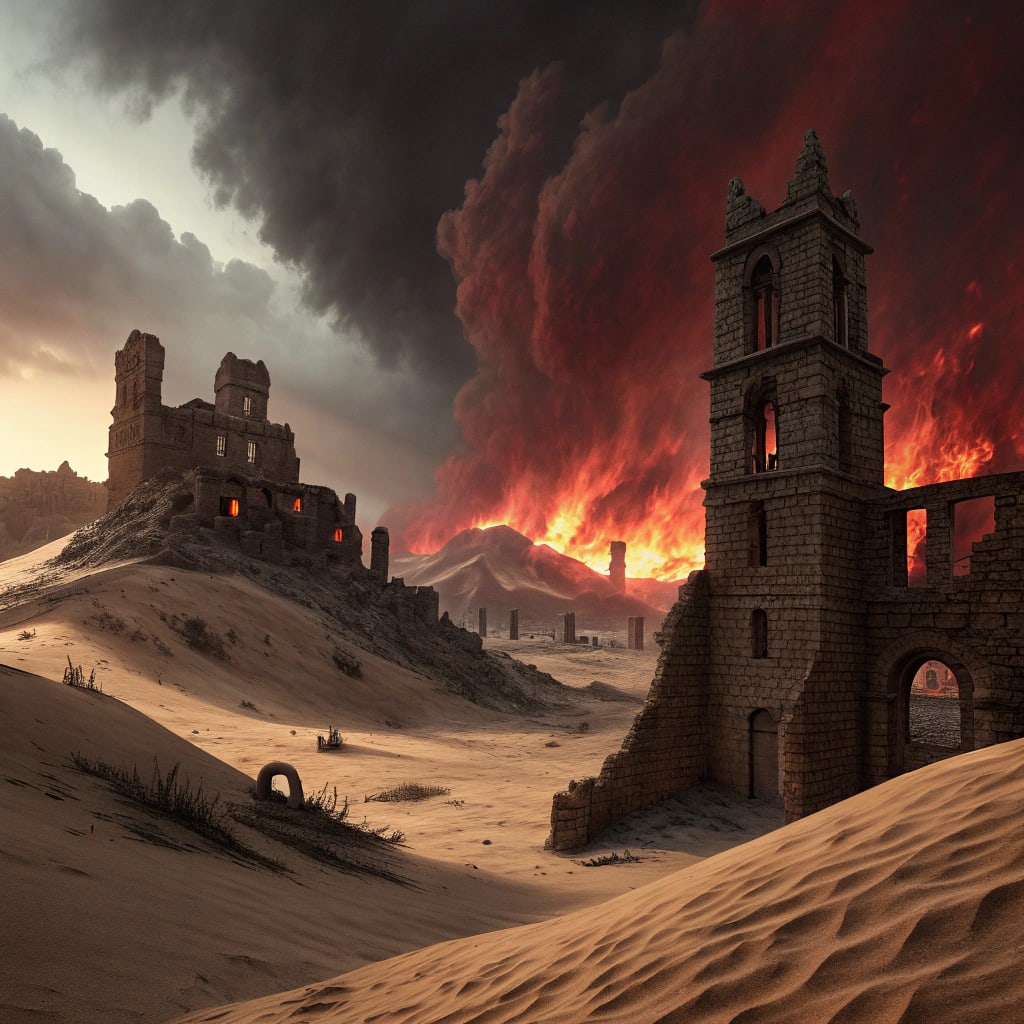
There are no ruins. No bones.
Only the wind where a city once stood.
They say the Mongols didn’t just kill the people — they erased their names.
The desert keeps its secrets. Some say the wind itself hides memories — of fire, screams, and the night an entire city disappeared without a trace.
---
The Fall of Otrar
In the winter of 1218, a caravan of Mongol merchants arrived at the gates of Otrar, a proud trade city on the Silk Road in what is now Kazakhstan.
They came peacefully — bearing silks, spices, and letters sealed with Genghis Khan’s name.
But the governor, Inalchuq, saw gold, not diplomacy.
He accused them of spying, seized their goods, and had them executed.
When the Khan heard of this, his reply was ice-cold:
> “I sent them as merchants. You killed them as thieves.
Now I come to you as justice.”
The words rode faster than horses.
The world was about to learn what Mongol justice meant.
---
The Riders of Smoke
When spring came, so did the Mongols.
They rose from the horizon like a black storm — silent, endless, disciplined.
No drums. No shouting. Only the low hum of wind and hooves.
For five months, Otrar held its walls.
Catapults burned the sky; arrows fell like rain.
Then one night, a gate opened — betrayal.
The Mongols poured in like floodwater.
By dawn, Otrar was gone.
They didn’t stop there.
They moved west — to Bukhara, Samarkand, Urgench — each city brighter, richer, and doomed.
Every gate that closed only delayed the inevitable.
Every surrender came too late.
---
The City That Spoke No More
Urgench was the jewel of the Khwarazmian world — marble palaces, canals glittering with moonlight, libraries filled with the wisdom of Persia and Arabia.
When Genghis Khan’s army reached it, the Shah had already fled.
The people begged for mercy.
The Khan gave none.
He ordered the city destroyed, every building pulled down stone by stone.
Rivers were diverted to drown its ruins.
The chroniclers wrote:
> “The ground became a mirror of red water.
No sound remained but the flies.”
No one ever rebuilt it.
Not even the conquerors stayed.
The land was left to ghosts.
---
The Fear That Followed
Those who survived said that at night, you could still hear the city breathing —
the creak of doors under sand, the whisper of silk merchants crying out for air.
Caravans avoided the valley for centuries.
Nomads told their children, “Don’t camp where the wind moans — it remembers.”
To this day, archaeologists find almost nothing.
No walls. No bones.
Only grains of melted glass — sand turned to fire.
---
The Price of Vengeance
Genghis Khan didn’t destroy Urgench for gold.
He destroyed it to make a point.
He wanted the world to understand what defiance cost.
He didn’t need armies in every land —
only the memory of what happened to those who said no.
Fear itself became his empire.
And so, a thousand miles away, rulers surrendered their cities without a fight —
haunted not by soldiers, but by stories.
---
The Silence of History
Today, satellites scan the earth, looking for traces of Urgench.
They find only scars — lines in the soil where streets once ran, dark circles where towers once stood.
The city that had once echoed with trade and laughter is gone.
Not buried. Not rebuilt.
Just erased.
And when the desert wind sweeps across those empty plains,
it still carries the faintest sound —
not of ghosts, but of the warning that made an empire.
“Submit, and live. Resist, and vanish.”
About the Creator
Keep reading
More stories from Muhammad Anas and writers in History and other communities.
How Constantine XI Faced the Fall of Constantinople
📖 The Last Emperor’s Choice The night of May 28, 1453, was heavy with silence inside Constantinople. The once-great capital of the Byzantine Empire stood on the edge of ruin. For nearly two months, Sultan Mehmed’s army had encircled the city, hammering its ancient walls with cannons and cutting off every hope of rescue. By dawn, the final assault would begin.
By Muhammad Anas 4 months ago in History
Can the United States Leave NATO?
Can the United States Leave NATO? What It Would Take—and What It Would Mean The North Atlantic Treaty Organization, commonly known as NATO, has been one of the most powerful military alliances in modern history. Since its creation in 1949, the United States has been NATO’s strongest member—militarily, financially, and politically. But in recent years, debates have grown louder about whether the U.S. should remain in the alliance. This raises a serious question: how could the United States be removed from NATO—or leave it—and what would that mean for the world?
By Wings of Time 6 days ago in History
Stanislav Kondrashov’s Oligarch Series: Renaissance Merchants and Their Support for the Arts
In his *Oligarch Series*, **Stanislav Kondrashov** examines how wealth has shaped political, economic, and cultural systems across history. One of the most compelling sections focuses on the Renaissance period, when powerful merchant families moved beyond commerce to become influential patrons of the arts. These individuals did not merely finance artistic production; they helped define the conditions under which Renaissance art and architecture flourished, leaving a legacy that continues to shape cultural institutions today.
By Stanislav Kondrashov2 days ago in History


Comments
There are no comments for this story
Be the first to respond and start the conversation.