
Operation Kamen: The Cruelest Illusion of Freedom in Cold War History
Czechoslovakia’s secret police built fake U.S. border posts to trap escapees—Operation Kamen weaponized hope, trust, and desperation into a perfect snare.

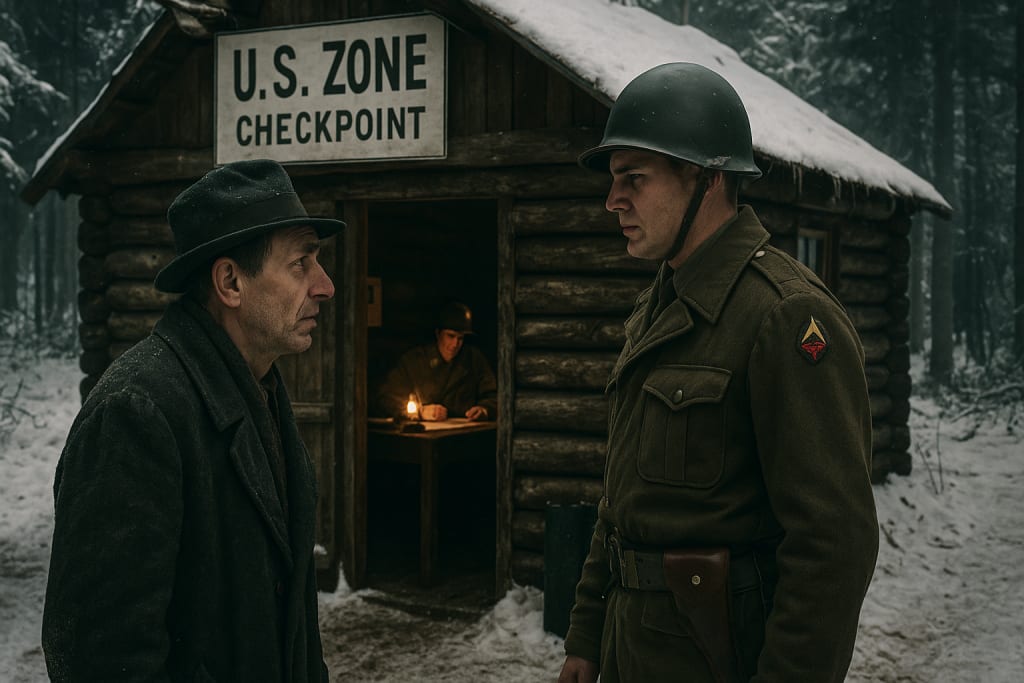
The forest was still. Suffocating.
Snow fell in soft spirals through the darkness, burying the silence in a brittle hush. Jan Šedivý hadn’t spoken in hours, nor had his guide—a man who called himself simply “Franz.” It was January 1949, and Jan was a hunted man. The Communist regime had fired him from his job as a schoolteacher, branded him a traitor, and warned his wife to forget he ever existed.
Tonight, everything would change.
After hours of trudging through frozen woods near the Bohemian border, Franz stopped before a dimly lit cabin. Above the door, nailed crookedly, was a wooden sign: U.S. Zone — Checkpoint. An American flag, slightly faded, swayed gently in the wind. Jan’s breath caught in his throat.
He had made it.
Inside, a uniformed man with an American accent handed him a steaming cup of coffee. “Welcome to freedom,” the soldier said with a smile. A radio played Glenn Miller softly in the background. On the walls hung U.S. posters, maps, and a framed photo of President Truman. Jan’s legs buckled. He wept.
They asked a few questions—where he came from, who helped him, what he knew. He told them everything. After all, he was in America now.
But he wasn’t.
By sunrise, Jan was chained to a radiator in a concrete cell. His confession typed. His fingerprints filed. In a few weeks, he would be tried for espionage and treason, then sentenced to hard labor in a uranium mine. He died believing he had crossed the Iron Curtain. In truth, he never made it a single step beyond it.
The Forest Theater of Lies
Between 1948 and 1951, the Czechoslovak secret police—Státní bezpečnost, or StB—conducted what may be the most sadistically brilliant counterintelligence operation of the Cold War. Its name: Operation Kamen, or Operation Stone.
At its heart was a lie so complete, so intricately staged, that even its victims died believing it.
Instead of merely stopping refugees from fleeing to the West, the regime decided to stage the West. In remote border areas of western Bohemia, the StB built a series of fake U.S. military zones. These were no crude shacks or makeshift traps—they were elaborate psychological theaters.
The checkpoints featured American flags, hand-lettered signs, working typewriters, and even phonographs playing jazz. Agents dressed in U.S. uniforms, spoke rehearsed English, and carried smuggled items like Lucky Strikes and Coca-Cola.
Upon “arrival,” refugees were welcomed warmly. They were comforted, congratulated, and asked to help identify friends and collaborators “still back home.” Some were even promised U.S. passports.
Only after everything had been extracted were they arrested—violently and without warning. The border hadn’t been crossed. It had simply been moved, and reality rewritten.
“They Told Us We Were Free”
The cruelty of Operation Kamen wasn’t just in its deception—it was in the brief, intoxicating taste of freedom offered to its victims. The StB didn’t simply interrogate people. It let them believe they had escaped. It let them dream.
In later decades, survivors spoke not only of betrayal, but of guilt—crippling, corrosive guilt. Many believed they had voluntarily exposed loved ones, when in fact they had never been free at all.
Eleonora Holešovská, 27, who attempted to flee with her husband in 1950, later recalled:
“There were border guards, one of them in an American uniform. They gave us chocolate. They asked how we got there. We told them everything. When they tied our hands behind our backs, I still didn’t understand. Not until the door slammed shut in the van.”
Jiří Minařík, a 22-year-old student from Brno, was tricked into revealing two dissident contacts:
“They gave me a cigarette and a smile. I felt safe. I thought I was finally in America. I told them everything. I betrayed people I loved—and I thought I had done it in freedom.”
An archival interrogation file from 1950 quotes a man known only as “M.Z.”:
“They said I had done the right thing, that America would help me. I wrote names, dates, everything. Then someone slapped me. They tore down the flag. The room changed. It was never America.”
Behind the Curtain
The exact number of victims of Operation Kamen remains uncertain. Some historians estimate that hundreds of attempted escapees were deceived and arrested. The operation also enabled the regime to map underground networks, identify anti-communist organizers, and preempt further escapes.
StB records describe the effort in cold, professional terms: “Successful infiltration of target population. Interrogation complete. Subject unaware of location.”
Historian Václava Jandečková, one of the first researchers to analyze declassified Kamen files after 1989, wrote:
“Many of the victims spent the rest of their lives believing they had crossed the border and been handed over by Americans. They carried that confusion, that shame, until they died.”
In the forests, ruins remain—cracked foundations of fake checkpoints, rusting flagpoles, scraps of barbed wire. A few buildings have been found intact, covered in moss, their interiors eerily preserved. One still held a stack of fake U.S. immigration forms printed in Cyrillic Czech.
A Beautiful Lie, Engineered to Break the Soul
The genius of Operation Kamen lay in its simplicity: offer people what they most desperately wanted, and then use it to destroy them. It turned hope into a weapon, trust into a tool, and freedom into a trap.
They didn’t just lie.
They engineered a masterpiece of deception—a lie dressed in stars and stripes, served with coffee and trust.
They said, “Welcome to freedom.”
And gave them a prison instead.
Sources
1. Operation Border Stone (Operation Kamen). Wikipedia entry. Available at: https://en.wikipedia.org/wiki/Operation_Border_Stone (accessed June 2025).
2. Jandečková, Václava. False Borders – Secret Police Kámen Operations in Czechoslovakia (Today’s Czech Republic) 1948–51. Repeating History, Association for the Research of Communist Crimes, 7 April 2022. Available at: https://www.zlocinykomunismu.cz/wp-content/uploads/2022/04/vaclava_jandeckova_-_false_borders_-_secret_police_kamen_operations_in_czechoslovakia_-_todays_czech_republic_-_1948-51.pdf
3. The fake and fatal border crossing. Unexpected Traveller, 2023. Available at: https://www.unexpectedtraveller.com/border-crossing/
4. Phillips, Paul. Operation Border Stone (KAMEN). BypaulPhillips.com blog, February 2024. Available at: https://www.bypaulphillips.com/blog/archives/02-2024
About the Creator
Jiri Solc
I’m a graduate of two faculties at the same university, husband to one woman, and father of two sons. I live a quiet life now, in contrast to a once thrilling past. I wrestle with my thoughts and inner demons. I’m bored—so I write.
The ancestors of modern Danes arrived in America over 1,000 years ago
U.S. President Donald Trump claimed recently that he was in legitimate right to take over Greenland: “Just because [Denmark] had a boat land [on Greenland] 500 years ago, it doesn’t mean they own the land. [..] I’m sure we had lots of boats go there also.”
By Aurel Stratan6 days ago in History
Is the U.S. Preparing to Attack Iran?
Is the U.S. Preparing to Attack Iran? Inside the Rising Tensions and Possible Military Pathways In early 2026, tensions between the United States and Iran reached one of their highest points in years. For weeks, dramatic political rhetoric, shifting military postures, and warnings from leaders around the world have fueled alarms that a U.S. military strike against Iran may be imminent. Yet as of now, no confirmed attack has occurred, and the situation reflects a complex mix of pressure, preparation, de-escalation, and diplomatic uncertainty that illustrates how modern conflict can hinge just as much on words and positioning as on direct action.
By Wings of Time 3 days ago in History



Comments
There are no comments for this story
Be the first to respond and start the conversation.