
The Forgotten Massacre of Lampedusa: Dragut’s 1553 Raid That Silenced an Island
In 1553 corsair Dragut razed Lampedusa, slaying scores and enslaving 5,000 souls. The island’s silence echoed for a long century across the empty Mediterranean.

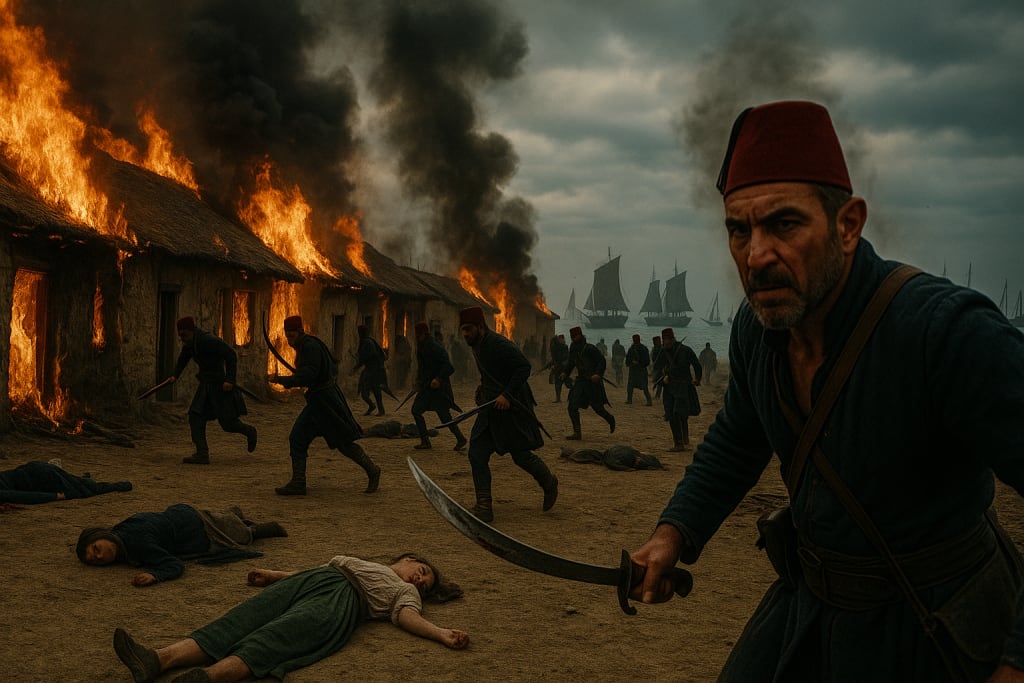
Matteo d’Angelo never forgot the smell—salted figs and fishy linen drifting through the July dawn as he rowed his skiff toward Lampedusa’s limestone quay. It was the summer of 1553, when water lay so clear you could count the shifting shadows of grouper twenty feet below. Matteo planned to barter nets for wheat and carry word back to Sicily that the lampedusani harvest looked promising. Instead, he saw the horizon thicken into a wall of foreign canvas: sixty Ottoman galleys advancing in a black crescent, lateen sails stacked like jagged teeth against the molten sky.
The fishermen sensed their fate before the first cannon boomed. Dragut Reis—the corsair admiral who served Sultan Süleyman and was already famed for emptying Gozo of its entire population two summers earlier—had chosen Lampedusa for what Spanish officials would later mark in secret memoranda as “ejemplo de terror.” At dawn the island held about six thousand souls: fishermen, sponge-divers, goat-herders, two Franciscan friars, their families, and a handful of seasonal traders sheltering from the Sicilian heat. By dusk scarcely a tenth remained.
Dragut’s Fleet and the Anatomy of a Raid
Dragut split his fleet into three prongs. He sent twelve ships around Punta Parrino to cut off escape toward Malta, sixteen anchored off Cala Pulcino to unleash mortars, and the core forty rammed directly into Cala Guitgia. Cannonballs burst through the sea wall and shattered the wooden granaries. Arquebus lines sprinted up the narrow streets, muskets pumping smoke so thick the air tasted of salted iron. Matteo tried to turn his skiff, frantic, but a boarding party overtook him within minutes; an oar smashed his jaw and he woke later beneath a pile of bleeding captives, chained ankle to ankle.
The raiders moved with horrifying precision—grenades into doorways to flush families into the open, scimitars rising and falling in a harvest of limbs. Women clutched rosaries that felt suddenly useless; men met steel with fishing knives that snapped on contact. By midday the chapel of the Madonna di Porto Salvo burned like a beacon; its bell fell through the nave and landed in molten bronze. Those who barricaded themselves in the watchtower were promised safe passage if they surrendered—then bound, branded with crescents, and added to the slave coffles.
The Death Toll and the Captives' Fate
By the time Dragut’s lieutenant unfurled the green banner of the fleet on the highest hill, more than seven hundred islanders lay dead amid smoldering thatch. Another five thousand—every adolescent girl, every strong-armed fisherman, every child old enough to walk—were herded along the beach. Iron collars were snapped shut with a hiss of hot tongs, the links strung through like beads on a rosary of despair. Elderly villagers and infants judged too weak for market were dispatched on the spot, throat to throat, to spare space and food. An Ottoman quartermaster’s log later recorded a chilling inventory: “Able-bodied men, 1,763; women of bearing age, 2,014; boys, 721; girls, 488; infirm and elderly disposed: no count.”
Dragut’s own casualties were trifling—fewer than forty dead—mostly from friendly fire and an accidental powder flare on a gun deck. According to a Maltese chronicle, one janissary joked that he lost more sweat than blood. The imbalance underscored the grim logic of the assault: Lampedusa had no real garrison, only a militia of forty crossbowmen and a rusty serpentine cannon that misfired its first shot and split down the barrel. The island’s isolation, once its protective cloak, became the very snare that doomed it.
Why No One Came to Help
When the galleys finally hauled anchor and curved toward Tripoli, the smoke they left behind formed a gray pillar tall enough to be seen from Malta’s southern watchtowers. Knights Hospitaller at Fort St. Angelo measured its height by lining the plume against the setting sun and knew Dragut had struck somewhere, but where, exactly, they could not yet guess. In Valletta, the Grand Master ordered bells muted and galleys armed, but by the time Maltese sails reached Lampedusa three days later, silence had already settled over the ruins.
A full inventory of the damage fills six parchment folios in the archives at Palermo: forty-three houses razed, three olive mills destroyed, two cisterns poisoned, the monastery’s library burned to ash, flocks stolen, vineyards uprooted. There were no priests left to give last rites; their bodies washed ashore days later, hands still bound behind their backs. The Habsburg crown debated a fortress but deemed the island indefensible—too exposed, too costly. Better to let Dragut’s specter haunt the place and deter future squatters.
A Century of Silence
For almost a century Lampedusa drifted across Mediterranean charts as a dark warning. Cartographers penned grim marginalia on otherwise cheerful portolan maps—“Here lies the island made empty by the Turk,” “Deserted for fear of piracy.” Passing sailors occasionally landed for water, staring at desiccated orchards and half-collapsed goat pens, the silence broken only by wind keening through shattered lintels. Maltese knights patrolling the channel sometimes claimed they saw bobbing candle-lights on moonless nights: the phantom fleet, rowing eternally toward a shore it had already bled dry.
Echoes in Stone and Sea
Yet absence itself creates opportunity. In 1667, Sicilian noble Ferdinando Tommasi secured a royal charter to “re-people the deserted land once scourged by Ottoman cruelty.” He shipped in twelve shepherd families from Agrigento and offered them ten years’ tax exemption if they rebuilt terraces and restored wells. They found iron collars fused shut by salt, charred rosary beads, musket balls flattened into ugly ovals. Each artifact told the same story in a language no one wished to speak aloud.
Slowly goats returned, carob sprang from old roots, and human voices—at first cautious, then confident—rose under new roofs of pale tufa. When the Bourbon crown inherited Sicily, it built a modest watchtower on Punta Cappellone, garrisoned by twelve conscripts armed with flintlocks and a rusty culverin. It was symbolic defense, but it signaled an island reclaiming its pulse.
Even today, stand on the cliffs at twilight and you may feel that pulse falter. The sea is flawless turquoise, yet every seventh breaker smashes the rocks with uncanny violence, as though mimicking the thud of drums that once drove five thousand souls toward slavery. Locals still refuse to fish near Cala Guitgia on the massacre’s anniversary; they say nets come up twisted, as if snagged on ancient chains. Dive guides speak of ghostly voices echoing through submarine caves, humming fragments of a litany last sung beneath burning rafters.
The Survivor Who Remembered
History prefers battles with political consequences—Lepanto’s clash of galleys, Malta’s heroic siege—but Lampedusa’s erasure shaped the Mediterranean in subtler ways. It fed the slave markets of Tripoli, Tunis, and Istanbul with fresh human coin, emboldened corsairs, and forced European powers to fortify every inlet from Sardinia to Crete. The massacre stands as proof that an island can die without sinking and that silence can outlast cannon smoke by centuries.
Matteo d’Angelo survived. He labored five years in a Tunisian rope-walk, was ransomed by Sicilian monks, and returned to find Lampedusa still empty save for goats and rubble. He lived another decade in Palermo, yet every night before sleep he traced the jagged scar on his jaw and remembered the thunder of oars and the high-pitched screams swallowed by surf. On his deathbed he told his grandson, “The sea forgets nothing. Listen to the waves, and you’ll hear our ghosts rowing home.” And when the boy later stood on a Sicilian cliff, he swore he heard them—oarlocks creaking somewhere beyond the dark horizon, rowing, always rowing, toward a shore that never answers back.
Sources
Compassion, Fear, Fugitive Slaves, and a Pirates’ Shrine: Lampedusa, ca. 1550–ca. 1750, SpringerLink. Available at: https://link.springer.com/chapter/10.1007/978-3-031-04915-6_9 [Accessed 23 June 2025].
Invasion of Gozo (1551), Wikipedia entry. Available at: https://en.wikipedia.org/wiki/Invasion_of_Gozo_(1551) [Accessed 23 June 2025].
Raid of the Balearic islands (1558), WikiMili. Available at: https://wikimili.com/en/Raid_of_the_Balearic_islands_(1558) [Accessed 23 June 2025].
MOD EVENT 1506 Naval Raiding Results, Reddit answer. Available at: https://www.reddit.com/r/empirepowers/comments/11jxox8/ [Accessed 23 June 2025].
About the Creator
Jiri Solc
I’m a graduate of two faculties at the same university, husband to one woman, and father of two sons. I live a quiet life now, in contrast to a once thrilling past. I wrestle with my thoughts and inner demons. I’m bored—so I write.
Albert Einstein: The Mind That Changed the Universe
Albert Einstein was not born a legend. When he entered the world on March 14, 1879, in the quiet German city of Ulm, nothing about his early life suggested that he would one day transform science forever. In fact, his beginnings were remarkably ordinary—and in some ways, difficult. As a child, Einstein spoke slowly, so slowly that his parents worried something might be wrong. Teachers considered him distracted and stubborn, a boy who questioned too much and obeyed too little. Yet hidden beneath that quiet exterior was a restless, powerful curiosity that would later reshape the universe itself.
By The best writer 4 days ago in History



Comments
There are no comments for this story
Be the first to respond and start the conversation.