
One hundred million years ago, squids ruled the primordial waters.
Using fossil rocks to study squids

We frequently envision enormous reptiles and shelled ammonites ruling the seas when we think of the ancient oceans. For many years, palaeontologists thought these animals had little competition and dominated the Mesozoic Era.
A recent study from Hokkaido University, however, casts doubt on that notion by demonstrating the surprising predominance of ancient squids.
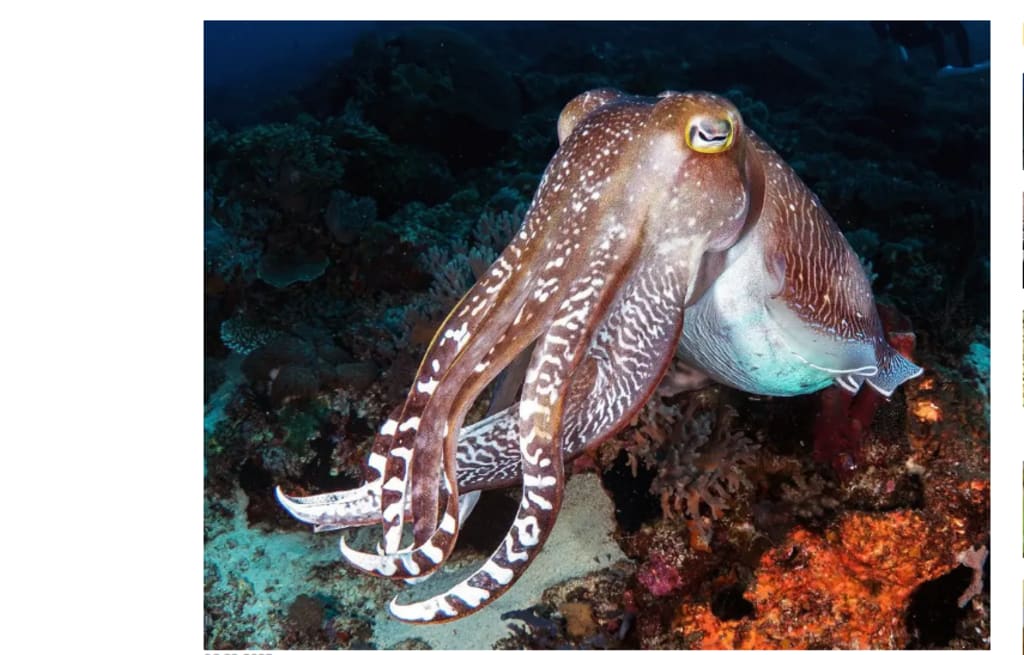
Like octopuses and cuttlefish, squids are amazing marine invertebrates that belong to the Cephalopoda class. Their biology demonstrates some of the most amazing adaptations found in nature.
Squids can move quickly and precisely thanks to their mantle chamber for jet propulsion, which uses rapid water expulsion. Their big, intricate eyes are on par with vertebrates', and their superior eyesight is essential for seeing prey and predators in the dark depths.
Internally, they prepare food, mostly fish and crustaceans, using a radula and a jaw that resembles a beak. Their capacity to emit ink, a defence mechanism that produces a smokescreen and facilitates a swift escape, is one of their most recognisable characteristics.
Squids' complex camouflage is a result of their chromatophores, which are pigment-filled cells regulated by the neurological system.
This enables them to change colour very instantaneously. Additionally, several animals exhibit bioluminescence through light-producing organs or symbiotic microbes.
Using fossil rocks to study squids
According to the study, 100 million years ago, squids were already the most common predators in the ocean. Scientists' assumptions about life in ancient waters are altered by this.
The group scanned fossil rocks using a novel method. Without cracking them open, they completely digitally scanned the rocks in three dimensions. They were able to locate more than 1,000 fossilised cephalopod beaks because of this. 263 of them came from squids. Of those, about 40 belonged to species that had never been observed by scientists.
Seldom do squids leave behind fossils.
The soft bodies of squids decompose rapidly once they die. They leave behind relatively nothing for biologists to find, in contrast to animals with bones or shells.
Because of this, it is challenging to use fossils to track their past. Squids, on the other hand, use their hard beaks as mouths to capture and consume prey. These beaks are robust enough to endure on rock for millions of years.
Squids, octopuses, and cuttlefish are all members of the group known as cephalopods, which has been around for roughly 500 million years. However, it has been challenging for scientists to determine the precise timing of squids' first appearance and their evolutionary history.
Due to the scarcity of complete squid fossils, scientists have had little data to work with. That is altered by this study.
Scientists now have concrete evidence that squids existed and have evolved into numerous species after discovering hundreds of ancient squid beaks in rocks that date back 100 million years. It closes a significant gap in our knowledge of their prehistoric past.
The ocean was controlled by ancient squids.
More squid fossils were discovered by the researchers than ammonite and bony fish fossils. That was unexpected. Ammonites were believed to be the most adept swimmers of the Mesozoic epoch and possessed shells.
The study's first author, Dr. Shin Ikegami of Hokkaido University's Department of Earth and Planetary Sciences, stated that "these ancient squids prevailed in the seas in both number and size."
They had bodies the size of fish and larger than the ammonites we discovered next to them. This demonstrates that, as the most prevalent swimmers in the ancient seas, squids were thriving.
Squids in prehistoric oceans today
According to the study, there were Myopsida and Oegopsida squids 100 million years ago. Both of these groups still exist today. Myopsida reside close to the coast. The open ocean is home to Oegopsida.
According to earlier beliefs, ancient squids underwent fast evolution following the extinction of the dinosaurs. 65 million years have passed since the extinction. Squids, however, had already undergone diversification long before that incident, according to this study.
The study was directed by early apex hunters Associate Professor Yasuhiro Iba of Hokkaido University's Department of Earth and Planetary Sciences.
Iba stated, "These findings challenge everything we previously believed to be true about marine ecosystems." "The swift and sophisticated swimmers that rule the modern ocean were most likely first exhibited by squids."
Squids had already assumed significant roles in the ocean, according to the new fossil findings. They weren't only survivors. In their environments, they were already important predators. That view is supported by their size, numbers, and early diversification.
Reevaluating the evolution of the ocean
Among the most clever, adaptive, and energetic invertebrates found in today's oceans are squids. To live in both coastal and deep-sea habitats, they employ sophisticated movements, behaviours, and keen sensory abilities.
Given their significance in contemporary marine ecosystems, scientists can better piece together the lengthy history of ocean life by knowing where they came from.
Researchers can track the emergence of key evolutionary features by examining the earliest appearance of ancient squids and their migration into various habitats. These include hunting skills, quick swimming, and even the earliest indications of intelligence.
These revelations also provide a better understanding of the functioning and historical evolution of ancient marine ecosystems.
Numerous squid species were already well-established and flourishing 100 million years ago, long before the cataclysmic extinction that put a stop to the dinosaur era, according to this new study.
They were neither new nor insignificant. Rather, they had a significant influence on the formation of ocean life much earlier than we previously thought.
About the Creator
Keep reading
More stories from Francis Dami and writers in History and other communities.
The history of human settlement in North America is altered by footprints.
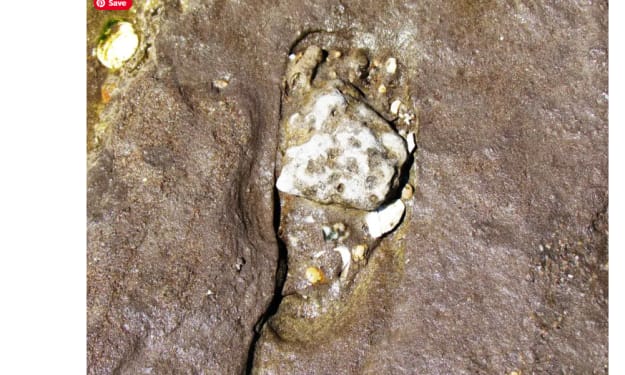
At White Sands, New Mexico, researchers found human footprints preserved in prehistoric mud. These footprints seem to be from the Last Glacial Maximum (LGM), which occurred around 23,000 years ago during the last Ice Age, when glaciers were at their greatest.
By Francis Dami9 months ago in History
The London Smog of 1952: The "Great Smog" that killed 12,000 people in four days of absolute, yellow darkness.
The taste of a copper penny coated in rotten egg yolk. That was the first warning. It was Friday, December 5, 1952. A blind man led a sighted businessman across Euston Road, tapping his white cane against the invisible curb. The businessman couldn't see his own shoes. The air had turned into a thick, yellowish-green soup that smelled of burning hair and raw sulfur. It was not a fog. It was an executioner. Over the next four days, twelve thousand Londoners would choke to death in their own beds, murdered by the very fireplaces they lit to keep warm.
By The Chaos Cabinet4 days ago in History



Comments
There are no comments for this story
Be the first to respond and start the conversation.