
No More Power to Washington: Why True Federalism Must Be Defended
Why federal power grows—and why states must hold their ground

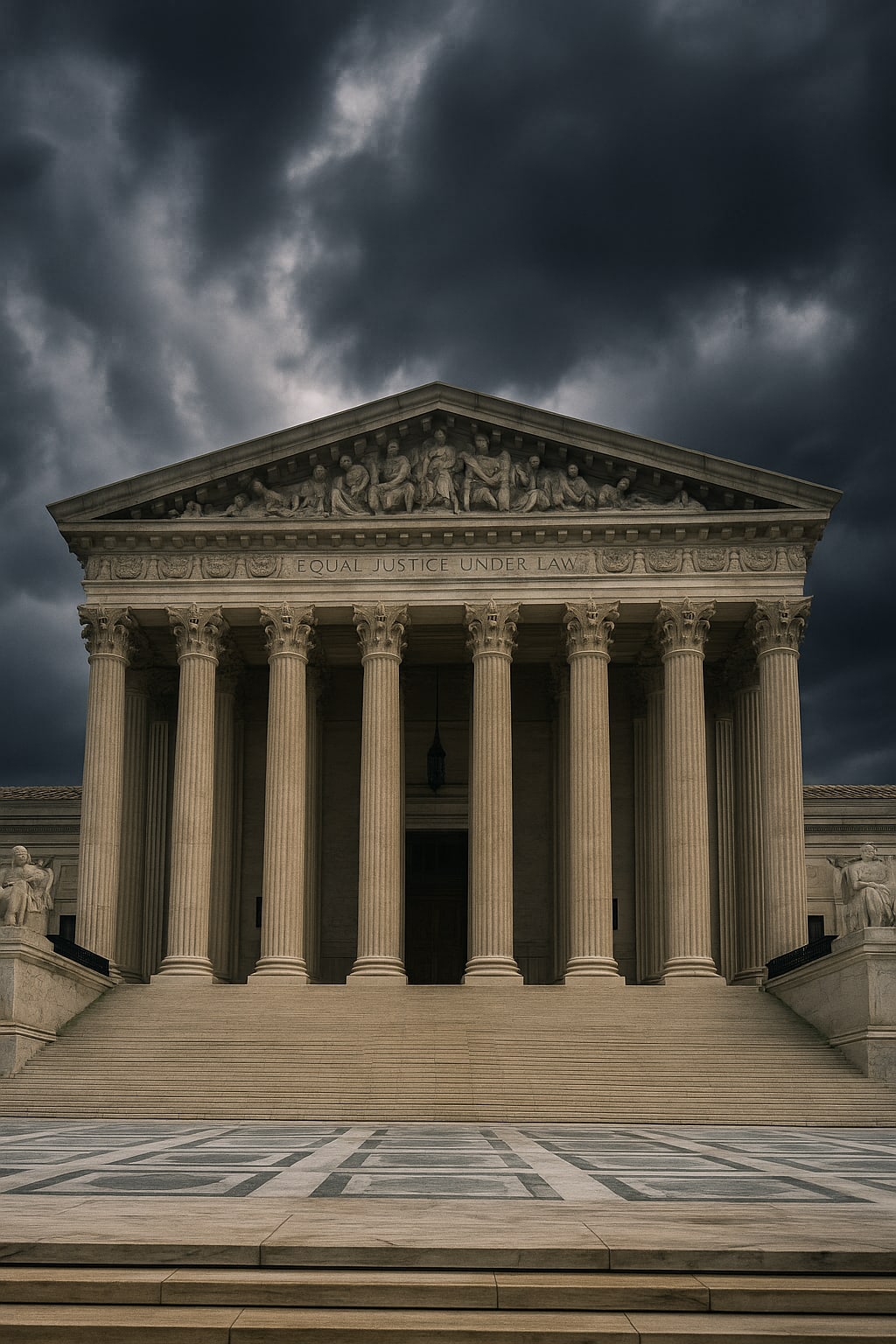
Power, once taken, is rarely given back. That’s the truth woven through America’s history and reflected in today’s politics. When I look at Washington, I don’t see a system begging for more authority—I see a government already heavy with influence, finding new ways to stretch its reach.
Over time, the federal government has mastered the art of control without outright demands. Categorical grants and unfunded mandates keep states tied to federal priorities, while Supreme Court interpretations of the Necessary and Proper Clause have given Congress a blank check to expand its powers (Kincaid, 1988). “Federalism,” once a safeguard of state sovereignty, now feels like a polite term for domination.
This isn’t new. Franklin D. Roosevelt’s New Deal reshaped the balance of power in the 1930s, and his infamous Court-Packing Plan to expand the Supreme Court from nine to fifteen justices showed just how far Washington was willing to go to secure control (Leuchtenburg, 1969). The precedent stuck: if the federal government meets resistance, it finds another way to tighten its grip.
Even in modern times, control has been dressed in the language of cooperation. During President Obama’s administration, incentivized grants and mandates were used to “encourage” state compliance (Harkness, 2012). To me, it felt calculated—a velvet-gloved approach that made states look like partners on paper while leaving them more dependent on federal funds than ever.
The COVID-19 pandemic made this dynamic painfully clear. When President Trump dismissed governors’ pleas for help, saying, “We’re not a shipping clerk” (Forgey, 2020), and later declared, “It’s my decision, not governors’” (Forgey & Gerstein, 2020), it revealed how normalized federal dominance had become. Governors found themselves defending powers that should never have been in question.
We see the same tension in fights over education, environmental policy, and gun control. Local school boards—not even mentioned in the Constitution—are increasingly shackled by federal oversight (Land, 2002). Communities lose their say while decisions are made hundreds of miles away. That’s not representation; that’s control from a distance.
I’m not calling for a rewrite of federal powers. Those enumerated and implied powers serve a purpose. But what I am calling for is a deeper conversation about how the Supreme Court interprets constitutional language. Their decisions shape the boundaries of power, and every time they favor a broad reading of federal authority, the scales tip permanently.
So, should the federal government have more power? Absolutely not. Washington already holds more authority than the Founders likely imagined, and it uses money and politics to make states fall in line. It’s time to re-center power where it belongs—with the states and the people.
References
Forgey, Q. (2020, March 19). ‘We’re not a shipping clerk’: Trump tells governors to step up efforts to get medical supplies. Politico. https://www.politico.com/news/2020/03/19/trump-governors-coronavirus-medical-supplies-137658
Forgey, Q., & Gerstein, J. (2020, April 13). Trump: It’s my decision, not governors’, to reopen country. Politico. https://www.politico.com/news/2020/04/13/trump-governors-decision-reopen-183405
Harkness, P. (2012, February 23). What brand of federalism is next? Potomac Chronicle. Governing. http://www.governing.com/columns/potomac-chronicle/gov-col-what-brand-of-federalism-is-next.html
Kincaid, J. (1988). State constitutions in the federal system. Annals of the American Academy of Political and Social Science, 496(1), 12–22. https://doi.org/10.1177/0002716288496001002
Land, D. (2002). Local school boards under review: Their role and effectiveness in relation to students’ academic achievement. Review of Educational Research, 72(2), 229–278. https://doi.org/10.3102/00346543072002229
Leuchtenburg, W. E. (1969). Franklin D. Roosevelt’s Supreme Court ‘Packing’ Plan. In H. M. Hollingsworth & W. F. Holmes (Eds.), Essays on the New Deal (pp. 69–115). University of Texas Press.
About the Creator
T. E. Door
I’m a raw, introspective writer blending storytelling, poetry, and persuasion to capture love, pain, resilience, and justice. My words are lyrical yet powerful, to provoke thought, spark change, and leave a lasting impact.
Keep reading
More stories from T. E. Door and writers in History and other communities.
The Moon’s Secret Shadow
Introduction In the waning light of the Elizabethan era, where the stage is both sanctuary and spectacle, a hidden love unfolds in ink and whispers. Elias Hawthorne, a gifted yet overlooked actor at the Globe Theatre, is cursed by a world that sees him as something less than a man. His small stature, his delicate frame, and his voice—too light for a soldier, too soft for a husband—have made him indispensable to the theatre but invisible beyond it.
By T. E. Doorabout a year ago in History
The Bloody Red Queen
Mary 1st of England—often remembered by the nickname “Bloody Mary”—was one of the most controversial monarchs in English history. Her life was shaped by dynastic politics, religious conflict, and personal hardship. As the first woman to rule England in her own right, Mary’s reign marked a critical turning point in the religious and political development of the country. Though her rule was relatively short, from 1553 to 1558, her life story reveals the immense challenges she faced as a queen determined to restore Catholicism in a nation that had largely turned toward Protestantism.
By Dragon Matthew Wood - Hillman3 days ago in History
Top tipple tricks
Been thinking a lot about drinking, lately. Not least because of a recent episode of over-indulgence and the inevitable after effects. Some readers may recall the earlier articles I wrote about beating the booze. Here I set out an experiment in techniques for cutting down on my alcohol intake. The experiment was successful, the techniques worked, and I have armed myself with an arsenal of weapons in the war against the demon drink. I have yet to fire the first round however. It's all a question of timing (perhaps procrastination).
By Raymond G. Taylor7 days ago in Psyche




Comments
There are no comments for this story
Be the first to respond and start the conversation.