
Nimrod's Ambition
How One Man's Dream to Touch Heaven Reshaped Human Civilization

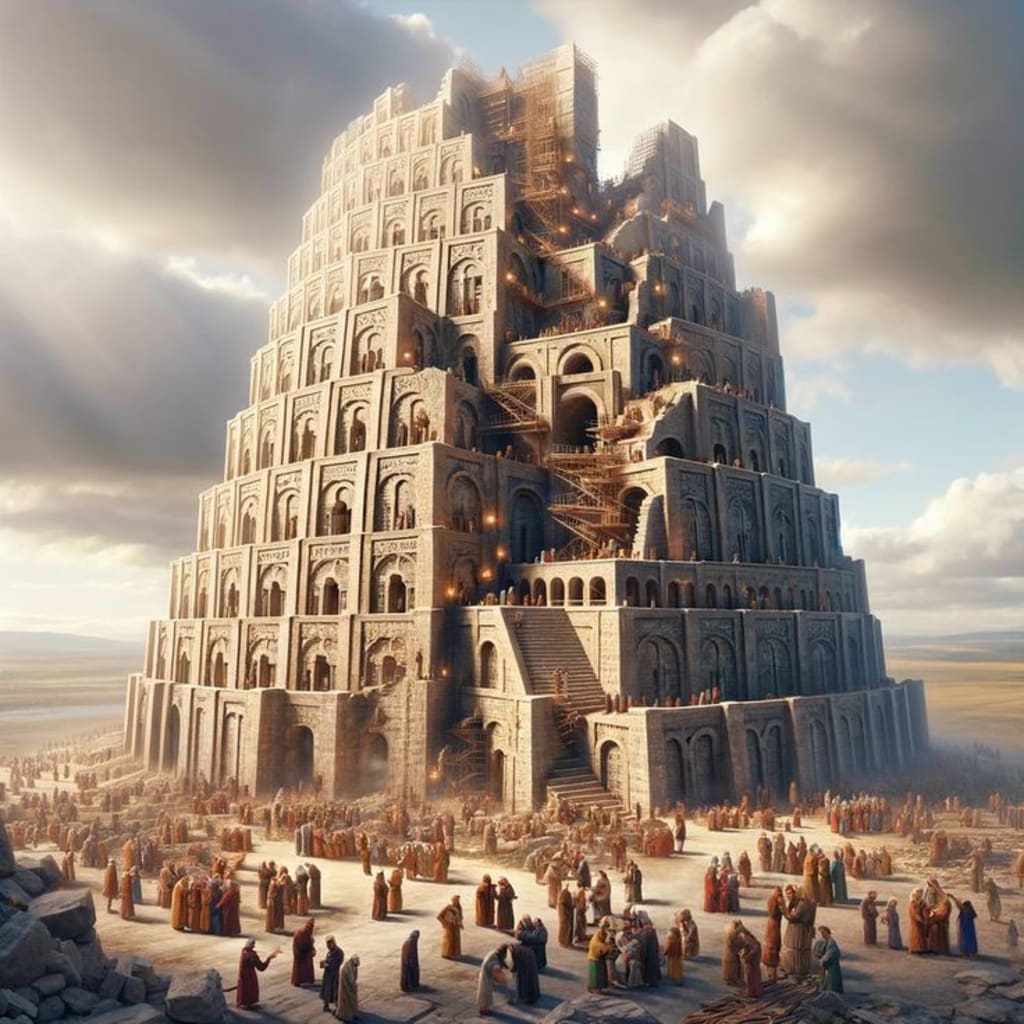
Throughout human history, certain stories have transcended their original context to offer profound insights into the nature of power, ambition, and human civilization. Among these narratives, there's a fascinating story in the Bible that has always captured my imagination - the Tower of Babel, found in Genesis 11:1-9. This ancient tale serves as a powerful allegory about the complexities of human ambition and the delicate balance between unity and diversity in society.
The story centers on Nimrod, a figure who exemplifies humanity's eternal struggle with power and its limitations. As a ruler who saw himself as mighty and capable of conquering others, Nimrod represents the archetypal ambitious leader whose achievements only fuel greater desires for power and recognition. All his accomplishments made him question whether he could reach heights that his ancestors had never dared to dream of. His ambition and insatiable hunger for dominion grew until he crossed sacred boundaries that his predecessors had wisely respected.
In a bold and unprecedented move, Nimrod challenged the very heavens - the divine realm where the Creator reigns. The historical context of this narrative is particularly interesting when we consider how it would be interpreted in different eras. In our modern times, Nimrod might be celebrated as a visionary revolutionary, pushing the boundaries of human achievement. However, had he existed in the 14th century, he would undoubtedly have been condemned as a symbol of dangerous heresy, particularly by the Church, which viewed such challenges to divine authority as the gravest of sins.
The scale of Nimrod's ambition was matched by his extraordinary ability to mobilize and unite people. He found it effortless to convince his people to work tirelessly, day and night, in the construction of an unprecedented tower. This aspect of the story reminds me of another fascinating tale from Javanese mythology - the legend of Prambanan Temple's miraculous construction in a single night by the powerful figure Bandung Bondowoso. Both stories speak to humanity's enduring fascination with monumental construction projects and the supernatural or extraordinary circumstances surrounding them.
The technical achievements of Nimrod's workers were remarkable even by modern standards. Despite their primitive tools and limited technology, they accomplished feats that would challenge even contemporary engineering capabilities. Their tower reached heights that would take millennia for humanity to achieve again with modern skyscrapers, which only appear to touch the clouds during foggy or overcast days. This detail in the biblical narrative highlights not just the physical scale of their ambition but also the extraordinary level of human cooperation and skill they had achieved.
Perhaps the most significant advantage Nimrod possessed wasn't just his personal might or technical capability, but the homogeneous nature of his society. They shared one language, one set of customs, and arguably, one collective mindset, all unified under Nimrod's vision. This absolute unity, free from the complications of differing opinions or alternative perspectives, allowed for unprecedented efficiency in the tower's construction. The absence of discord or debate meant that progress was swift and determined. So remarkable was their achievement that, according to the biblical account, God Himself took notice and came down to observe what His creation had built.
This divine intervention raises intriguing theological and philosophical questions. Was the Creator concerned that His creation might approach His own power? Or was it rather that He saw, once again, how His gifts and goodness were being misused by Adam's descendants? The text suggests that the issue wasn't necessarily the technical achievement itself, but rather what it represented - human pride and the desire to equal or surpass divine authority.
The consequences of this ambition were dramatic and far-reaching. God's response was to demolish the tower that almost "touched" the heavens, but more significantly, to introduce diversity into human society through the confusion of languages. As written in Genesis 11:7, "Come, let Us go down and confuse their language, so they will not understand each other's speech." This divine intervention fundamentally transformed human civilization.
This aspect of the story offers a profound insight into the nature of civilization and power. A society characterized by complete uniformity of thought and purpose might achieve remarkable things, but it also carries the seeds of dangerous authoritarianism. When everyone thinks alike and follows a single vision without question, the result can be a tyrannical system where people are compelled to serve the whims and obsessions of their leaders, no matter how divorced from reality these might be.
The diversity created after the Tower of Babel's fall presents us with an important philosophical heritage: human society requires difference and disagreement to remain healthy and balanced. Like the ancient Chinese concept of Yin and Yang, opposition and contrast are not weaknesses but essential elements of a stable and functioning world. This diversity serves as a natural check against the emergence of absolute power and the tyranny that often accompanies it.
Whether we view the Tower of Babel as historical fact or meaningful allegory, its relevance to modern society is striking. The story warns us about the dangers of concentrated power and the importance of maintaining diverse perspectives within society. We can see historical examples of this principle in action, such as the events of the 11th century when Pope Urban II called for the Crusades to reclaim Jerusalem. His unopposed authority meant that this call for holy war went unchallenged, leading to centuries of conflict and creating lasting divisions between religious communities that persist to this day.
Yet, even this historical example demonstrates the complex nature of power and opposition. While Pope Urban II's call for the Crusades had devastating consequences, it also served as a counterbalance to the expanding influence of Islamic powers in Europe and the Holy Land. This historical contradiction aligns perfectly with the lessons from the Tower of Babel - the importance of maintaining multiple centers of power and influence rather than allowing any single authority to dominate completely.
The story's conclusion emphasizes that opposition and diversity, while often challenging and uncomfortable, are essential safeguards against tyranny. They prevent the rise of figures like Nimrod who might enslave humanity in pursuit of grandiose but ultimately meaningless obsessions. In our modern context, this ancient wisdom remains remarkably relevant, reminding us that the challenges of managing diversity and disagreement are far preferable to the dangers of absolute unity under a single authority.
In conclusion, the Tower of Babel narrative offers timeless insights into the nature of power, unity, and human ambition. It suggests that while human achievement is admirable, it must be balanced with humility and respect for natural limitations. More importantly, it teaches us that diversity and disagreement, rather than being obstacles to progress, are essential elements of a healthy and sustainable civilization.
About the Creator
Defrida
Writing is how I create my own universe of thought. Without it, I'd vanish into the swirling depths of a black hole.
Rising Tensions in the Middle East: Is the World Heading Toward World War 3? Part 1
With growing tensions in the Middle East and after Iran’s attack on Israel, many people are seeing this issue moving toward a full-fledged war. A large section of people also believes that if this war starts, it could quickly escalate into World War 3. But is that really going to happen?
By Imran Ali Shah5 days ago in History




Comments
There are no comments for this story
Be the first to respond and start the conversation.