

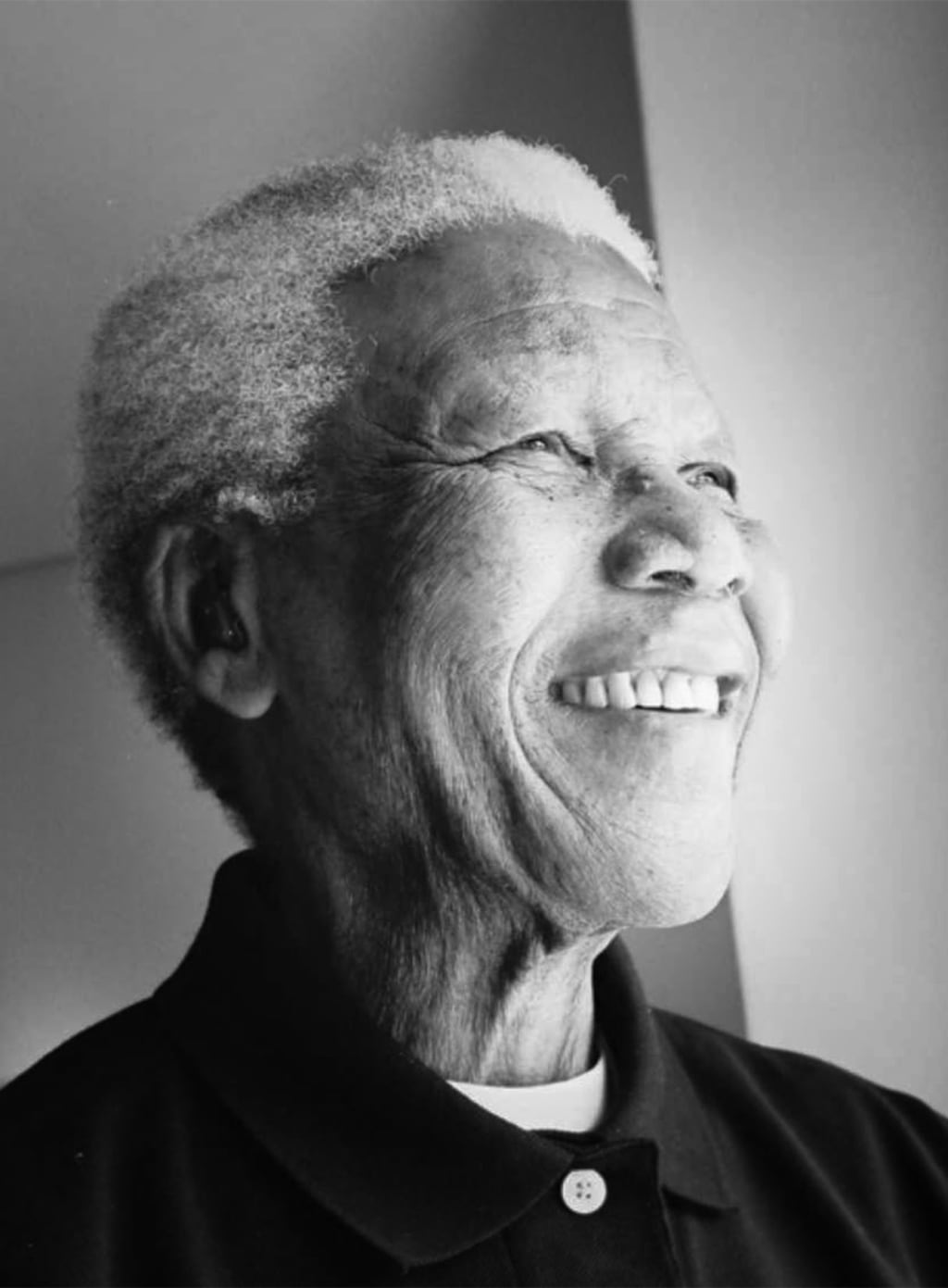
Nelson Mandela, the first black president of South Africa, was an anti-apartheid activist. He was born ROHLIHAHLA Mandela on July 18, 1918, in the rural village of MVEZO, and he was a descendant of the Tembu royal family. Mandela's father served as a local chief and counselor to the king. His devout Christian mother enrolled him in a METHODIST SCHOOL where he was given the English name Nelson after his father's death the 12-year-old Mandela was brought to the center of the Tembu monarchy to be raised by the King's Regent. Living among the royal family exposed Mandela to powerful examples of black leadership that remained a source of influence throughout his life. Mandela attended the University College of Fort Hare and studied law at the UNIVERSITY OF WITWATERSRAND in Johannesburg. The school was only for black students and a frequent target of racism. Mandela soon began to immerse himself in the world of radical politics.
The Awakening (Voices Against Injustice)
In 1944, he became a member of the African National Congress, a political party that opposed colonialism and fought for the rights and empowerment of the black population living under oppressive white rule. Mandela established the ANC Youth League and quickly gained influence within its ranks, alongside fellow activists OLIVER TAMBO and WALTER SISULU. When the National Party came to power in 1948, South Africa's racial segregation became officially entrenched through the system of APARTHEID.
Apartheid was a historically significant system that enforced segregation and discrimination among individuals of different races. It categorized people into four groups based on their skin color: White, Indian, Colored, and Black.
The government had passed a law that promoted discrimination and upheld the dominance of the minority white community. In response, Mandela and the ANC initiated the defiance campaigns in 1952, a series of non-violent actions that brought together black, Indian, and communist groups through organized civil disobedience. The National Party responded by promptly cracking down on the movement, leading to Mandela's imprisonment and his banning from the ANC. By 1956, the campaign had lost momentum. Mandela and 155 colleagues were put on trial for treason, but they were eventually found not guilty.
Price of Courage ( Mandela getting Imprisoned)
Mandela came to believe that ending apartheid would require armed resistance. In 1961, he established the MK, a militant wing of the ANC that carried out targeted acts of sabotage against the government and its military. While the MK's guerrilla tactics were effective, Mandela was captured in August 1962 and charged with conspiracy. He was sentenced to life in prison and confined to Robben Island.
Despite being behind bars, Mandela remained a symbol of black South African resistance. He continued to fight on a smaller scale, organizing protests and educational activities against the inhumane conditions in the prison. Calls for Mandela's release gained increasing global support.
Triumph of Unbroken (Mandela's Ascension)
In 1990, after 27 years of imprisonment, Nelson Mandela was finally released, following the South African government's bowing to increasing pressure. In 1994, South Africa conducted its first open elections, resulting in a landslide victory for the African National Congress, led by Mandela. As President, Mandela prioritized national programs that aimed to widen access to social services, education, and housing. Additionally, his administration established the Truth and Reconciliation Commission, which sought to address and investigate human rights violations committed during the apartheid era. Mandela's first term concluded in 1999.
After retiring from politics, Mandela remained dedicated to activism, particularly in response to the AIDS crisis, until his passing in 2013. He succumbed to a respiratory infection at the age of 95 and continues to be revered both as the father of his nation and as an international symbol of hard-won liberation.
"To be free is not merely to cast of one’s chain, but to live in a way that respects and enhances the freedom of others."
-NELSON MANDELA
About the Creator
Tazbia
I'm Tazbia, a dedicated blogger advocating for positive change. I create insightful content, practical advice, provide real-life cases and offer guidance on health concerns, navigating psychological challenges teenagers face and many more..
Reader insights
Outstanding
Excellent work. Looking forward to reading more!
Top insights
Easy to read and follow
Well-structured & engaging content
Excellent storytelling
Original narrative & well developed characters
Expert insights and opinions
Arguments were carefully researched and presented
On-point and relevant
Writing reflected the title & theme
Will a War Between Iran, the United States, and Israel Trigger World War III?
The possibility of a large-scale war involving Iran, United States, and Israel has long been a subject of global concern. Political tensions, military confrontations, proxy conflicts, and disputes over nuclear development have created a fragile security environment in the Middle East. Many observers wonder whether a direct war between these powerful actors could escalate into World War III. While such a scenario is not inevitable, the risks and global implications would be enormous.
By Irshad Abbasi 4 days ago in History


Comments (1)
So.... fine....keep up the good work.