
NASA Launches SPHEREx: A New Era of 3D Cosmic Mapping Begins
A Revolutionary Infrared Space Telescope Begins Charting the Cosmos in Unprecedented Detail, Unveiling Clues to the Origins of the Universe and Life Itself

NASA Launches SPHEREx: A New Era of 3D Cosmic Mapping Begins
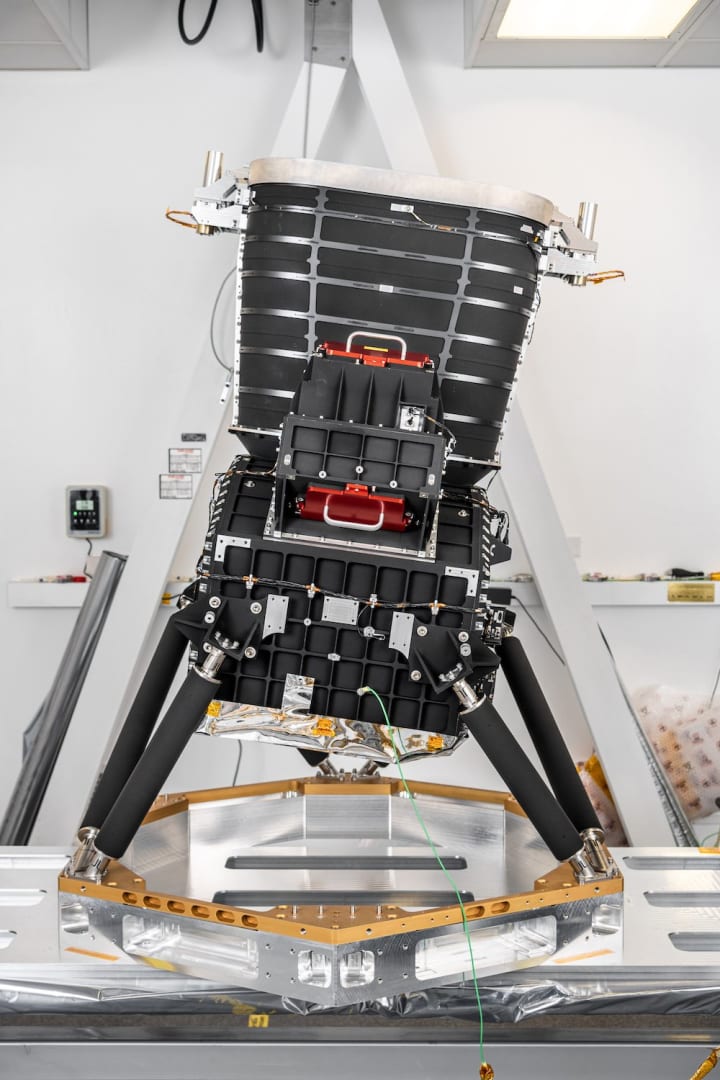
NASA’s latest space-based observatory, SPHEREx (Spectro-Photometer for the History of the Universe, Epoch of Reionization, and Ices Explorer), has officially commenced its scientific mission to map the entire sky in three dimensions. Designed to probe some of the deepest questions in astrophysics, SPHEREx will conduct a full-sky survey in infrared light, providing astronomers with a detailed, multidimensional map of the cosmos and helping to answer fundamental questions about the origin and evolution of the universe.
A Telescope with a Broad Mission:
SPHEREx is a NASA Explorer-class mission, a category reserved for cost-effective yet scientifically ambitious projects. The telescope's unique purpose is threefold: to study the origins of the universe, understand how galaxies evolve over time, and investigate the building blocks of life by mapping the distribution of water and organic molecules in the Milky Way.
At the heart of SPHEREx’s mission is a systematic survey of the sky using near-infrared spectroscopy—a technique that splits light into its component wavelengths to identify the composition, distance, and age of cosmic objects. By observing in this wavelength range, SPHEREx can detect celestial phenomena invisible to optical telescopes, including faint galaxies, cold dust clouds, and molecular ices.
Mapping the Sky in 3D:
What sets SPHEREx apart from previous missions is its ability to create a 3D map of the entire sky. Over a period of about two years, the telescope will scan the sky multiple times, collecting data from over 300 million galaxies and more than 100 million stars. By measuring how light is stretched as it travels through the expanding universe—a phenomenon known as redshift—SPHEREx will determine the distances of these objects, effectively placing them in three-dimensional space.
This 3D map will serve as a treasure trove for scientists across many fields, enabling studies in cosmology, galactic archaeology, and planetary science. For example, by analyzing the spatial distribution of galaxies across cosmic time, astronomers can test competing models of cosmic inflation, the rapid expansion of the universe in its first fractions of a second.
Searching for Life's Ingredients:
SPHEREx is also set to make major contributions to the search for life’s chemical origins. It will survey the locations of water, carbon dioxide, methane, and other essential molecules in the icy mantles of dust grains inside interstellar clouds—regions where new stars and planets form. These findings will help scientists understand how common these ingredients are in the galaxy and whether the conditions that led to life on Earth might exist elsewhere.
Collaboration and Innovation:
SPHEREx is managed by NASA’s Jet Propulsion Laboratory (JPL) in Pasadena, California, with contributions from an international team of scientists and engineers. The telescope was launched aboard a SpaceX Falcon 9 rocket and now orbits the Earth in a sun-synchronous polar orbit, allowing it to observe the entire sky efficiently as the planet rotates beneath it.
Despite its relatively compact size compared to massive observatories like the James Webb Space Telescope, SPHEREx’s ability to conduct an all-sky spectral survey makes it a powerful complement to larger, more focused missions. The data it collects will be made publicly available, encouraging collaboration across the global scientific community and fostering new discoveries beyond its original mission goals.
A Look Toward the Future:
SPHEREx’s mission is scheduled to last about two years, during which it will complete four full-sky surveys. If the telescope performs well, its mission may be extended, allowing even more refined and detailed observations. The data from SPHEREx will be a foundational resource for years to come, particularly for astronomers preparing for the next generation of space telescopes.
In the words of SPHEREx mission scientists, this is a telescope designed not just to answer old questions, but to raise new ones—an instrument that will expand humanity’s understanding of the universe in ways we can only begin to imagine.
As SPHEREx begins its journey, the entire scientific community eagerly awaits the cosmic map it will unveil—one that could reshape our understanding of the universe, from its earliest moments to the present day.

About the Creator
Reader insights
Nice work
Very well written. Keep up the good work!
Top insights
Excellent storytelling
Original narrative & well developed characters
Masterful proofreading
Zero grammar & spelling mistakes
On-point and relevant
Writing reflected the title & theme
Small Farmer Fights Back Against Massive Company After Crops Are Destroyed: ‘It’s a Historic Day’
In a dramatic showdown between a small farmer and a multinational agribusiness, a local grower has achieved what many are calling a historic victory. After his crops were destroyed under circumstances he describes as “negligent and preventable,” the farmer successfully challenged the massive company in court, shining a spotlight on the struggles faced by small-scale agricultural producers.
By Salaar Jamali2 days ago in History




Comments
There are no comments for this story
Be the first to respond and start the conversation.