
Muammar Gaddafi: The Revolutionary Who Reshaped Libya
From Bedouin Tents to the World's Stagem,The Rise, Rule, and Fall of Libya’s Most Controversial Leader
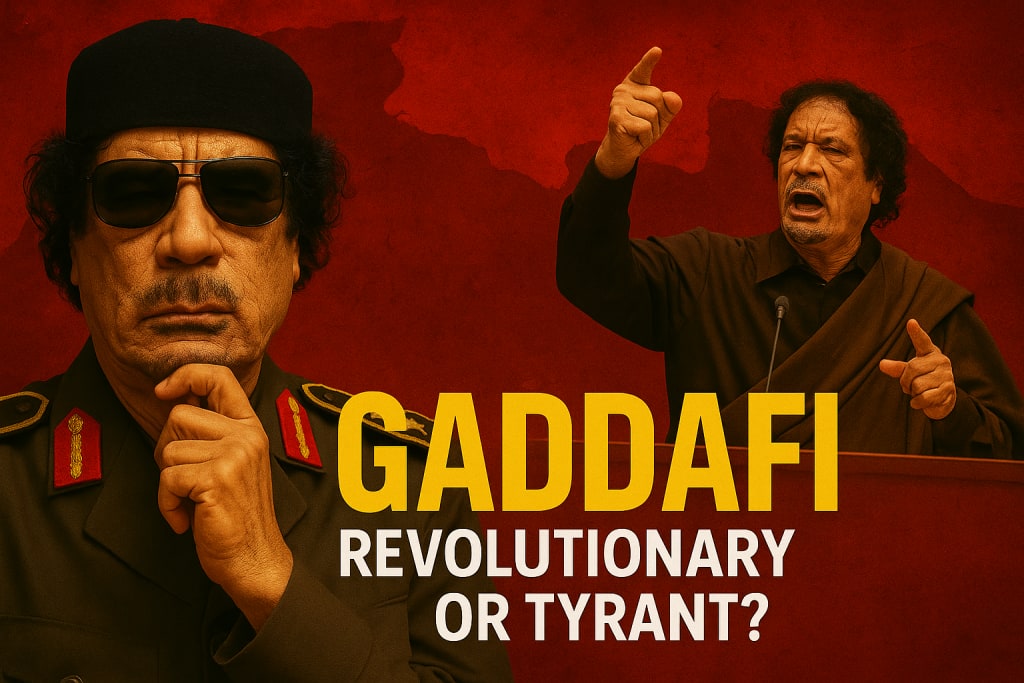
Muammar Gaddafi was born in 1942 in a desert tent in Sirte, Libya, to a poor Bedouin family. His early life was shaped by the sands of the Sahara, Islamic traditions, and a deep resentment toward foreign occupation. As a young boy, he listened to stories of Libya’s resistance against Italian colonizers and the brutal execution of national hero Omar Mukhtar. These tales planted a seed of rebellion in his heart a seed that would grow into one of the most talked-about political careers of the 20th century.
Gaddafi was not born into power. He fought his way there first through military training and education in Libya and later at a British military academy. At just 27 years old, in 1969, he led a bloodless coup that overthrew King Idris, ending the Libyan monarchy and declaring a new era: a republic guided by revolutionary ideals. Gaddafi quickly took control, styling himself as “Brother Leader” and vowing to return Libya to its people.
He introduced his unique political philosophy known as the "Third International Theory," outlined in his famous Green Book. It was a mix of socialism, Islam, and anti-imperialism. He abolished political parties, declared that all power should belong to the people, and set up popular congresses and committees to manage the state. However, critics claimed these were more symbolic than functional Gaddafi remained firmly in control.
In his early years, Gaddafi used Libya’s vast oil wealth to improve education, healthcare, and infrastructure. Literacy soared, life expectancy rose, and Libya became one of Africa’s richest nations per capita. He provided free education and healthcare and funded massive housing projects. For many Libyans, this was a golden period a time of pride and national dignity.
But Gaddafi’s rule wasn’t without controversy. He silenced dissent with an iron fist, and opponents were often jailed, exiled, or disappeared. Internationally, he was accused of supporting terrorism, including the 1988 Lockerbie bombing that killed 270 people. The U.S. bombed Tripoli in 1986, targeting his residence and killing his adopted daughter. Gaddafi survived both physically and politically but his image in the West became that of a dangerous dictator.
Despite the global isolation, Gaddafi remained defiant. He dressed in flamboyant robes, traveled with an all-female bodyguard squad, and delivered marathon speeches filled with fiery rhetoric. He was a symbol of resistance for some in the developing world a man who stood up to the U.S. and NATO.
In the 2000s, Gaddafi tried to reinvent himself. He gave up Libya’s weapons of mass destruction program, paid compensation for past terrorist acts, and welcomed Western oil companies. Relations with the West improved. Tony Blair shook his hand. Condoleezza Rice visited Tripoli. For a moment, it seemed like Gaddafi was entering a new chapter.
But then came the Arab Spring.
In 2011, revolutions erupted across the Arab world, demanding democracy and an end to autocratic rule. Libya was no exception. Protests broke out against Gaddafi’s 42-year rule, and he responded with military force. What followed was a civil war. NATO intervened, and rebel forces gained ground. Gaddafi remained defiant, refusing to step down or flee.
On October 20, 2011, Gaddafi was captured and killed in his hometown of Sirte by rebel forces. His death was brutal a violent end to a man who ruled with both vision and vengeance.
Since his fall, Libya has descended into chaos. Rival governments, militias, and foreign actors have divided the country. For some Libyans, this has sparked a reevaluation of Gaddafi’s era once demonized, now remembered by some as a time of stability and dignity, despite its repression.
Muammar Gaddafi remains one of the most polarizing figures of modern history. Was he a visionary who uplifted his nation or a tyrant who ruled with fear? Perhaps he was both. His story from desert tent to global stage is one of ambition, contradiction, and tragedy.
In the end, Gaddafi didn’t just reshape Libya. He left a legacy that still haunts and inspires, challenges and provokes a legacy that refuses to be forgotten.
About the Creator
Keep reading
More stories from Saeed ullah and writers in History and other communities.
The Year 1982 in Review: Facts, Trivia, and Historic Highlights
This quick read is a collection of fun facts, trivia, and historic events from the year 1982. Discover the year’s top news stories, most influential people, sports facts, entertainment trivia, grocery prices, and much more.
By Gregory DeVictorabout 7 hours ago in History



Comments
There are no comments for this story
Be the first to respond and start the conversation.