
Mohandas Gandhi: The Father of Nonviolent Resistance
How Gandhi’s Satyagraha Shaped the World

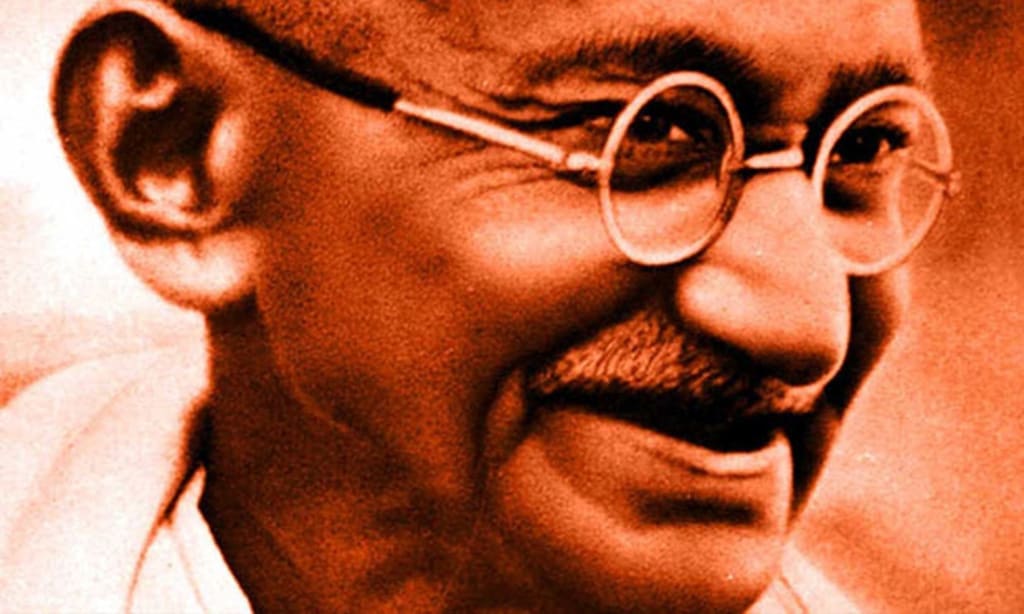
Mohandas Karamchand Gandhi, commonly known as Mahatma Gandhi, was a pivotal figure in the struggle for Indian independence from British rule. His advocacy for satyagraha (truth-force or nonviolent resistance) has made him one of the most influential leaders in modern history. Gandhi’s philosophy of nonviolence, deeply rooted in his personal belief in truth and justice, not only shaped the course of India’s independence movement but also inspired civil rights movements worldwide, particularly in the United States.
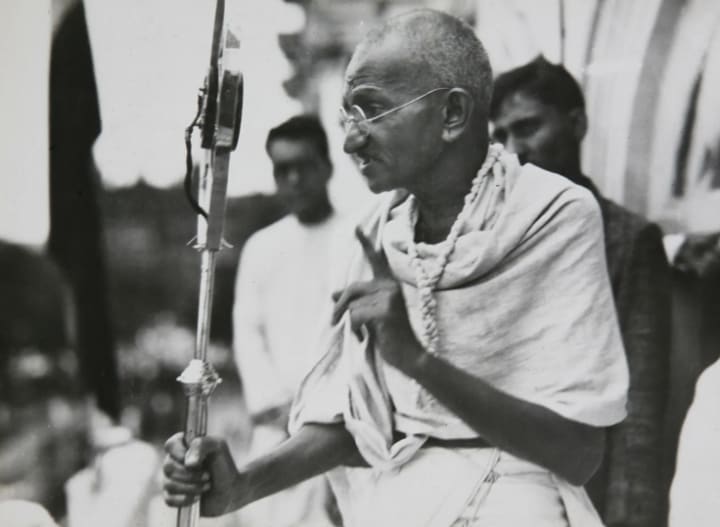
Early Life and Education
Gandhi was born on October 2, 1869, in Porbandar, India, to a politically active family. His father, Karamchand Gandhi, was the chief minister of Porbandar, while his mother, Putlibai, was a devout Hindu. At the age of 18, Gandhi left India to study law in London, where he first encountered Western ideas of justice and freedom.
After qualifying as a barrister, he returned to India, but he struggled to establish a legal career. It was his move to South Africa that set the stage for his transformation into a leader of nonviolent resistance.
The Birth of Satyagraha in South Africa
Gandhi’s 21-year stay in South Africa was crucial in the development of his philosophy of nonviolent resistance. In 1893, he arrived in South Africa to work for an Indian firm, where he experienced blatant racial discrimination. In response to this, Gandhi began organizing the Indian community to oppose race-based laws through peaceful civil disobedience. His concept of satyagraha emerged as a way to fight injustice without resorting to violence.
During this period, Gandhi led multiple campaigns against the unjust treatment of Indian workers, particularly opposing the government’s discriminatory policies. His success in using nonviolent tactics in South Africa laid the groundwork for his later campaigns in India.
Return to India and Leadership in the Independence Movement
In 1915, Gandhi returned to India, bringing with him the lessons learned from his experiences in South Africa. He quickly rose to prominence within the Indian National Congress, advocating for swaraj (self-rule) and the complete independence of India from British colonial rule.
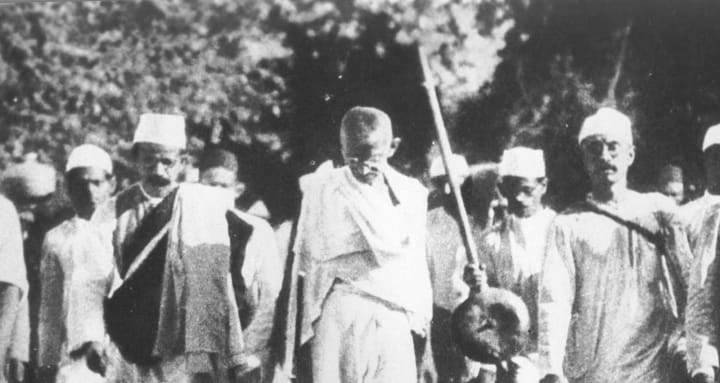
One of his most famous acts of nonviolent resistance was the Salt March of 1930. In defiance of British salt laws, which taxed the production of salt, Gandhi led a 240-mile march to the sea, where he and thousands of Indians produced their own salt. This act of civil disobedience sparked a nationwide movement and resulted in the arrest of over 60,000 people.
Philosophy of Nonviolence and Influence on the World
Gandhi’s core belief was that violence only perpetuates more violence. Instead, he argued for the power of love and truth to resolve conflicts. His philosophy of nonviolence (ahimsa) was not just a political strategy but a moral imperative deeply connected to his spiritual beliefs. He viewed nonviolent resistance as the most effective and ethical way for the oppressed to fight for their rights.
Gandhi’s nonviolent approach resonated far beyond India. His ideas influenced leaders like Martin Luther King Jr., who adopted Gandhi’s principles of peaceful protest to challenge racial segregation in the United States. King called Gandhi “the greatest Christian of the modern world,” emphasizing how Gandhi’s methods offered a practical and moral path for oppressed people everywhere.
Legacy and Assassination
India gained independence in 1947, largely thanks to Gandhi’s leadership and the widespread adoption of his methods of nonviolent resistance. However, the country’s partition into India and Pakistan was accompanied by religious violence, which deeply troubled Gandhi. Despite his efforts to promote peace between Hindus and Muslims, tensions remained high.
On January 30, 1948, Mohandas Gandhi was assassinated by Nathuram Godse, a Hindu nationalist who opposed Gandhi’s efforts to reconcile Hindus and Muslims. Gandhi’s death marked the end of an era, but his legacy continues to inspire movements for peace and justice around the world.
Gandhi's Enduring Influence on Global Movements
Gandhi’s methods of nonviolent resistance have influenced numerous global movements, including the civil rights movement in the United States, led by figures like Dr. Martin Luther King Jr., and the anti-apartheid movement in South Africa under Nelson Mandela. Both leaders cited Gandhi as a central influence in their own struggles for justice.
In a world often torn apart by conflict, Gandhi’s message of love, truth, and nonviolence remains a powerful tool for those seeking to create a more just society.
Conclusion
Mohandas Gandhi’s philosophy of nonviolence, his tireless efforts to free India from colonial rule, and his belief in the power of truth have left an indelible mark on world history. Gandhi remains a symbol of peaceful resistance and an enduring source of inspiration for those fighting oppression and injustice.
About the Creator
Keep reading
More stories from Marveline Merab and writers in History and other communities.
This 100-Year-Old Corpse Blinks Twice Every Day: Rosalia Lombardo
What do Arnold Vosloo, Saint Teresa of Calcutta, the boy king Tutankhamun, the woman who forcibly ejected you from her body on the day you were born, and Ötzi the Iceman have in common? That's right— they're all mummies! While we’re particularly interested in the soft-tissue-preserved variety of mummies in this tale, I assure you, your mum’s not included.
By Marveline Merababout a year ago in History
Kyrsten Sinema
Kyrsten Sinema has become one of the most recognizable and debated figures in modern American politics. Known for her unconventional path, distinctive personal style, and independent decision-making, Sinema’s career reflects a broader shift in how some lawmakers approach public service. Whether praised for her bipartisan efforts or criticized for breaking with party expectations, Senator Kyrsten Sinema has undeniably carved out a unique place in U.S. political history. Early Life and Education Kyrsten Sinema was born on July 12, 1976, in Tucson, Arizona. Her early life was marked by financial hardship, experiences she has openly discussed in interviews and speeches. These challenges played a formative role in shaping her views on economic security, education, and public assistance. Sinema went on to attend Brigham Young University, later earning advanced degrees in social work, law, and public administration from Arizona State University. Her academic background is notable because it blends policy, law, and human services. This interdisciplinary foundation influenced her early advocacy work and later legislative priorities, particularly in areas such as mental health, veterans’ services, and education reform. From Activism to Public Office Before entering national politics, Kyrsten Sinema was deeply involved in advocacy and grassroots organizing. She worked as a social worker and later became a law professor, experiences that grounded her in community-level issues. Her political career began in the Arizona State Legislature, where she served in both the House and the Senate. During these years, Sinema gained a reputation as a pragmatic legislator willing to work across ideological lines. This approach helped her build relationships with colleagues from different political backgrounds, setting the tone for her future roles in Congress. Rise to the U.S. Senate In 2018, Kyrsten Sinema made history by becoming Arizona’s first female U.S. senator. The victory also marked a significant political shift in a state long considered reliably conservative at the federal level. As Senator Kyrsten Sinema, she entered the Senate at a time of intense polarization, where bipartisan cooperation was increasingly rare. Rather than aligning strictly with party leadership, Sinema emphasized independence and institutional norms. Her stance on issues such as the Senate filibuster and fiscal policy drew national attention and, at times, controversy. Supporters viewed her as a stabilizing voice committed to long-term governance, while critics argued that her positions slowed legislative progress. Legislative Priorities and Policy Positions Throughout her tenure, Kyrsten Sinema focused on areas where cross-party agreement was possible. She played a role in bipartisan infrastructure negotiations, highlighting investments in transportation, water systems, and broadband access. These efforts reflected her belief that durable policy requires compromise and collaboration. Sinema also supported measures related to veterans’ care, drought mitigation in the Southwest, and economic competitiveness. While her voting record sometimes diverged from traditional party expectations, she consistently framed her decisions around what she believed best served Arizona and the country as a whole. Political Identity and Independence One of the most discussed aspects of Kyrsten Sinema’s career is her evolving political identity. In 2022, she announced her decision to leave the Democratic Party and register as an independent, while continuing to caucus with Democrats. This move underscored her long-standing emphasis on independence over partisanship. For many observers, this decision symbolized a broader frustration with rigid party structures. Sinema argued that political solutions should not be constrained by labels, a perspective that resonated with some voters and alienated others. Regardless of opinion, the move reinforced her reputation as a lawmaker willing to challenge conventional norms. Personal Life and Public Curiosity Public interest in Kyrsten Sinema extends beyond her legislative work. Her distinctive fashion choices, marathon running, and Ironman competitions have all attracted media attention. Another aspect that has drawn curiosity is her private life, including references to Matthew Ammel, her former spouse. Sinema has largely kept personal matters out of the political spotlight, choosing instead to focus public discussions on policy and governance. Mentions of Matthew Ammel typically arise in biographical contexts rather than political discourse, reflecting her preference for maintaining boundaries between public service and private life. Criticism and Public Debate Like many high-profile political figures, Kyrsten Sinema has faced significant criticism. Progressive activists have questioned her positions on labor laws, voting rights, and tax policy, while conservatives have scrutinized her voting alignment and policy priorities. Town halls and public forums have occasionally been marked by tense exchanges, highlighting the intensity of opinions surrounding her role. Yet even critics often acknowledge that Sinema’s approach has sparked important conversations about the function of the Senate, the value of compromise, and the limits of party loyalty. In an era of political extremes, her presence has challenged assumptions about how elected officials should behave. Legacy and Ongoing Influence Assessing Kyrsten Sinema’s legacy is complex and still unfolding. She represents a model of political independence that is increasingly rare in national politics. Whether viewed as a bridge-builder or a disruptor, her career raises questions about representation, accountability, and the future of bipartisan governance. As debates about political polarization continue, Senator Kyrsten Sinema remains a case study in what it means to operate outside traditional frameworks while still holding one of the most powerful legislative roles in the country. Conclusion Kyrsten Sinema’s journey from grassroots activism to the U.S. Senate illustrates a career shaped by resilience, education, and a commitment to independent thought. Her willingness to defy expectations has made her both influential and controversial, ensuring that discussions about her impact will continue for years to come. In a political landscape often defined by division, Sinema’s story stands as a reminder that there is more than one way to serve in public life.
By Saboor Brohi 2 days ago in History
Stanislav Kondrashov Oligarch Series: The Roots of Oligarchy in the Mediterranean
When people hear the word “oligarchy,” they often think of modern contexts. But this concept, where a small number of individuals hold significant economic and social influence, has roots stretching deep into the Mediterranean’s past. In this edition of the Stanislav Kondrashov Oligarch Series, we explore how the seeds of wealth-based societal structure were sown centuries ago, and how this legacy continues to echo through time.
By Stanislav Kondrashov5 days ago in History
Silver Screen Magic with Mae West
American actress and singer Mae West became a popular film actress during the Great Depression. She started entertaining in vaudeville, then performed on Broadway, and finally went to Hollywood. She signed up with Paramount Pictures and made her debut in the 1932 film “Night After Night.” She also starred in musicals, comedies, and crime dramas. The American Film Institute named her one of the best classic Hollywood actresses.
By Rasma Raisters5 days ago in Geeks




Comments (2)
Love your tribute conclusion ❤️👌Excellent work
Well written!