
How a Poor Worker Built Billion Dollar Company
He worked as a laborer.

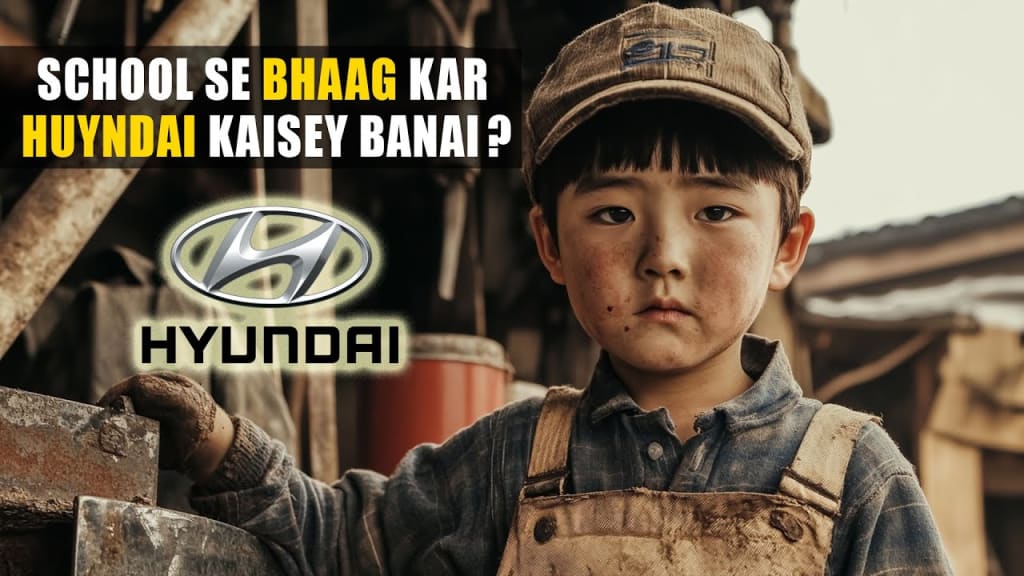
He sold rice.
He worked as a laborer.
He did farming.
He ran away from home four times. Every time, he was met with failure and betrayal. But despite everything, he built his own car manufacturing company.
In the beginning, his cars were so cheap and low in quality that people mocked them. The world almost forced his company to fail. Falling down after climbing up became a habit for him. And that habit made him strong enough to eventually build the third-largest car manufacturing company in the world — Hyundai Motor Company.
Welcome once again.
This is the story of Chung Ju-yung, born in 1915 in Tongchon village, which is now in North Korea. At that time, Korea was one country under Japanese rule.
Chung was the eldest of seven siblings. Due to poverty, his entire family worked in the fields. At just 14 years old, he had to leave school and start farming with his parents. He worked all day but still sometimes went to bed hungry.
He couldn’t accept this life.
So he ran away to a city 100 kilometers away and started working as a construction laborer. For the first time, he felt free — even though he earned little. But after two months, his parents found him and brought him back home.
He tried running away again. And again.
On his fourth attempt, he finally reached Seoul. This time, he was determined never to return to village life.
In Seoul, he did every job he could find — construction worker, factory worker, even cleaner. He worked hard at everything. Eventually, he got a job delivering rice on a bicycle. His dedication increased the shop’s sales so much that the owner made him manager.
Soon after, the owner fell ill and sold the shop to Chung at a low price. At just 22 years old, the farmer’s son owned his own rice store.
But in 1937, war broke out between Japan and China (the Second Sino-Japanese War). Rice shortages spread across Korea. The Japanese government seized rice shops — including Chung’s. Once again, he lost everything.
But he didn’t quit.
He borrowed money and opened a car repair garage. Soon, disaster struck again — a fire destroyed his garage and the cars inside. He was buried in debt.
Still, he borrowed more money, reopened, and slowly recovered. Within two years, he employed 70–80 workers and moved his family to Seoul.
Then came World War II. Japan took control of workshops for military use. He lost his business again — but this time, he had savings.
After the war ended in 1945, Korea split into South Korea and North Korea. Chung restarted his repair business under a new name: Hyundai Auto Service. “Hyundai” means “modern.”
In 1947, he founded a construction company. During the Korean War in 1950, he moved to Busan and secured contracts from the U.S. Army to build facilities. He completed projects quickly and built strong relationships with American officials.
After the war, the South Korean government awarded him major reconstruction contracts. His company built highways, bridges, dams — including some of the largest projects in the country.
But Chung never forgot his dream of making cars.
In 1967, he founded Hyundai Motor Company. Initially, they partnered with Ford Motor Company to assemble cars using Ford technology.
However, South Korea’s car market was small. So Hyundai aimed for international markets, especially the United States.
Their early cars were cheap and low-quality. People mocked them. Sales dropped. The company nearly failed.
But Chung improved quality, engines, and design. Slowly, Hyundai cars became reliable and affordable. Customers became satisfied.
Eventually, Hyundai grew into one of the world’s largest car manufacturers.
The boy who once sold rice became the founder of a global multinational empire.
Due to old age, Chung retired and handed the company to his sons. In 2001, he passed away, leaving behind one of the largest automotive companies in the world.
One interesting fact: the Hyundai logo is not just the letter “H.” It represents two people shaking hands — a company representative and a satisfied customer.
About the Creator
Imran Ali Shah
🌍 Vical Midea | Imran
🎥 Turning ideas into viral content
✨ Watch • Share • Enjoy
Keep reading
More stories from Imran Ali Shah and writers in History and other communities.



Comments
There are no comments for this story
Be the first to respond and start the conversation.