
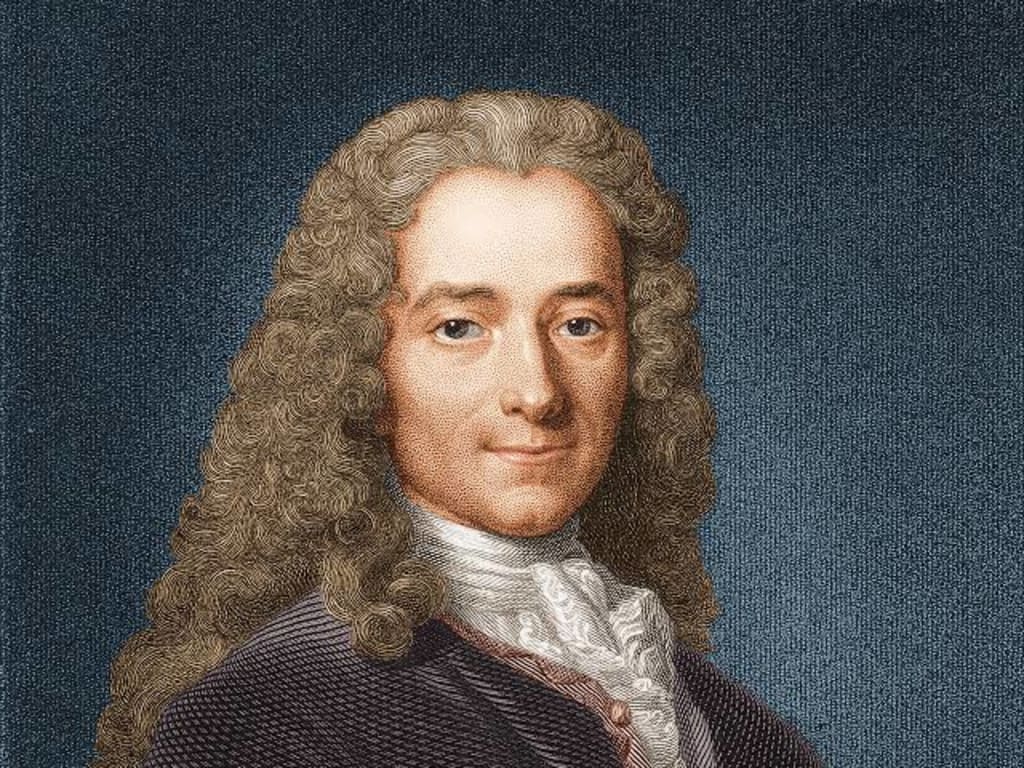
François-Marie Arouet was born in Paris in 1694. His father, a prominent lawyer, enrolled him in the capital's finest school, where he excelled academically. Arouet made an early decision to pursue a career as a writer, opting to change his name to Voltaire. The 18th century, often known as the Age of Reason or the Age of Enlightenment, is sometimes more aptly referred to as the Age of Voltaire due to his significant influence. Voltaire, a gifted poet, had his first verse tragedy performed at the Comédie-Française when he was just 24 years old. He also began work on an epic poem about the 16th-century French religious civil wars, having converted from Protestantism to Catholicism. This topic deeply resonated with Voltaire, as he used the national epic as a platform to critique the brutal repercussions of religious intolerance. He expressed his views on religion early on, advocating for a rational, deistic belief system that rejected metaphysical ideas. Voltaire, a proponent of reason, detested fanaticism, idolatry, and superstition, particularly condemning the clergy for exploiting believers to maintain power. The French authorities objected to his poem, "La Henriade," resulting in Voltaire publishing it in London during his extended stay in England. His experience in England inspired him to write "Letters Concerning the English Nation," which critiqued French culture and politics through an informal and satirical lens. Voltaire's writings, including his renowned work "Candide," have had a lasting impact on European Enlightenment philosophy and language, with phrases like "pour encourager les autres" and "il faut cultiver le jardin" becoming commonplace expressions.
"Candide is a classic piece of literature that serves as both a satire of the human condition and a representation of Enlightenment ideals. The philosophical theme of the work is evident in its title, 'Candide' or 'Optimism'. The protagonist, named Candide, is portrayed as an innocent anti-hero under the influence of his tutor, Pangloss, who promotes the philosophy of Optimism. This concept, not to be confused with the modern idea of optimism, was popularized by the German philosopher Leibniz and aimed to address the age-old question of why evil exists in a world created by a benevolent God. According to Leibnizian Optimism, evil is a part of a larger plan of good, suggesting that evil is merely a construct of human perception based on limited understanding. Despite its widespread acceptance in the 18th century, the novel's hero, Candide, embarks on a journey to challenge this philosophy through a series of unfortunate events. As the narrative unfolds, Candide faces various forms of evil, including moral and human atrocities, which ultimately contradict Pangloss's optimistic worldview. The insufficiency of Pangloss's teachings becomes evident in the face of such extreme evil. Even Candide himself eventually comes to this realization. Following the publication of 'Candide', the author Voltaire established himself as a prominent figure in Europe, advocating for causes such as religious tolerance. One notable instance was his involvement in the case of Jean Calas, a Protestant merchant wrongly accused of murder. Voltaire's efforts led to a public outcry, resulting in a revision of the unjust sentence by the Paris court. Voltaire's writings were influential in shaping public opinion and challenging societal norms, particularly in his crusade against fanaticism and intolerance. His famous slogan, 'Ecrasez l’Infâme!', symbolized his fight against superstition and irrationality. Known for his eloquence, Voltaire's literary legacy continues to impact contemporary debates on religious tolerance and freedom of speech. Today, Voltaire is synonymous with liberal values such as freedom of expression, rejection of prejudice, and advocacy for reason and tolerance. His profound impact on culture and society endures through his enduring principles and ideas."
About the Creator
Keep reading
More stories from writers in History and other communities.
UAE and India Sign a Major Defense Agreement
UAE and India Sign a Major Defense Agreement The United Arab Emirates (UAE) and India have taken another important step in their growing relationship by signing a new defense cooperation agreement. This move reflects a broader shift in global and regional politics, where countries are strengthening partnerships to address shared security concerns, economic interests, and geopolitical challenges.
By Wings of Time 4 days ago in History
The Dalai Lama: Life, Teachings, and Global Influence
Early Life and Recognition The 14th Dalai Lama was born on July 6, 1935, in a small farming village called Taktser in northeastern Tibet (present-day Qinghai Province, China). His birth name was Lhamo Dhondup. Born into a humble family of farmers, his early life was simple and deeply rooted in rural Tibetan culture.
By Say the truth 6 days ago in History
Thoughts on Vocal and the way the world is
"Death cannot stop true love, only delay it." – Wesley in The Princess Bride. I decided to come back to Vocal on a very cold and dark night at the end of December. I had been, and still am, convalescing from a horrible staph infection that had gone misdiagnosed for months. This, paired with the increasing challenges of being healthy, making the best choices for my co-parented child, being a wife, and being a director at a new job, was a lot to manage.
By Jazzy 6 days ago in Confessions


Comments (1)
I'm enjoying this article for its excellent writing and informative content.