

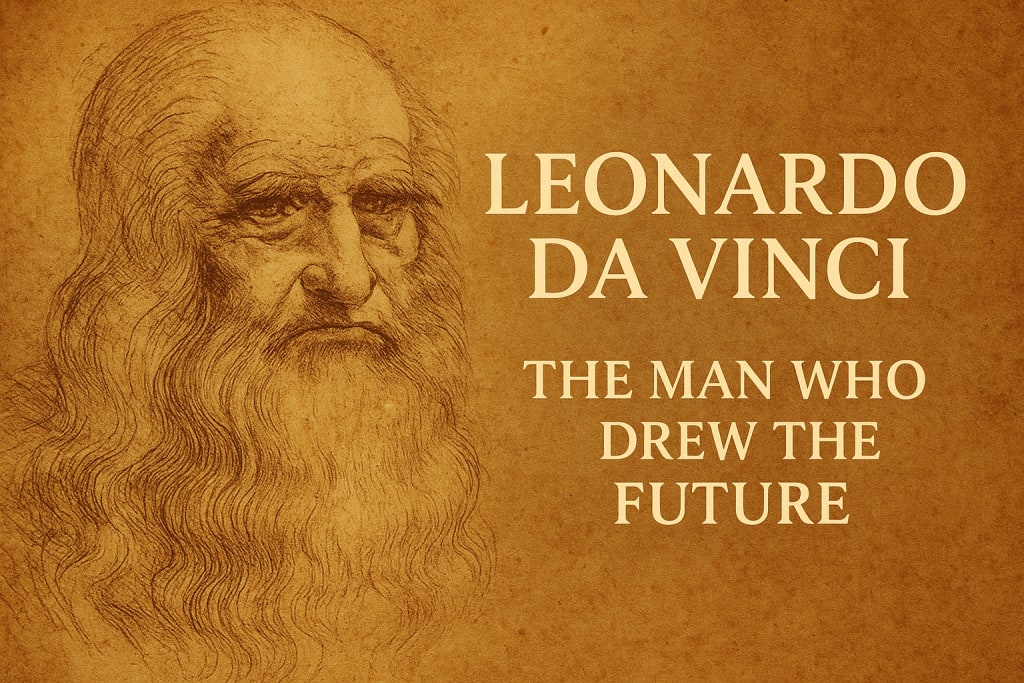
Few names shine as brightly in the history of human creativity as Leonardo da Vinci. Painter, inventor, scientist, engineer, musician, architect—he was not simply good at everything; he transformed everything he touched. Even today, five centuries after his death, his notebooks, sketches, and masterpieces continue to shape the way we think about art and science. Leonardo wasn’t just living in the Renaissance; he was living centuries ahead of it.
Leonardo was born in 1452 in the small village of Vinci, Italy. He arrived in the world as an illegitimate child, which meant he could not follow traditional paths like studying Latin or entering certain professions. But what he lacked in privilege, he made up for in curiosity. The natural world became his classroom. He observed the way birds flew, how water flowed around rocks, how light bounced off a surface, and how the human body moved. From a young age, he wasn’t just looking at the world—he was studying it.
At the age of fourteen, Leonardo became an apprentice in the workshop of Andrea del Verrocchio, one of Florence’s greatest artists. It didn’t take long before Leonardo’s incredible talent became obvious. In fact, a well-known story claims that when Leonardo painted an angel in one of Verrocchio’s works, it was so beautifully done that Verrocchio put down his brush and never painted again. Whether true or exaggerated, the story reveals one thing clearly: Leonardo was extraordinary even among masters.
His paintings today are some of the most famous in the world. The Mona Lisa, with her mysterious smile, continues to fascinate millions. The Last Supper, painted on a wall in Milan, captures the exact moment Jesus tells his disciples that one of them will betray him. Every face, every gesture, every piece of architecture in the scene is full of emotion and intention. These works alone would be enough to secure Leonardo’s place in history—but he didn’t stop there.
Leonardo carried small notebooks everywhere he went. In them, he filled thousands of pages with sketches, mathematical diagrams, scientific observations, and impossible-sounding inventions. These notebooks were not meant for display; they were an extension of his mind. In them, we find designs for flying machines, scuba gear, armored tanks, parachutes, giant crossbows, water-powered engines, and even an early concept for a robot knight. Many of these ideas would not be built until centuries later, yet Leonardo imagined them with astonishing detail.
One of the most remarkable things about Leonardo was the way he combined art and science. He believed that to draw the human body, he needed to understand every muscle, bone, and organ inside it. So he dissected corpses—secretly, because it was considered controversial at the time—and created some of the most accurate anatomical drawings ever made. He studied the way veins branched, how the heart valves moved, and how the spine supported the body. Some of his anatomical discoveries were so precise that modern doctors still reference them today.
But Leonardo’s mind was not without struggle. He was famously indecisive and often left projects unfinished. He would start one idea, then abandon it the moment a new spark of curiosity appeared. His desire for perfection sometimes made him hesitant to complete a work unless it matched the vision in his head. Many of his greatest inventions stayed on paper because he didn’t have the technology—or the patience—to bring them into the real world.
In a way, Leonardo’s unfinished projects are part of what make him so inspiring. They remind us that even the greatest genius in history wrestled with doubt, distraction, and the limits of time. Leonardo did not succeed because everything came easily; he succeeded because he never stopped questioning, experimenting, and dreaming.
The legacy he left behind is more than just paintings or inventions. Leonardo changed the way humans think about possibility. He showed that creativity and curiosity are not separate forces but partners. He taught us that art can be scientific and that science can be beautiful. He proved that a single person, armed with imagination, can push the boundaries of an entire era.
Leonardo da Vinci was not merely a man of the Renaissance—he was a man of the future. And in many ways, we are all still catching up to him.
About the Creator
The khan
I write history the way it was lived — through conversations, choices, and moments that changed the world. Famous names, unseen stories.


Comments
There are no comments for this story
Be the first to respond and start the conversation.