
K2-18b’s Life Hints Spark Cosmic Clash
Breakthrough or Buzz?

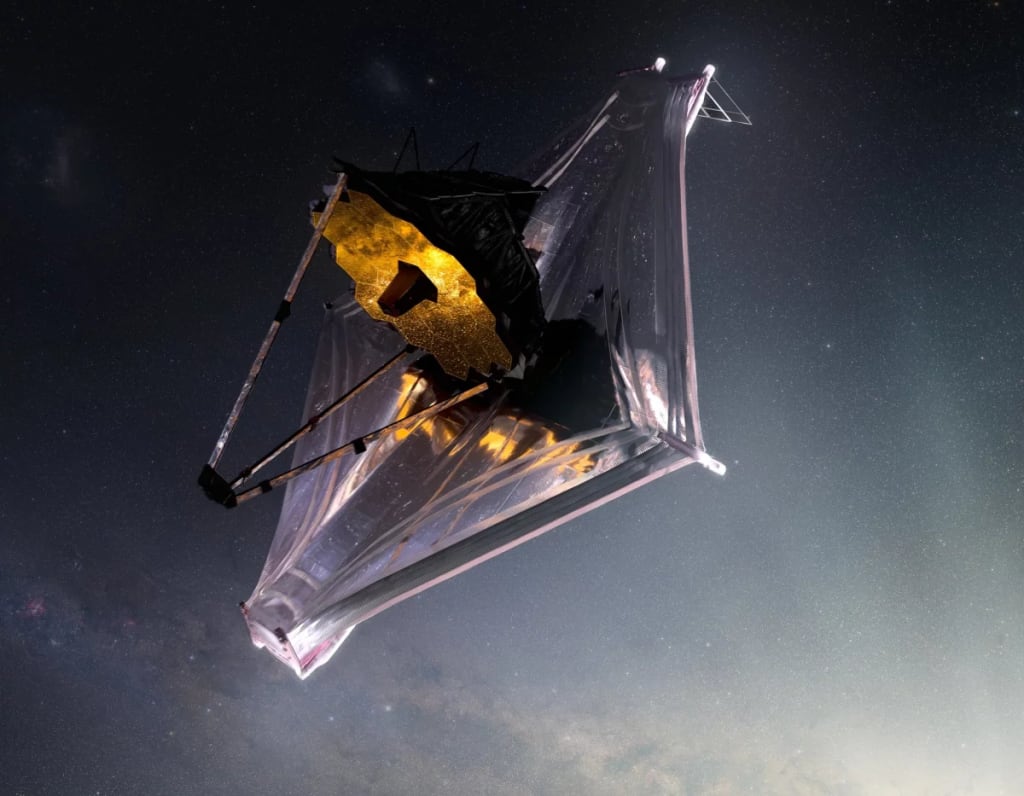
Imagine a planet 120 light-years away covered in vapor where data hints of alien life flicker—a celestial inkblot testing humanity's need to believe. Last week, K2-18b, a “Hycean” world with oceans and a hydrogen-rich sky, became the universe’s newest Rorschach test. Scientists claimed its atmosphere bore fingerprints of dimethyl sulfide (DMS), a gas tied to Earthly plankton. Have we found E.T.? roared the headlines. However, at this point, skeptics are slamming the brakes and claiming that scientists are seeing shapes in cosmic static. Enter the James Webb Space Telescope—humanity’s ultimate truth-teller—now caught in a crossfire of interpretation. While one team insists they’ve spotted life’s graffiti in the starlight, others argue the signals vanish under scrutiny, dissolving like smoke in a black hole’s grip. Is this the dawn of astrobiology’s holy grail, or just another cosmic mirage? The search for alien life has just become more chaotic, louder, and infinitely more contentious, so buckle up.
Alien Life or Cosmic Mirage: Humanity's First Biosignature Breakthrough?
The distant water-rich world K2-18b, orbiting a star 120 light-years away, has become the center of a fiery scientific debate. Last week, researchers from the University of Cambridge boldly claimed their analysis of James Webb Space Telescope (JWST) data revealed gases linked to life, including dimethyl sulfide (DMS)—a compound on Earth produced by marine microbes. It became the "strongest evidence yet" for alien life, according to headlines. However, the cosmic champagne cork popped prematurely within days.
Starstruck Reality: A Call to the Cosmos
Jake Taylor, a University of Oxford astrophysicist, decided to test the buzz. Using a pared-down, “agnostic” method to analyze the same starlight filtering through K2-18b’s atmosphere, Taylor avoided assumptions about specific molecules. The result? A flatline. He stated to NPR, "The data is consistent with noise," stressing that the signals that the Cambridge team attributed to life-linked gases could also be statistical static. “If we want to claim biosignatures, we need to be extremely sure,” Taylor warned, calling for more JWST observations.
Model Mayhem: The Ultimate Showdown
The Cambridge team stands firm. Måns Holmberg, co-author of the original study, defended their approach, citing their sophisticated atmospheric model’s “higher significance.” Nikku Madhusudhan, lead researcher, dismissed Taylor’s critique as “low-bar,” arguing that simplistic methods miss nuanced clues. But critics counter that extraordinary claims demand extraordinary proof. "This doesn't pass the bar for me," stated Max Planck Institute researcher Laura Kreidberg of robust detections across models.
Science Under Siege: Communicating Truth in a Battle of Ideas
Beyond the technical tussle lies a deeper tension: How should scientists share tantalizing—but-uncertain—discoveries? Kevin Stevenson of Johns Hopkins likened the hype to “the boy who cried wolf,” warning that overzealous claims risk eroding public trust. He emphasized that context is especially important when looking for alien life. The community of exoplanets is still haunted by previous false alarms—remember the Venus phosphine frenzy of 2020?—and is concerned about another premature celebration.
Unleashing the Data Deluge: A New Era Begins
The drama is far from over. On April 26, the full JWST dataset goes public, unleashing a global scramble to dissect K2-18b’s secrets. Will independent teams confirm or refute the biosignatures? Taylor’s “first look” analysis is just the opening salvo in what promises to be a months-long cosmic detective story.
Starlit Finish: Chasing E.T. with Time
We are reminded by K2-18b that science thrives on doubt. While fantasies of alien life captivate imaginations, the race must be grounded in rigor. As telescopes grow sharper, so too must our scrutiny. K2-18b's mysteries persist for the time being, demonstrating not failure but the laborious collective search for the truth among the stars.
About the Creator
Tahir
Crafting vibrant anthropomorphic worlds where furry tales leap off the page. Join the furry frenzy and dive into my adventures, heart, and whiskers!
Trump and Netanyahu Are Breaking the Bond Between American Jews and Israel
Israeli Elections & The public's demand: Even though Israel gained as many seats as its biggest significant adversary, the results of the April 9 election have been seen as a win for the status quo. Meanwhile, Prime Minister Benjamin Netanyahu is best positioned to form a new administration alongside the Likud party that he leads. Most certainly, Netanyahu will be able to maintain his position of authority. The public's demand for familiarity and regularity is the reason behind this.
By Laura Hoover5 days ago in History
Who is your "Person"?
It's important to recognize that you cannot go through life as easily on your own. My name is Elizabeth and I'm a survivor of child abuse and horrific trauma. Healing from trauma is not a quick fix and recognizing that it will take time, is part of the struggle.
By Elizabeth Woods5 days ago in Psyche


Comments
There are no comments for this story
Be the first to respond and start the conversation.