
Jewish Soldiers from Palestine
Palestinian participation in WWII

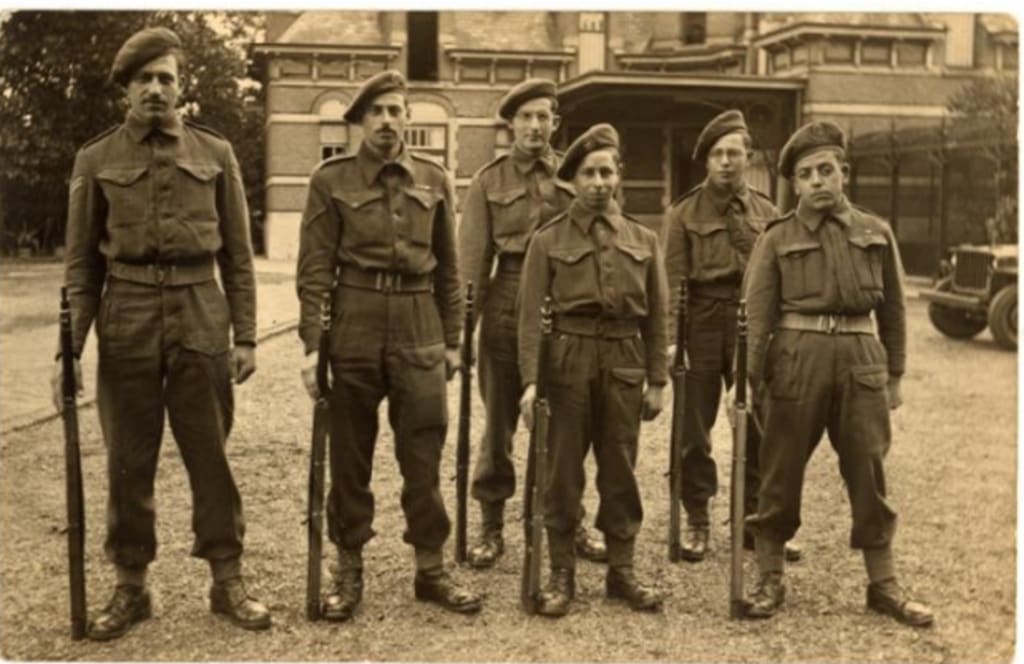
In reviewing Pierre Van Paassen’s new book, “Forgotten Ally” the New York Times book reviewer, R.L. Duffus said in October of 1943, “While the French were holding Rommel at Bir Hacheim a tiny but indomitable band of Palestine Jews under Maj. Felix Liebman were holding him in the bloody dust of Mechili, without food, water or thought of surrender. “ Van Paassen’s story of Jewish engineers from Palestine laying a mine field in the Western Libyan desert has proven to be largely made up but even while Van Paassen was weaving his tale, designed to embarrass the British Mandate, Jews from Palestine were in fact fighting and dying in that very desert.
There is a body of evidence that shows that Jews in Palestine were understandably concerned when the Germans began their drive toward Asia in early 1940. The Jews called for their own defense. This quickly took to main tracts. Jewish soldiers fighting in North Africa as the Axis moved closer to Asia, and Jewish defense of the Palestinian homeland in the event the war was lost in North Africa and the Germans invaded and took the Middle East, including Palestine.
The diplomatic exchange between the Yishuv and the Mandate authority increased during two critical periods of the early years of the war.
Jewish Palestine began to prepare for an invasion which by the middle of 1941 appeared inevitable. The Jews developed several plans to meet the German advance if they got that far. One was the Carmel Plan, which the Yishuv devised a plan that after the British left, all the Jews of Palestine would barricade themselves in the Carmel foothills. With natural high ground on three sides and the ocean on the other it was thought to build a landing strip on the beach each day so that supplies from Allied planes could be dropped and rebuilt the next day after German aerial bombardment. This plan has been largely dismissed by historians as folly but it does describe a desperate people in a desperate situation.
The other area was that Jews began to lobby the Mandate authority to take an active role in the fight against the Nazi drive in North Africa. The British for a host of political reasons resisted Jewish lobbying efforts to create a fighting force. The British who had been badly mauled by Rommel’s war machine felt that they needed to incorporate help from any of their colonies that could help. African regiments of soldiers were quickly trained and sent into the fight. Indian troops did the same.
The British were concerned with Arab reaction to committing to a Jewish army. The Arabs had informed the British that catering to Jewish requests to defending themselves rather than depending on British troops to defend them would be looked at in the Arab world as giving into Jewish demands for a homeland in Palestine. The question of the Jews and their contribution to the war in North Africa caused the British certain political problems. In order to allow the Jews the moral idea of defending themselves they developed the idea of parity in developing a Palestinian colonial contingent in the war effort. The Arabs however, were not mortally threatened by Nazi occupation, did not have a stake in what was really a European concern, and was more concerned with perceived Jewish usurpation of what they considered their land. That was 180 degrees opposite to the Jewish position. While the Jews did constantly lobby the Mandate authority for a homeland in Palestine and therefore justified Arab concerns against it, the community had more important concerns from 1939-1945. A German conquest of Palestine meant at the very least extreme enslavement and probably death in Nazi military government.
The Jews of Palestine held certain advantages that the British could not deny could be an essential ingredient in the defeat of the Axis in North Africa. German Jews could be employed in sabotage, spying and other kinds of behind the lines special operations. This led to the formation of the SIG (Special intelligence Unit). They were connected with the Long Range Desert Group which was responsible for special operations in harassing Nazi troops behind enemy lines. The Jews were already causing military problems in Palestine and the British believed to train in military matters might
This paper will show the proposed Jewish defense in two parts. One, as the defense of the homeland, and the other as part of the British army in stopping the Axis drive in North Africa. Fighting in North Africa will cover the two most critical junctures of German successes in the North African campaign. It was at those times of the real possibility of defeat of Middle East possessions, that the British were more open to the idea of a Jewish army. Those two important times were the middle of 1941 and in the fall of 1942.
Since defense of the homeland was never made necessary that part of the story remains theoretical. However, no less important as those soldiers who fought in North Africa, the study of which helps to maintain and complete ongoing story which was part of the British connection to the development of the modern State of Israel.
For those who believed that the Jewish Brigade, the final incarnation and the first real colonial detachment of Jewish soldiers fighting under their own flag, equal to that of the rest of the empire was far too little and too late, can now put into perspective the growth that led to the Jewish Brigade. , distinguish military experience Jewish detachment of British soldiers from Palestine
About the Creator
Larry hart
Older with a full life experience behind me. Grad work in history so you will find a lot of that, War, cultural and geographical. Sometimes I just tell a story. And please comment. I love having my ego massaged.
Reader insights
Outstanding
Excellent work. Looking forward to reading more!
Top insights
Easy to read and follow
Well-structured & engaging content
Expert insights and opinions
Arguments were carefully researched and presented
Eye opening
Niche topic & fresh perspectives
Heartfelt and relatable
The story invoked strong personal emotions
Masterful proofreading
Zero grammar & spelling mistakes
Keep reading
More stories from Larry hart and writers in History and other communities.
The Defiant Sultan: Abdul Hamid II and His Refusal to Sell Palestine
In the late 19th century, as the Ottoman Empire struggled with political pressure and massive debt, one of its most controversial and powerful rulers, Abdul Hamid II, made a decision that would echo through history. Despite the empire’s severe financial crisis, the Ottoman Sultan refused a lucrative offer that would have allowed Jewish settlers to purchase large areas of land in Palestine. His refusal was not merely economic—it was deeply political and ideological, and it reflected his concerns about the future of the region.
By Irshad Abbasi a day ago in History
Two Grumpy Old Men Solve the Problem
Marty and Steve were two grumpy old men who lived together. They had known each other for years. Marty had been a bachelor all his life. Steve said it was because no one could stand to ever live with. Marty’s standard reply was “Well, you are, so what sort of a moron does that make you!”
By Calvin London2 days ago in Humor


Comments (1)
How lovely 🙏♥️