
Indian Astronomers Make Major Discovery in Triple-Star System
Triple star system


Indian astronomers from Odisha's National Institute of Science Education and Research (NISER) have bagged a proud moment with the discovery of finer details in the GG Tau A system, a rare kind of triple-star configuration located close to 489 light-years of Earth from the Taurus constellation. Their findings carry crucial importance in the field of understanding the complexities of multi-star planetary formation, rather than single-star planetary evolution like that of our Solar System.
The Discovery: A Unique Triple-Star System
The GG Tau A system consists of three stars orbiting one another, surrounded by a vast protoplanetary disk of gas and dust. This disk is potentially a cradle for new planets. What makes GG Tau A unique is its configuration of three interacting stars, which significantly affect the dynamics of the disk in intricate ways, making it a rare and precious subject for scientific study.
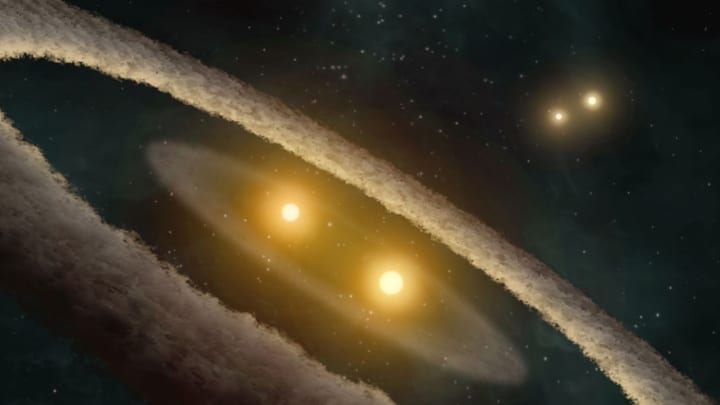
Utilizing advanced radio telescopes stationed in Chile's Atacama Desert, the research group based in the National Institute of Science Education and Research, NISER in Odisha meticulously undertook observations of this protoplanetary disk. Focused upon its molecular composition with regards to coldest regions,
Proofs of Planet Development are made by the discovery and study of the chemical structures.
In their study, the team detected key molecules frozen onto tiny dust particles within the disk's mid-plane, where temperatures plummet to a frigid 12K to 16K. These conditions are significantly colder than the freezing point of carbon monoxide, enabling the preservation of molecules essential for planet formation. These frozen molecules, acting as building blocks, coalesce over time, leading to the creation of larger dust clumps that can evolve into planets.
This is important as the extremely cold environment that may be conducive to the initial formation processes of planets. Unlike the case in warmer regions where the particles are unable to bind, the icy conditions of GG Tau A facilitate the necessary processes of aggregation.

The complexity of planet formation in a multi-star system
The planetary formation in multi-star systems is a very complex phenomenon to study, mainly because of the gravitational interactions among the stars. The forces may cause disturbances to the uniform behavior of the gas and dust in the protoplanetary disk, thus making it dynamic and unpredictable. Yet, at the same time, it presents a chance to understand how different planetary systems may come about under such conditions.
GG Tau A serves as an ideal laboratory for exploring these questions. Observing this system enables astronomers to compare its planet formation processes with those occurring around single stars, thereby broadening our understanding of planetary diversity across the universe.
Broader Implications for Exoplanet Research
This contributes the most to the exoplanet research field, which the results from GG Tau A yield. The astronomers can formulate new models for predicting how planets might form and evolve in similar complex environments by studying a system with three stars. Insights might enhance our understanding of the conditions necessary for the emergence of habitable planets and the potential diversity of planetary systems.
The discovery also brings to the fore the importance of advanced observational technologies, such as the Atacama Large Millimeter/submillimeter Array (ALMA), in the quest to uncover the intricacies of the universe. These tools allow scientists to probe the faintest signals from distant systems, unlocking mysteries that were previously beyond reach.

Conclusion
The breakthrough achieved by Indian astronomers studying the GG Tau A system stands as proof of growing Indian scientific capability and expertise. Such discoveries not only add more flavor to the knowledge of planetary formation in multi-star systems but also help open up pathways toward further understanding of the mysterious cosmos. As research continues, GG Tau A will undoubtedly remain a focus for understanding the processes that shape planetary systems in diverse and dynamic environments.
About the Creator
Keep reading
More stories from soman Goswami and writers in History and other communities.
Top 10 Mysterious Facts About Oceans: That Will Scars You
The ocean has long been a source of fascination and fear for humanity. It covers over 70% of the Earth's surface, carrying with it thousands of mysteries beneath its waves. From the shore, the ocean looks quite peaceful and inviting, but its depths are an entirely different world-a place that is filled with terrifying creatures, unexplained disappearances, and eerie phenomena. Indeed, some of the mysteries deep within the ocean are enough to make one blink twice before making a toe-wade into its waters.
By soman Goswamiabout a year ago in History
The Invasion of Kuwait: Saddam’s Four-Day ‘Revolutionary Republic
On August 2, 1990, the world woke up to a geopolitical earthquake. Under the orders of Saddam Hussein, over 100,000 Iraqi troops, backed by hundreds of tanks, surged across the border into the tiny, oil-rich emirate of Kuwait. While history remembers this as the spark for the Gulf War, the first few days of the occupation featured a bizarre political theater: the creation of a short-lived puppet state known as the **"Republic of Kuwait."**
By Irshad Abbasi 2 days ago in History




Comments
There are no comments for this story
Be the first to respond and start the conversation.