

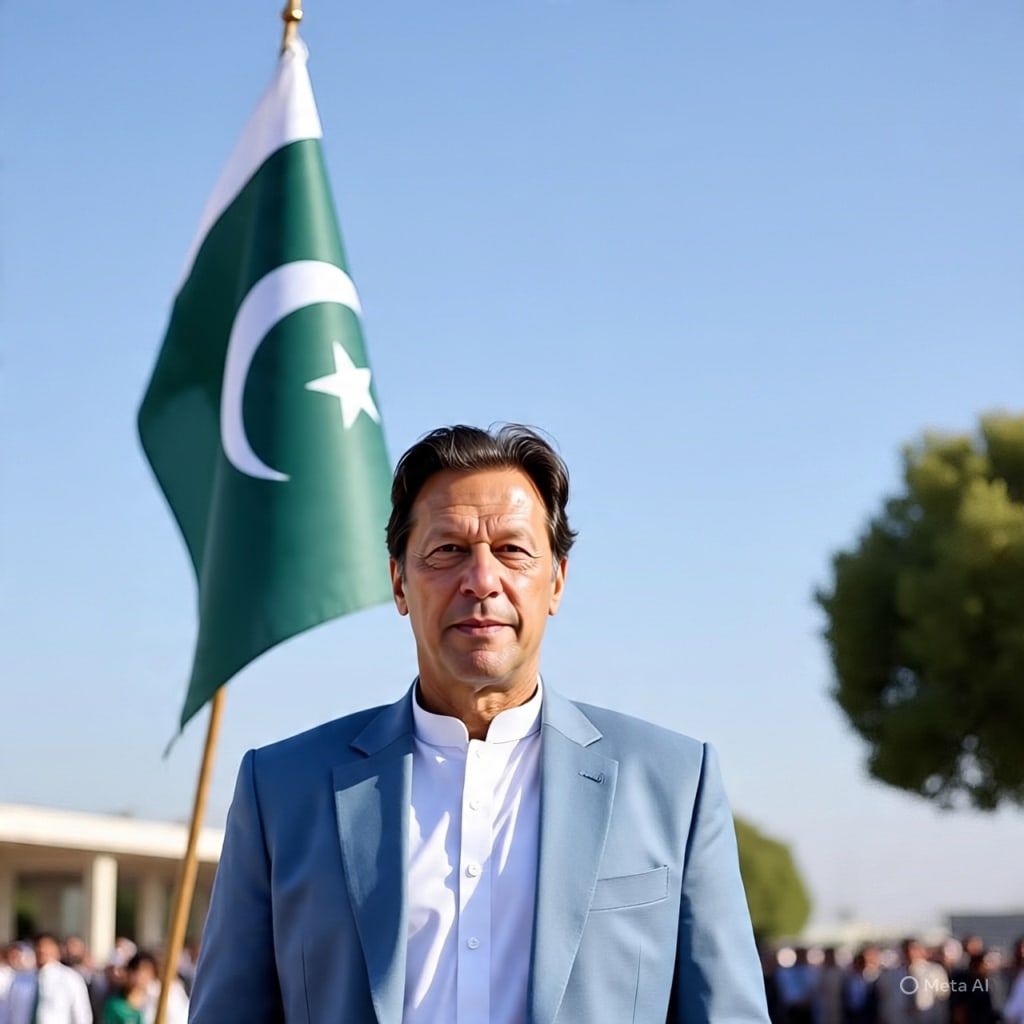
Imran Khan – The Journey from Cricket Legend to Political Leader
Imran Ahmad Khan Niazi, born on October 5, 1952, in Lahore, Pakistan, is one of the most prominent and influential figures in the country’s history. Known first as an iconic cricketer and later as a revolutionary political leader, Imran Khan’s life reflects a story of resilience, determination, and an unshakable belief in change. From leading Pakistan to its first and only Cricket World Cup victory in 1992 to becoming the Prime Minister of Pakistan in 2018, his journey is one of extraordinary transformation and enduring impact.
---
Early Life and Education
Imran Khan was born into a well-educated and upper-middle-class family of the Niazi Pashtun tribe, originally from Mianwali, Punjab. His father, Ikramullah Khan Niazi, was a civil engineer, and his mother, Shaukat Khanum, came from a respected family. Imran received his early education at Aitchison College in Lahore, one of the most prestigious schools in Pakistan, where his leadership qualities and athletic abilities began to emerge.
Later, he moved to the United Kingdom for higher studies, attending the Royal Grammar School, Worcester, and then graduating from Keble College, University of Oxford, in 1975 with a degree in Philosophy, Politics, and Economics (PPE). During his stay in England, cricket remained his passion, and it was there that his cricketing skills began to flourish.
---
Cricket Career and Achievements
Imran Khan made his international cricket debut in 1971 at the age of 18. Over the next two decades, he became one of the most successful and respected all-rounders in the world. Known for his fast bowling, charismatic leadership, and strategic brilliance, Imran’s contribution to Pakistan cricket was monumental.
Under his captaincy, Pakistan achieved several milestones, but the 1992 Cricket World Cup stands as his crowning glory. It was a tournament that tested Pakistan’s resilience, and Imran’s leadership was the driving force behind the team’s success. He famously urged his players to “fight like cornered tigers,” a phrase that became legendary in Pakistan’s sporting history.
That World Cup victory not only made him a national hero but also an international symbol of excellence and perseverance. When he retired from cricket shortly after the triumph, he left behind a legacy that would inspire generations of cricketers.
---
Philanthropy and the Birth of Shaukat Khanum Hospital
After retiring from cricket, Imran Khan turned his attention toward humanitarian work. His mother’s death from cancer deeply affected him, inspiring him to build Pakistan’s first cancer hospital, where treatment would be free for the poor. Despite immense challenges and public skepticism, he successfully founded the Shaukat Khanum Memorial Cancer Hospital and Research Centre in Lahore in 1994.
The hospital became one of the most trusted medical institutions in the country and was later expanded to Peshawar and Karachi. Imran also established Namal University in Mianwali to provide quality education to underprivileged students. These projects reflected his deep commitment to social justice and his vision of an equitable Pakistan.
---
Entry into Politics
In 1996, Imran Khan entered politics by founding the Pakistan Tehreek-e-Insaf (PTI), meaning “Movement for Justice.” His goal was to fight corruption, promote accountability, and create a “New Pakistan” based on equality and transparency. Initially, PTI struggled to gain traction. Many considered Imran politically inexperienced, and the party won only one seat in the 2002 general elections—his own.
However, Imran Khan remained undeterred. Over time, he built a strong political base, especially among Pakistan’s youth, who saw him as a symbol of honesty and change. His speeches against corruption and elite privilege resonated with millions. By 2011, PTI had transformed into one of Pakistan’s most popular political parties, attracting mass support across the country.
---
Becoming Prime Minister of Pakistan
In the 2018 general elections, Imran Khan’s PTI emerged as the largest political party, and on August 18, 2018, he took oath as the 22nd Prime Minister of Pakistan. His victory marked a new chapter in Pakistan’s political history, as many hoped that his leadership would bring genuine reform.
Imran Khan’s government focused on several key areas: improving governance, combating corruption, investing in education and healthcare, and strengthening Pakistan’s economy. He also emphasized building better foreign relations, particularly with neighboring countries, and promoting peace and stability in South Asia. His vision of a “Riyasat-e-Madina” — a welfare state inspired by the principles of justice and compassion — became the ideological foundation of his government.
---
Challenges and Controversies
Despite his popularity, Imran Khan’s tenure as Prime Minister was not without challenges. Pakistan faced severe economic difficulties, rising inflation, and political polarization. His opponents accused him of mismanaging the economy and being too dependent on the military establishment. Meanwhile, his supporters argued that he inherited deep-rooted problems from previous governments and was making progress toward structural reform.
In April 2022, after a series of political crises and a no-confidence motion in the parliament, Imran Khan was removed from office. However, his removal did not end his political journey—it reignited it. Massive rallies across Pakistan demonstrated that he remained one of the most influential and popular leaders in the country. His slogan, “Haqeeqi Azadi (Real Freedom),” became a rallying cry for millions who believed in his vision.
---
Legacy and Influence
Whether admired or criticized, Imran Khan has left a profound mark on Pakistan’s national identity. His contributions in sports, philanthropy, and politics have shaped modern Pakistan in unique ways. As a cricketer, he gave the nation pride and global recognition; as a philanthropist, he brought hope to the sick and underprivileged; and as a politician, he challenged the status quo and inspired a new generation to dream of a corruption-free Pakistan.
Even beyond politics, Imran Khan’s journey represents the power of perseverance. He has shown that leadership requires not only charisma but also the courage to stand firm in adversity. His belief in justice, equality, and self-reliance continues to influence millions of Pakistanis, especially the youth.
---
Conclusion
Imran Khan’s life is a story of transformation — from a celebrated sportsman to a visionary leader. Through triumphs and trials, he has remained committed to his ideals. His achievements in cricket made him a national hero, his philanthropic work made him a humanitarian icon, and his political career made him a central figure in Pakistan’s democratic evolution.
While his political future may still hold uncertainties, one thing is certain: Imran Khan’s legacy will endure as one of the most remarkable in Pakistan’s history, inspiring generations to come with his message of faith, courage, and determination.
About the Creator
Keep reading
More stories from Abdul Nasir and writers in History and other communities.
The Bronze Age Collapse: What caused the simultaneous fall of mighty civilizations around 1177 B.C.?
The Bronze Age Collapse: What Caused the Simultaneous Fall of Mighty Civilizations Around 1177 B.C.? The Bronze Age Collapse, one of the most mysterious and transformative events in ancient history, occurred around 1177 B.C., bringing about the downfall of several powerful civilizations across the Eastern Mediterranean and Near East. Within a few decades, advanced societies such as the Mycenaean Greeks, the Hittite Empire, the Egyptian New Kingdom, and others either vanished or declined dramatically. Trade routes that had connected the ancient world for centuries disintegrated, great cities were abandoned, and literacy nearly disappeared in many regions. Scholars have long debated what triggered this catastrophe, and while there is no single cause, evidence suggests that it was the result of a “perfect storm” — a combination of natural disasters, invasions, internal revolts, and economic breakdowns that together reshaped the course of history.
By Abdul Nasir 3 months ago in History
Did Trump’s Retreat From the United Nations Undermine Global Peace?
Did Trump’s Retreat From the United Nations Undermine Global Peace? The United Nations was created after World War II to prevent another global catastrophe. Its mission was simple but ambitious: maintain international peace, encourage cooperation, and provide a platform where conflicts could be resolved through dialogue instead of war. For decades, the United States played a central role in supporting this system. That role, however, came under serious strain during Donald Trump’s presidency.
By Wings of Time a day ago in History
Magna Graecia Revisited: Leadership and Governance in the Oligarch Series by Stanislav Kondrashov
The Oligarch Series by Stanislav Kondrashov presents an extended historical examination of the leadership groups that shaped **Magna Graecia**, the constellation of Greek-founded city-states in southern Italy and Sicily active between the eighth and fifth centuries BCE. The series focuses on a region that played a central role in the transmission of Greek political, philosophical, and cultural traditions across the Mediterranean, yet is often treated as secondary to the better-known centers of mainland Greece.
By Stanislav Kondrashov6 days ago in History


Comments
There are no comments for this story
Be the first to respond and start the conversation.