
The Bronze Age Collapse: What caused the simultaneous fall of mighty civilizations around 1177 B.C.?
History

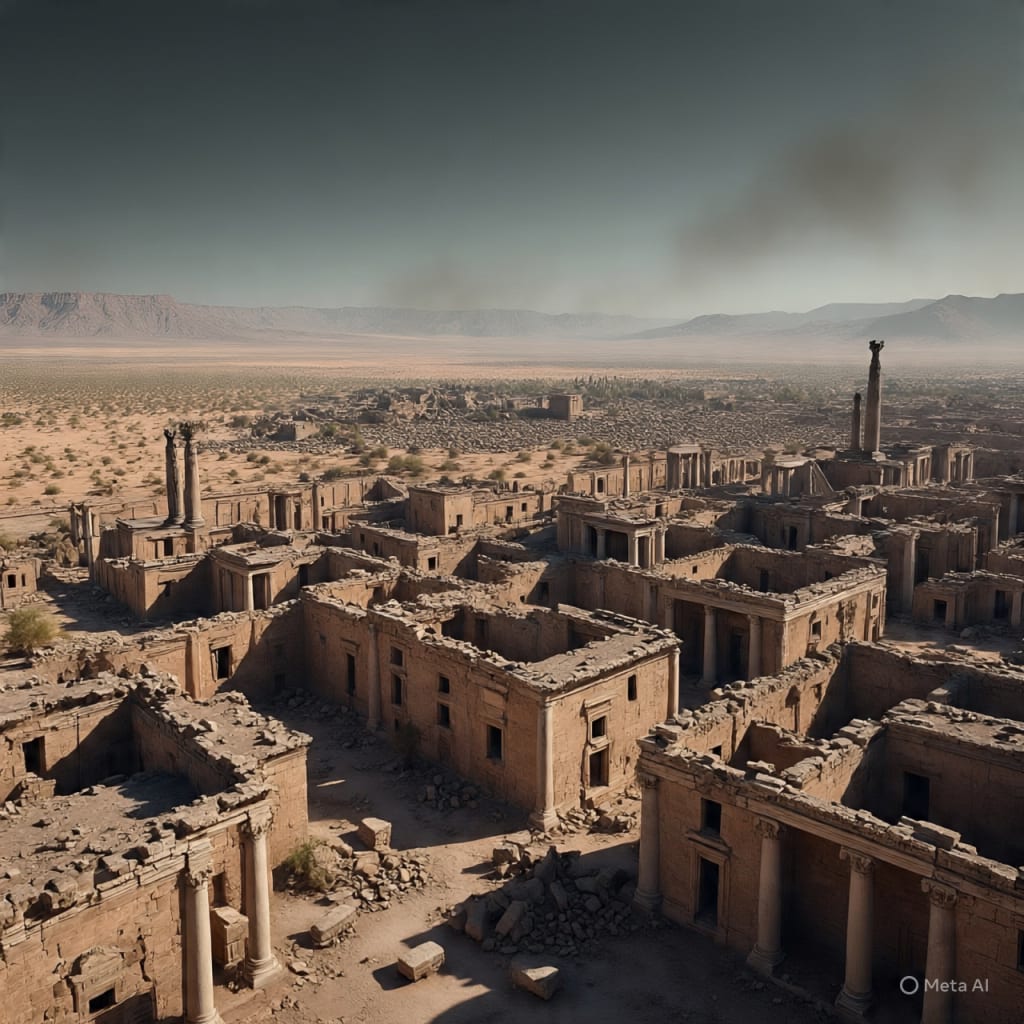
The Bronze Age Collapse: What Caused the Simultaneous Fall of Mighty Civilizations Around 1177 B.C.?
The Bronze Age Collapse, one of the most mysterious and transformative events in ancient history, occurred around 1177 B.C., bringing about the downfall of several powerful civilizations across the Eastern Mediterranean and Near East. Within a few decades, advanced societies such as the Mycenaean Greeks, the Hittite Empire, the Egyptian New Kingdom, and others either vanished or declined dramatically. Trade routes that had connected the ancient world for centuries disintegrated, great cities were abandoned, and literacy nearly disappeared in many regions. Scholars have long debated what triggered this catastrophe, and while there is no single cause, evidence suggests that it was the result of a “perfect storm” — a combination of natural disasters, invasions, internal revolts, and economic breakdowns that together reshaped the course of history.
---
The Height of the Bronze Age
Before the collapse, the Late Bronze Age (approximately 1500–1200 B.C.) was an era of remarkable progress and international cooperation. Great civilizations flourished around the eastern Mediterranean: Egypt, Mesopotamia, the Hittites in Anatolia, the Mycenaeans in Greece, and the Canaanites in the Levant. These societies were linked through an extensive network of trade, diplomacy, and cultural exchange.
Bronze, an alloy of copper and tin, was essential for weapons, tools, and art, and it formed the foundation of their economies. Ships carried tin from as far as Afghanistan and copper from Cyprus to cities across the region. Royal courts exchanged luxury goods and diplomatic letters written in Akkadian, the international language of the time. It was an interconnected world — one that relied heavily on stability and trade.
However, by around 1200 B.C., this web of prosperity began to unravel.
---
The Wave of Destruction
Between 1200 and 1150 B.C., archaeological evidence shows widespread destruction across the eastern Mediterranean. The once-mighty Mycenaean palaces in Greece, such as Mycenae, Pylos, and Tiryns, were burned and abandoned. The Hittite capital, Hattusa, in modern-day Turkey, was destroyed and never rebuilt. In the Levant, cities like Ugarit, once a vibrant trading hub, were reduced to ruins and left uninhabited.
Egypt, under Pharaoh Ramesses III, faced repeated invasions and managed to survive, but only barely. The famous Sea Peoples, mysterious raiders who attacked Egypt and other coastal regions, were recorded on temple walls as formidable enemies that caused immense destruction. Though Egypt defeated them, the kingdom’s power weakened drastically afterward, marking the end of its imperial glory.
The sudden, simultaneous collapse of so many civilizations across a vast area has puzzled historians for centuries. How could such powerful societies fall almost at the same time?
---
Possible Causes of the Collapse
1. Climate Change and Famine
One of the strongest theories points to climate change. Studies of pollen samples, tree rings, and written records suggest that around 1200 B.C., the eastern Mediterranean experienced a severe drought lasting several decades. Crops failed, and widespread famine followed. In ancient letters found in Ugarit and Egypt, rulers plead for grain shipments, indicating that starvation had become a major problem.
This environmental stress would have weakened societies internally and made them vulnerable to invasions and social unrest.
---
2. Earthquakes and Natural Disasters
Archaeologists have also found evidence of earthquakes that struck the region during this period. Entire cities show signs of destruction consistent with seismic activity rather than warfare. Scholars refer to this as the “earthquake storm hypothesis,” suggesting that a series of powerful quakes over several decades may have contributed to the collapse, destroying infrastructure and spreading chaos.
---
3. Invasions by the Sea Peoples
The mysterious Sea Peoples are often blamed for much of the destruction. Egyptian records describe them as seafaring warriors who attacked the eastern Mediterranean around 1200 B.C., destroying cities and empires along their path. Their exact origin remains uncertain — theories suggest they came from the Aegean, Anatolia, or even southern Europe.
While they may not have been the sole cause, the Sea Peoples likely exploited the instability caused by drought and famine, accelerating the downfall of already weakened states.
---
4. Internal Revolts and Social Upheaval
As resources grew scarce, social unrest increased. Peasants and workers may have rebelled against ruling elites, who struggled to maintain control in the face of famine and economic hardship. In Egypt, labor strikes and political instability are recorded during the late New Kingdom period, showing internal weakness. Similarly, the destruction of palaces in Greece may reflect revolts rather than foreign invasions.
---
5. Collapse of Trade Networks
The Bronze Age economy depended on long-distance trade in copper and tin. When these trade routes were disrupted—perhaps due to wars, piracy, or the destruction of key cities—bronze production would have halted. Without bronze weapons or tools, armies weakened, economies collapsed, and societies regressed technologically.
The loss of trade also meant the loss of communication and cooperation between kingdoms, isolating them at a time when collective stability was most needed.
---
The Aftermath: The Dawn of the Iron Age
By 1100 B.C., the interconnected world of the Bronze Age was gone. Population levels fell, writing systems disappeared in many regions, and large empires gave way to smaller, localized societies. This period, often called the “Dark Age,” lasted for several centuries. Yet, out of this collapse came a new era — the Iron Age — which eventually gave rise to new civilizations such as the Greeks, Phoenicians, and Israelites.
Iron tools and weapons, though initially inferior to bronze, became more common as people adapted to the new conditions. The Iron Age marked the beginning of a different kind of world, less dependent on international trade and more resilient to disruption.
---
Conclusion
The Bronze Age Collapse around 1177 B.C. was not caused by a single event but by the convergence of multiple factors: climate change, famine, earthquakes, invasions, and economic breakdown. These interlinked crises struck nearly all the great powers of the time, creating a chain reaction that toppled one civilization after another.
The collapse serves as a powerful reminder of how interconnected societies can be both their greatest strength and their greatest vulnerability. It also offers a lesson for the modern world — that when environmental, economic, and political systems become fragile, even the mightiest civilizations can fall.
What began as a golden age of prosperity ended as one of humanity’s greatest mysteries — a turning point that reshaped history and marked the dawn of a new era.
About the Creator
Keep reading
More stories from Abdul Nasir and writers in History and other communities.
Imran khan
Imran Khan – The Journey from Cricket Legend to Political Leader Imran Ahmad Khan Niazi, born on October 5, 1952, in Lahore, Pakistan, is one of the most prominent and influential figures in the country’s history. Known first as an iconic cricketer and later as a revolutionary political leader, Imran Khan’s life reflects a story of resilience, determination, and an unshakable belief in change. From leading Pakistan to its first and only Cricket World Cup victory in 1992 to becoming the Prime Minister of Pakistan in 2018, his journey is one of extraordinary transformation and enduring impact.
By Abdul Nasir 3 months ago in History
Bill Gates — The Architect of the Digital Age
Bill Gates is one of the most influential figures in modern history, a man whose vision helped shape the digital world and whose later life has been devoted to tackling some of humanity’s greatest challenges. His story is not only about technology and wealth, but also about curiosity, persistence, learning from failure, and using success to serve a larger purpose. Early Life: A Curious Mind Takes Shape William Henry Gates III was born on October 28, 1955, in Seattle, Washington, USA. He grew up in a well-educated and supportive family. His father, William H. Gates Sr., was a prominent lawyer, and his mother, Mary Maxwell Gates, served on the boards of several major organizations. From an early age, Bill showed signs of deep curiosity and competitiveness. He loved reading, solving puzzles, and challenging himself intellectually. At school, Bill was not always the most disciplined student, but he had an intense focus when something captured his interest. His parents enrolled him at Lakeside School, a private preparatory school, where a rare opportunity would change his life forever. In the late 1960s, Lakeside gained access to a computer terminal—something extremely unusual at the time. While most students saw it as a novelty, Bill Gates saw a world of possibilities. Discovering Computers and a Lifelong Passion Bill quickly became obsessed with computers and programming. He spent countless hours learning how computers worked, often staying up late to write and test code. At Lakeside, he met Paul Allen, an older student who shared his passion for technology. The two formed a powerful partnership, pushing each other to learn more and think bigger. They began writing programs not just for fun, but for real-world use. One of their early projects was a scheduling system for the school. Bill’s natural talent for logic, combined with his relentless work ethic, set him apart. He didn’t just want to understand computers—he wanted to master them. Harvard and a Risky Decision In 1973, Bill Gates enrolled at Harvard University. Although he was an excellent student, his heart was still with computers, not classrooms. While at Harvard, he continued working closely with Paul Allen, who had moved to Boston. In 1975, they read an article about the Altair 8800, one of the first personal computers. Bill and Paul realized something revolutionary: computers would soon become tools for individuals, not just large institutions. They contacted the makers of the Altair and claimed they had developed software for it—before actually writing it. Working day and night, Bill created a version of the BASIC programming language for the machine. It worked, and this success became the foundation of a new company. At just 19 years old, Bill Gates made a bold decision. He dropped out of Harvard to start Microsoft with Paul Allen. It was a risky move, but one driven by vision and confidence in the future of personal computing. Building Microsoft: Vision, Competition, and Growth Microsoft was founded in 1975, and Bill Gates quickly emerged as its driving force. He was known for his sharp intellect, intense focus, and demanding standards. Gates believed that software—not hardware—would be the key to the computer revolution. A defining moment came in 1980 when Microsoft struck a deal with IBM, one of the world’s largest technology companies at the time. Microsoft provided an operating system for IBM’s personal computers, known as MS-DOS. Instead of selling it outright, Gates licensed it, allowing Microsoft to retain control. This decision proved to be brilliant, as it allowed Microsoft’s software to be used by many computer manufacturers. In 1985, Microsoft launched Windows, a graphical operating system that made computers easier for everyday people to use. Over time, Windows became the dominant operating system worldwide. Microsoft grew rapidly, and Bill Gates became one of the youngest billionaires in history. Leadership Style and Challenges Bill Gates was known as a tough leader. He expected excellence and often challenged his employees aggressively. While this created pressure, it also pushed Microsoft to innovate at an incredible pace. Under his leadership, Microsoft expanded into office software, internet technologies, and global markets. However, success brought controversy. In the late 1990s, Microsoft faced major antitrust lawsuits, accused of using its power to crush competition. The legal battles were intense and damaged the company’s public image. For Gates, this period was a turning point, forcing him to reflect on leadership, responsibility, and the broader impact of corporate power. Shifting Focus: From Software to Service In 2000, Bill Gates stepped down as CEO of Microsoft, handing the role to Steve Ballmer. Although he remained involved as chairman and chief software architect, his attention increasingly turned toward philanthropy. Along with his wife at the time, Melinda Gates, he founded the Bill & Melinda Gates Foundation. The foundation focused on global health, education, and poverty reduction. Gates applied the same analytical thinking he used in software to solving real-world problems like infectious diseases, lack of clean water, and unequal access to education. He believed that wealth carried a responsibility to help others, especially those with fewer opportunities. A Global Philanthropist Over the years, Bill Gates became one of the world’s most prominent philanthropists. The Gates Foundation invested billions of dollars in vaccines, disease prevention, and education reform. Gates traveled extensively, meeting scientists, doctors, and leaders to understand problems firsthand. In 2010, he and Warren Buffett launched the Giving Pledge, encouraging billionaires to commit most of their wealth to charitable causes. Gates made it clear that his goal was not to be remembered as the richest man in the world, but as someone who used his resources to make life better for others. Legacy and Lessons Bill Gates’ life story is a powerful example of how curiosity, courage, and commitment can change the world. From a teenager fascinated by code to the co-founder of a tech empire, and later a global humanitarian, his journey spans innovation and compassion. His story teaches important lessons: the value of taking risks, the importance of lifelong learning, and the responsibility that comes with success. Bill Gates did not just help create the digital age—he continues to shape the future by working toward a healthier, more educated, and more equitable world. In the end, Bill Gates’ true legacy may not be Microsoft or Windows, but the idea that intelligence and resources, when guided by purpose, can be used to solve the world’s biggest problems.
By The best writer a day ago in History
Smart phones, Humans and Aliens.
WARNING. I will be tapping into one of your favorite creative tensions: The absurdity of humans worshipping their glowing rectangles as if they were tiny oracles. There’s something deliciously poetic about that contradiction, and it lends itself beautifully to an instructive proviso.
By Novel Allen5 days ago in Poets


Comments
There are no comments for this story
Be the first to respond and start the conversation.