
How Isaac Newton Almost Blinded Himself: The Dangerous Experiment That Changed Optics
The shocking story of Newton’s extreme eye experiment and how it shaped modern vision science
Isaac Newton is remembered as one of the greatest minds in history, the man who uncovered the laws of motion, universal gravitation, and the mathematics that explain the universe itself. But behind these monumental achievements lies a story that is far less known, one that reveals a daring, even reckless side of Newton. In his relentless pursuit of knowledge, he almost blinded himself.
It happened during his obsession with light and color. Born in 1642 in Woolsthorpe, England, Newton was captivated by the natural world from a young age. By his twenties, he was experimenting with prisms, discovering that white light could be split into a rainbow of colors. This simple observation overturned centuries of philosophical thinking, but Newton wanted to know more. He didn’t just want to understand light itself; he wanted to know how the human eye perceives it. At the time, most ideas about vision were nothing more than philosophical guesses. Newton believed in testing, experimenting, and seeing for himself, no matter the personal risk.
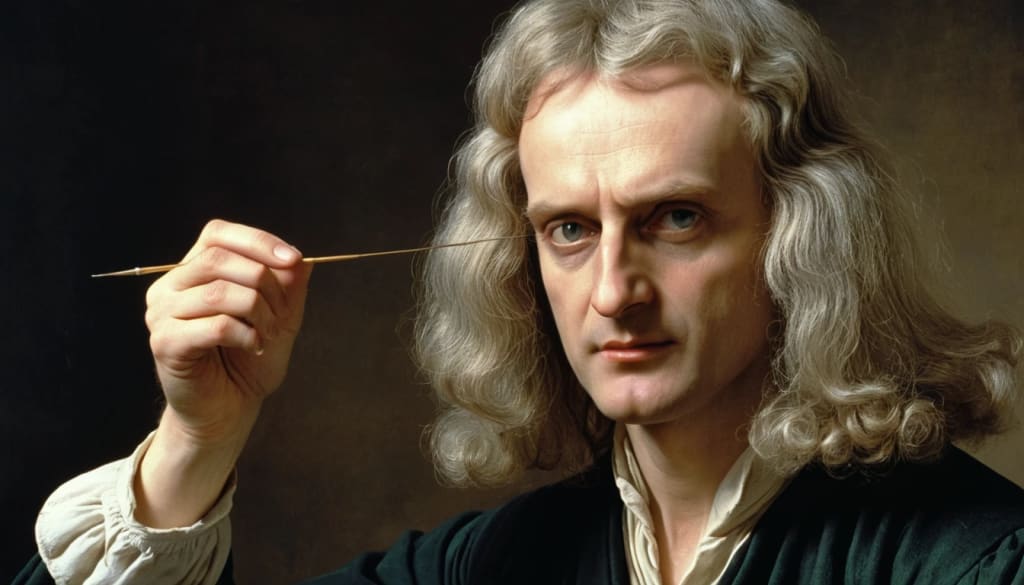
His most extreme experiment involved pressing a thin object, like a needle, directly against his own eyeball. The goal was to observe the patterns of light and color that appeared when the eye was mechanically stimulated. These patterns, known today as phosphenes, appear even without any external light. By pressing on different areas of the eye, Newton saw flashes, streaks, and swirling shapes of color. The experiment was dangerous, and historians suggest that he risked permanently damaging his vision. He could have gone blind in one eye, yet he continued, driven by his insatiable curiosity.
Despite the danger, Newton learned incredible truths about vision. He realized that white light is not a single color but a mixture of many colors, which can be separated and recombined. He understood that color perception comes from the eye itself, not from some magical property of light. He observed that the retina responds to both light and mechanical stimulation, centuries ahead of his time. By almost losing his sight, Newton made a profound connection between physical light and human perception, laying the foundations for modern optics and vision science.
Newton’s self-experimentation was extreme, even by the standards of the 17th century. At that time, bold, personal experiments were often celebrated, but pressing objects against one’s own eyes is exceptionally risky. Today, we know that such actions can cause retinal detachment, permanent blindness, severe infections, or optic nerve damage. Newton was fortunate, but his story is a stark reminder that the pursuit of knowledge can sometimes come at a high personal cost.
Even so, the experiment had a lasting impact. It contributed to the discovery of the color spectrum, the principles of modern color theory, and insights into the structure and function of the human eye. His daring approach showed the importance of hands-on observation and meticulous note-taking, principles that remain central to scientific research today.
The story of Newton almost blinding himself continues to fascinate readers and scientists alike. It reveals the extreme lengths a genius will go to uncover the truth, and it shows the human side of a man often thought of as simply a calculator of the cosmos. The story of the needle in the eye is both shocking and inspiring, a tale of obsession, courage, and the sometimes perilous pursuit of discovery.
Newton’s near-tragic experiment teaches a timeless lesson. Curiosity can drive incredible discoveries, but it must be tempered with caution. Observation is invaluable, but personal safety should never be ignored. Documentation allows knowledge to be passed on safely, and ethics must guide experimentation. Newton almost lost his sight in the pursuit of understanding, yet the knowledge he gained continues to illuminate science centuries later. His story reminds us that the search for knowledge is thrilling, sometimes dangerous, and always driven by an unyielding desire to see the world in a new light.
About the Creator
Algieba
Curious observer of the world, exploring the latest ideas, trends, and stories that shape our lives. A thoughtful writer who seeks to make sense of complex topics and share insights that inform, inspire, and engage readers.
America Will LOSE This War Part 1
Can you imagine that in 2026 the world’s only superpower, the United States, could lose to a country it has been sanctioning for the past 40 years? This isn’t my claim—it’s the prediction of Professor Syne, whose two predictions about Trump have already come true. Now the world is waiting for the third one.
By Imran Ali Shah2 days ago in History



Comments
There are no comments for this story
Be the first to respond and start the conversation.