
Franz Liszt and His Women: Love Affairs of a Musical Genius
The passionate, often secret romances of the virtuoso pianist who captivated Europe’s women


Liszt: Virtuoso and Lover
Franz Liszt (1811–1886) was more than a musical revolutionary — he was a man whose charisma and charm inspired devotion, desire, and sometimes scandal. Tall, striking, and magnetic, Liszt had the rare combination of artistic genius and personal magnetism that drew women into both his public and private life. Beyond admiration and friendship, he maintained a number of passionate affairs, often with women of noble or upper-class backgrounds, though some were from the artistic world or bourgeois circles.
Liszt’s affairs were usually discreet, in keeping with the social norms of 19th-century Europe, but they were genuine romances, characterized by intense emotional and sometimes sexual involvement. Unlike brief flirtations or casual liaisons, many of these relationships left lasting marks on both Liszt and the women involved.

Princess Carolyne zu Sayn-Wittgenstein
Perhaps the most famous of Liszt’s lovers was Princess Carolyne zu Sayn-Wittgenstein, a Polish noblewoman. Their relationship began in the early 1840s and lasted for decades. Though married at the time, Carolyne separated from her husband and became Liszt’s confidante, companion, and intimate partner.
Their connection was far more than romantic; it was intellectual and collaborative. Carolyne advised Liszt on musical, philosophical, and spiritual matters, and the pair often corresponded through deeply personal letters. Plans for marriage were repeatedly delayed and ultimately blocked by the Catholic Church, yet their intimate bond endured, making Carolyne perhaps the most significant woman in Liszt’s private life.
Countess Marie d’Agoult
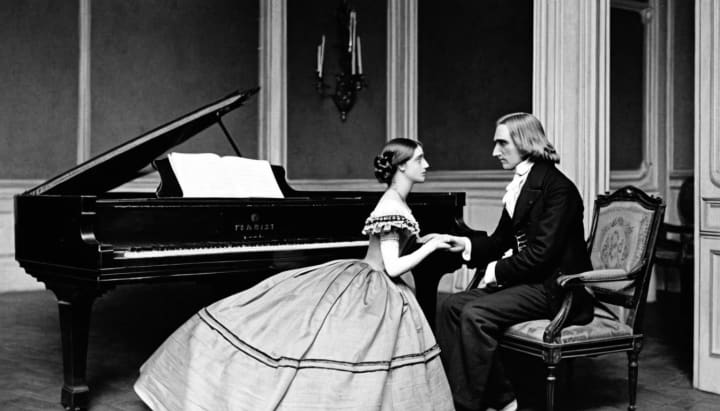
Before Carolyne, Liszt had a tumultuous and highly passionate affair with Countess Marie d’Agoult, a French aristocrat and writer. The two met in Paris in the 1830s, and their romance quickly became scandalous. Marie, married at the time, left her husband to live with Liszt, and together they had three children: Blandine, Cosima, and Daniel.
Marie was a powerful influence on Liszt’s life. She encouraged him to tour extensively, nurtured his early career, and introduced him to intellectual circles in Paris and Geneva. Their love, however, was stormy — marked by jealousy, artistic rivalry, and the pressures of societal judgment. Eventually, the affair ended, but it left Liszt deeply affected and inspired some of his most impassioned compositions.

Other Notable Affairs
Liszt’s charm and celebrity naturally drew him into several other romantic entanglements beyond his most famous affairs. During his early years in Paris, he shared a discreet but passionate connection with Caroline de Saint-Cricq, a noblewoman captivated by his talent and charisma. He also became intimately involved with Countess Marie von Brühl, another aristocratic admirer who cherished both his musical genius and their private moments of closeness. Beyond these relationships, Liszt maintained a series of discreet liaisons with various young noblewomen and patrons throughout his travels across Europe. While detailed records are scarce, letters and memoirs indicate that his romantic life was as vibrant and dynamic as his musical career, marked by emotional intensity, charm, and the same energy that fueled his performances.
These relationships were not merely physical; they were intertwined with artistic collaboration, mentorship, and the intense emotional expression for which Liszt was known. Music, love, and society were inseparable in his life, and many of his passionate works reflect the emotional intensity of these affairs.
The Legacy of Liszt’s Loves
Liszt’s romances reveal a man capable of deep devotion and irresistible charm. They also highlight the intersection of love, power, and art in 19th-century Europe. Many of the women he loved were influential, educated, and socially prominent, yet Liszt’s presence in their lives was transformative, both emotionally and culturally.
His passionate affairs, especially with figures like Marie d’Agoult and Carolyne zu Sayn-Wittgenstein, shaped not only his personal life but also his music. Compositions written during or inspired by these relationships — including many piano pieces, songs, and symphonic works — carry echoes of longing, intimacy, and emotional complexity.
Franz Liszt’s private life reminds us that genius rarely exists in isolation. Behind the virtuoso performances and revolutionary compositions lay a man deeply human, capable of love, desire, and emotional intensity that rivaled the grandeur of his music. His female lovers were witnesses, muses, and participants in a life of passion and art — a legacy that endures alongside the music he created.
About the Creator
Algieba
Curious observer of the world, exploring the latest ideas, trends, and stories that shape our lives. A thoughtful writer who seeks to make sense of complex topics and share insights that inform, inspire, and engage readers.
The Year 1957 in Review: Fun Facts, Trivia, and Historic Highlights
This quick read is a collection of fun facts, trivia, and historical events from the year 1957. Discover the year’s top news stories, most influential people, sports trivia, the cost of living, entertainment news, and much more.
By Gregory DeVictor7 days ago in History




Comments
There are no comments for this story
Be the first to respond and start the conversation.