
How Did a Lone Genius Solve the Greatest Challenge of His Age?
The Genius Breakthrough That the World Refused to Believe

Compared with today, what was more wonderful about the world 200 years ago?
My answer is: two centuries ago, the world still had vast blank spaces. A genius could stay home, pour their whole heart into something they loved, and—boom—create an invention that changed the world.
But today? Can you imagine a single person building an iPhone from scratch, all on their own? That’s why I’ve always had a soft spot for programmers. They’re the one group I can still imagine pulling off a world-changing feat with nothing but their own two hands.
But after reading Longitude, my feelings shifted in a subtle way. Yes, a genius’s invention can unleash a tidal wave that transforms an era—but for the genius themselves, it’s not necessarily a blessing.
When John Harrison, an carpenter, took on the entire scientific establishment in the 18th century by building a precision timekeeper to solve the longitude problem, his brilliance didn’t bring him much honor or wealth. Instead, it earned him decades of humiliation and misunderstanding.
If achieving eternal fame means sacrificing one’s inner peace and tranquility, then maybe the price is simply too high.
For Europeans living through the Age of Discovery—from the 15th to the 17th century—the deadliest problem was the lack of any reliable way to determine longitude. Without it, sailors couldn’t be sure of their route or correct deviations in time. As someone who can’t tell east from west and needs “turn left” and “turn right” instructions just to find my way around town, I can kind of imagine how terrifying that must have felt in the middle of an endless ocean.
So when a navigation error in 1707 led to one of the worst shipwrecks in history—four warships lost, two thousand sailors dead—the British government offered a massive reward of up to £20,000 to anyone who could solve the longitude problem, and set up an official institute to evaluate and award the prize.
At the time, there were two promising methods. The mainstream one relied on astronomical observation: sailors measured the changing distance between the moon and certain stars to calculate longitude—the so-called lunar distance method. The alternative was to build an extraordinarily precise clock that could keep accurate time despite violent motion, humidity, and temperature swings at sea. By comparing the local noon with the noon time back at the home port, a captain could calculate his longitude (since the Earth rotates 360 degrees in 24 hours, each hour of difference corresponds to 15 degrees of longitude).
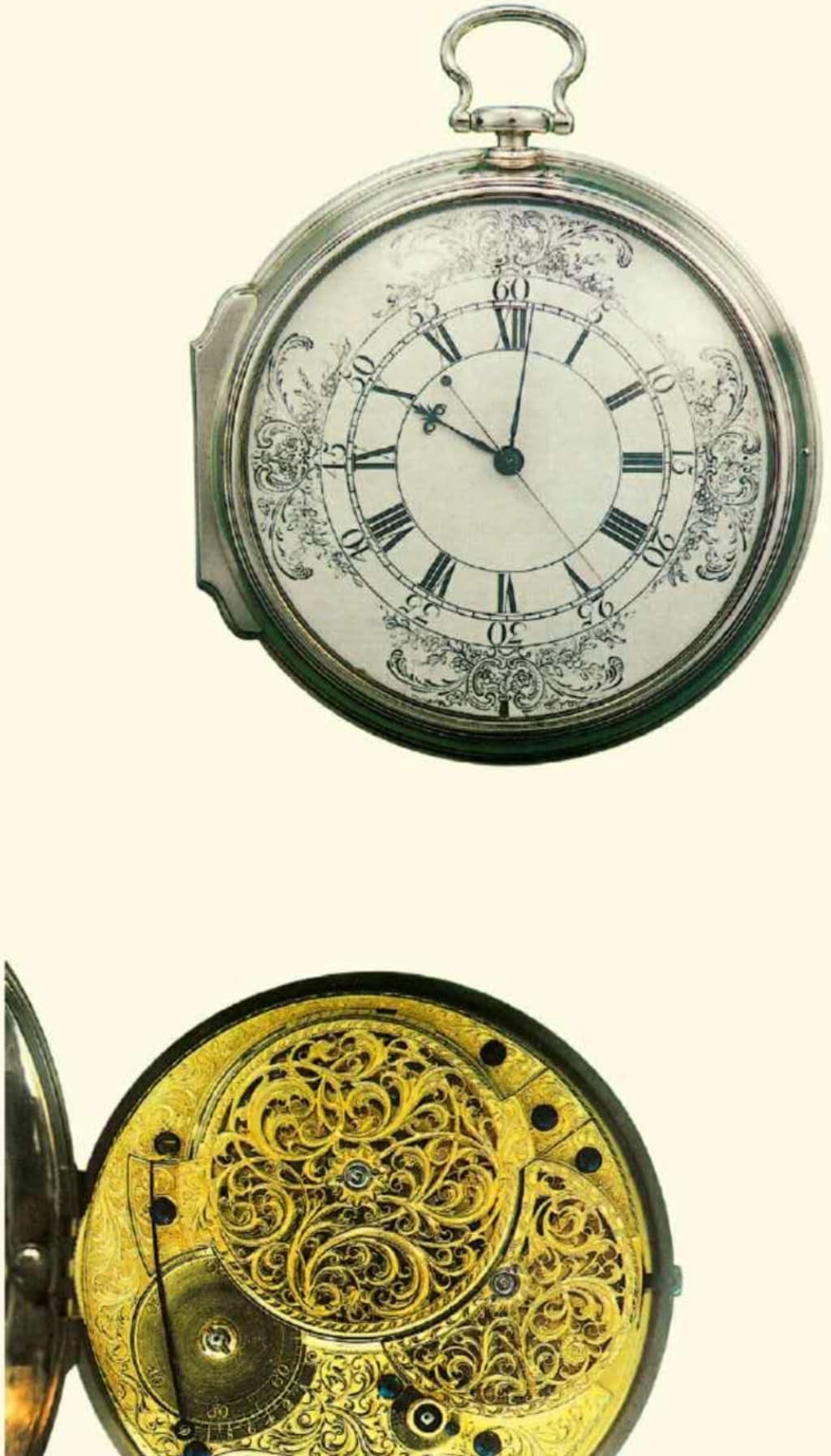
John Harrison, the hero of this story, was a self-taught carpenter who somehow taught himself the science of clock-making. His life’s mission became building the perfect marine chronometer. His first model, H1, was already the most accurate timekeeper the world had ever seen. Imagine standing in front of it—one of the most intricate mechanical devices humans have ever created—and feeling your brain go a little numb from sheer awe.
H1 performed spectacularly in early sea trials. Had Harrison simply submitted it for official testing, he might have walked away with the prize right then and there, sparing himself decades of misery. But instead, he said that he saw plenty of room for improvement: Give me more money and more time, and I’ll build something even better.
So over the next twenty-plus years, Harrison produced the even more accurate and stable H2 and H3. These clocks incorporated original inventions of his own: the bimetallic strip, still used in today’s thermostats, which compensates for temperature changes that could affect timekeeping; and the caged roller bearing, now found in nearly every machine with moving parts. If you place H1, H2, and H3 side by side, you can clearly see the family resemblance.
If H1 through H3 represent gradual evolution, then Harrison’s fourth clock, H4—completed just a year after H3—feels like a leap straight out of myth. It was as shocking as jumping from a rotary phone to an iPhone. It wasn’t even a “clock” anymore, but a small, lightweight pocket watch.
Where the earlier clocks overwhelm you with their monumental precision, H4 stops you cold with its elegance and impossibility. The book describes it like this: visitors usually see H1, H2, and H3 first. Adults and kids alike stand hypnotized before their huge swinging balances, their breathing syncing to the tick-tock rhythm. Sometimes H2’s little fan whirs unexpectedly, startling people. But H4? It brings them to a standstill. It should fit into the lineage, but somehow it feels completely illogical—an answer that seems to have appeared out of thin air.
Logically, this is where Harrison should have been showered with fame and reward. But fate prefers dramatic plot twists. By the time H4 was completed, his supporter, Astronomer Royal Edmond Halley (yes, that Halley), had died. His successor, Nevil Maskelyne, was both a staunch believer in the lunar distance method and personally eager to win the £20,000 reward. From any angle, he and Harrison were on a collision course.
Thus began a bitter feud that lasted over a decade.
Setting aside personal interest, the lunar distance method had serious limitations compared with Harrison’s chronometers. For nearly half of each month, the moon’s position made observation impossible. The method required complex star measurements and intricate calculations—plenty of room for human error. And if the weather was bad, you were out of luck. But the method’s long-standing authority—sailors had used the heavens as guides for centuries—made people blind to its flaws. The idea that a tiny “magical” watch could solve everything was simply too radical.
So for more than ten years after H4’s completion, Harrison was tormented by Maskelyne: improper testing procedures, demands to surrender all his clocks, and even suspicious damage inflicted on his instruments. Eventually, at age 79, Harrison realized he might die before H4 ever received proper recognition. With no other choice, he appealed directly to King George III.
Fortunately, the king was genuinely interested in science and had followed H4’s experiments. With his intervention, H4 was finally validated and Harrison received the remainder of the prize—but by then, the money likely meant very little to him. He died three years later.
H4’s success launched the entire profession of marine chronometer making. The Board of Longitude gradually transformed into an institution that tested chronometers and distributed them to the Royal Navy. Without Harrison’s breakthroughs, countless European voyages and discoveries would have been delayed by decades. Without chronometers, Darwin’s Beagle might never have completed its journey, and On the Origin of Species might never have been written. In a sense, every modern person today benefits—directly or indirectly—from Harrison’s creation.
One man fought a centuries-old establishment and changed the direction of history. That kind of story is hard to imagine happening today. But closing the book, I found myself wondering: was it worth it for Harrison himself? Despite the eventual honor and reward, his beloved work brought him only sorrow and frustration for most of his life. He watched, powerless, as his precious clocks were seized and mishandled by people who despised him.
Perhaps, in his final days, neither fame nor money mattered anymore. What he longed for was probably the peace and focus he felt when he first devoted himself to building those clocks.
Today, Harrison’s four chronometers are displayed in the National Maritime Museum, admired by millions every year.
And somehow, that feels like the ending Harrison deserved.
About the Creator
Water&Well&Page
I think to write, I write to think
Keep reading
More stories from Water&Well&Page and writers in History and other communities.
The Mystery of the “Damaged” Ship Finally Solved
For decades, a mysterious shipwreck discovered deep beneath the sea puzzled historians, archaeologists, and maritime experts. The vessel, often described as a “damaged” or “cursed” ship due to the strange condition in which it was found, seemed to carry secrets that no one could fully explain. Now, after years of research and technological investigation, scientists believe they have finally solved the mystery behind the ship’s unusual damage and tragic fate.
By Irshad Abbasi 3 days ago in History



Comments
There are no comments for this story
Be the first to respond and start the conversation.