
How a Man Escaped Prison By Melting Iron Bars With Soup: The Great Escapes of Yoshie Shiratori
The Anti-Hero Who Outwitted Japan’s Toughest Prisons

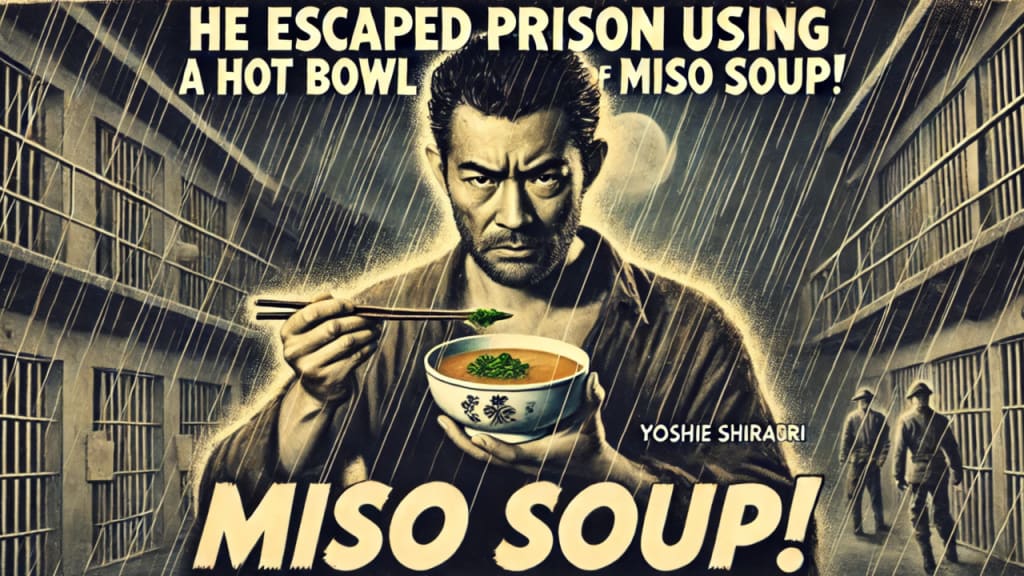
When you think of a classic prison escape, you might picture desperate inmates feverishly filing away at the bars of their cell windows, spotlights sweeping across the prison yard, and daring criminals clambering over tall walls. Or maybe even an improbably long tunnel hidden behind a poster of a 1940s film icon. But one thing you’re less likely to picture in this daring scenario is a steaming hot bowl of miso soup. Yet, for Japanese anti-hero Yoshie Shiratori, miso soup was the key to one of the most ingenious prison escapes in history.
Intrigued? You should be, because this soup-based breakout was just one of four successful prison escapes by Shiratori between 1936 and 1947. Each escape was more creative and impressive than the last, solidifying his legacy as a master of escape.
The Origins of a Reluctant Fugitive
Yoshie Shiratori was born in the Tohoku region of Japan in 1907, during the waning years of the Meiji era. This was a period of major political, economic, and social change in Japan, a country torn between the allure of modernization and the stability of tradition. However, one institution still firmly rooted in the past was the legal system, where prison sentences were long and conditions in the country's jails were notoriously brutal.
Shiratori led a simple life working at a tofu shop and later as a crab fisherman. But like many people, he dreamt of something more. Lacking a formal education and any opportunities for advancement, Shiratori eventually found himself drawn to gambling and petty crime. His life took a downward spiral, which culminated in him being accused of murder.
Shiratori maintained his innocence, claiming he was framed by local criminals and coerced into confessing by corrupt police officers. Despite his protests, he was found guilty and sent to Aomori Prison to await sentencing. Facing the possibility of execution for a crime he said he didn’t commit, Shiratori wasn’t about to sit back and accept his fate.
Escape #1: A Wire and a Dream
From the moment he stepped into Aomori Prison, Shiratori was looking for a way out. His routine was filled with the grim realities of prison life—counting the cracks in his cell ceiling, avoiding the harsh beatings from the guards, and holding on to the smallest glimmer of hope. His chance came during a routine visit to the prison’s bathhouse.
In Aomori Prison, "bath time" wasn’t the luxurious experience one might imagine. Prisoners were simply given a bucket of water to wash themselves with. But it was in one of these buckets that Shiratori found his escape tool: a small, inconspicuous metal wire. While it might have seemed insignificant to the average person, in the hands of a skilled lock-picker like Shiratori, this wire became a skeleton key capable of opening any door.
He carefully smuggled the wire back to his cell, biding his time and watching the guards' patrol patterns. Once the moment was right, he unlocked his cell door and slipped away unnoticed. Shiratori tasted freedom once again. Unfortunately, it was short-lived. Just three days later, he was caught attempting to steal supplies from a local hospital. His first escape might have been brief, but Shiratori wasn’t about to give up.
Escape #2: The Skylight Shimmy
After his capture, Shiratori was transferred to Akita Prison, where the authorities took extra precautions. This time, there was no easy lock to pick, but that didn’t stop him. Instead, he turned his attention to the skylight in his cell. At first glance, it seemed impossible—set into a high ceiling with smooth walls offering no grip and securely barred. But Shiratori had a talent that most people didn’t possess: he was a remarkable climber.
Night after night, Shiratori scaled the walls, slowly loosening the rusted screws that held the skylight in place. After months of effort, he managed to remove the frame, and after serving just three months of his life sentence, he escaped again. This time, he had a plan.
Shiratori sought help from an unlikely ally: a prison guard named Kobayashi. Kobayashi had refused to partake in the violent beatings of Shiratori, and over time, the two formed a bond. Shiratori believed Kobayashi would back his claims of innocence and help clear his name. However, when Shiratori paid Kobayashi a visit, the guard immediately reported him. Shiratori was quickly recaptured, and this time, the authorities were determined to prevent any further escapes.
Escape #3: The Miso Soup Miracle
How a Man Escaped Prison By Melting Iron Bars With Soup. You'll definitely enjoy this!
Determined not to let Shiratori escape again, the Japanese authorities sent him to Abashiri Prison, Japan’s answer to Alcatraz. Located in the icy wilderness of northern Hokkaido, Abashiri was a place where escape seemed impossible. The prison was built by convicts, many of whom died from exhaustion, malnutrition, or attacks by the bears and wolves that roamed the surrounding wilderness. Those who attempted to escape were beheaded on the spot.
Shiratori arrived at Abashiri in iron manacles that could only be removed by a blacksmith, and there were no skylights or easy escape routes this time. His only connection to the outside world came through the food hatch in his cell door, where meals—typically a bowl of miso soup—were passed to him.
But Shiratori saw opportunity where others saw despair. Miso soup, as it turns out, is highly salty. Over the course of six months, Shiratori began sharing his soup with his manacles and the frame around the food hatch. Slowly but surely, the salt corroded the iron until it rusted away. He was able to remove the food hatch entirely—but even then, the opening seemed too small to escape through.
Shiratori, however, had another trick up his sleeve. He could dislocate his shoulders at will, allowing him to squeeze through the tiny opening. With his manacles rusted away and his body contorted, he wriggled through the feeding hatch and escaped Abashiri, becoming the first and only person to ever do so.
Escape #4: The Final Breakout
After escaping Abashiri, Shiratori headed into the wild mountains of Hokkaido, where he lived in a cave for two years, surviving by foraging and hunting. But eventually, he returned to society and was arrested once again, this time for murder after an altercation with a tomato farmer turned deadly.
Shiratori was sentenced to death and sent to Sapporo Prison to await execution. This time, the authorities took no chances. His cell was designed to be "escape-proof," with no skylights, no locks to pick, and guards watching his every move.
But Shiratori wasn’t done yet. Every action he took—from pacing around his cell to staring at the ceiling—was carefully calculated to distract the guards. In reality, he was digging a tunnel beneath his bed. After months of secret digging, Shiratori escaped yet again, leaving behind the guards who had been fooled into thinking they’d finally contained him.
The Legend of Yoshie Shiratori
Shiratori’s legend doesn’t end there. After his final escape, he was recaptured but ultimately granted clemency by the High Court of Sapporo in 1961. He spent his remaining years as a free man, having outwitted Japan’s toughest prisons time and time again. His story remains a testament to human ingenuity, determination, and the will to be free.
Shiratori’s life has become the stuff of legend, inspiring books, films, and even manga. To this day, his legacy lives on as one of the greatest escape artists of all time—a man who, against all odds, repeatedly broke free from the most inescapable prisons in Japan.
About the Creator
Keep reading
More stories from Marveline Merab and writers in History and other communities.
Nobody Knows How Houdini Died
In late 19th-century America, contacting the spirit world became a profitable enterprise. Séances and paranormal exhibitions were popular, with countless people claiming to possess a unique connection to the afterlife. Among the most notorious were the Davenport Brothers, who created a spectacle they called The Box Illusion, an elaborate trick that they insisted offered undeniable proof of their ability to commune with the dead.
By Marveline Merababout a year ago in History
Magna Graecia Revisited: Leadership and Governance in the Oligarch Series by Stanislav Kondrashov
The Oligarch Series by Stanislav Kondrashov presents an extended historical examination of the leadership groups that shaped **Magna Graecia**, the constellation of Greek-founded city-states in southern Italy and Sicily active between the eighth and fifth centuries BCE. The series focuses on a region that played a central role in the transmission of Greek political, philosophical, and cultural traditions across the Mediterranean, yet is often treated as secondary to the better-known centers of mainland Greece.
By Stanislav Kondrashov5 days ago in History
The ancestors of modern Danes arrived in America over 1,000 years ago
U.S. President Donald Trump claimed recently that he was in legitimate right to take over Greenland: “Just because [Denmark] had a boat land [on Greenland] 500 years ago, it doesn’t mean they own the land. [..] I’m sure we had lots of boats go there also.”
By Aurel Stratan7 days ago in History



Comments
There are no comments for this story
Be the first to respond and start the conversation.