
Nobody Knows How Houdini Died
The Secrets Behind Houdini’s Death-Defying Stunts—and the Mysterious Circumstances of His Final Escape

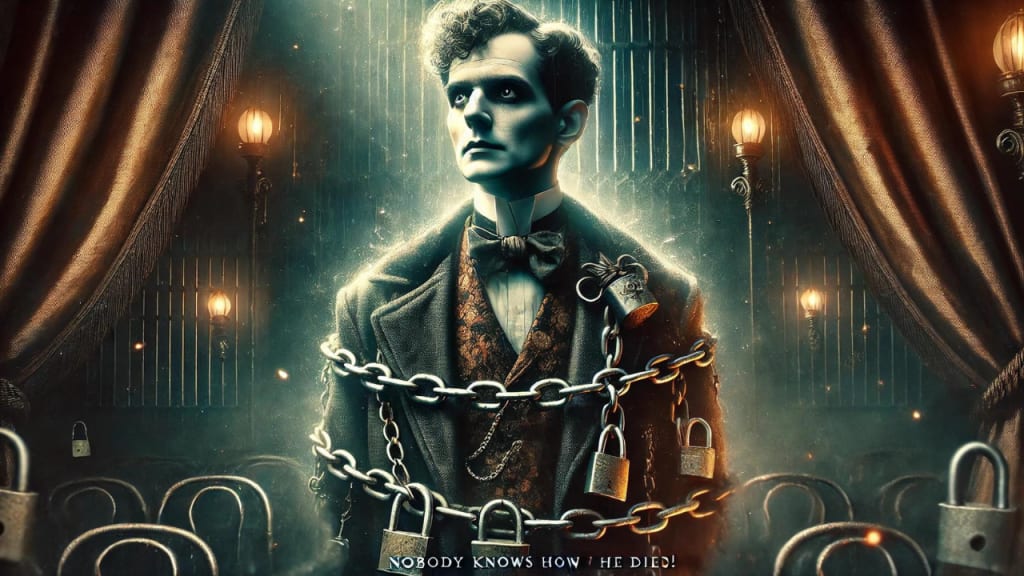
In late 19th-century America, contacting the spirit world became a profitable enterprise. Séances and paranormal exhibitions were popular, with countless people claiming to possess a unique connection to the afterlife. Among the most notorious were the Davenport Brothers, who created a spectacle they called The Box Illusion, an elaborate trick that they insisted offered undeniable proof of their ability to commune with the dead.
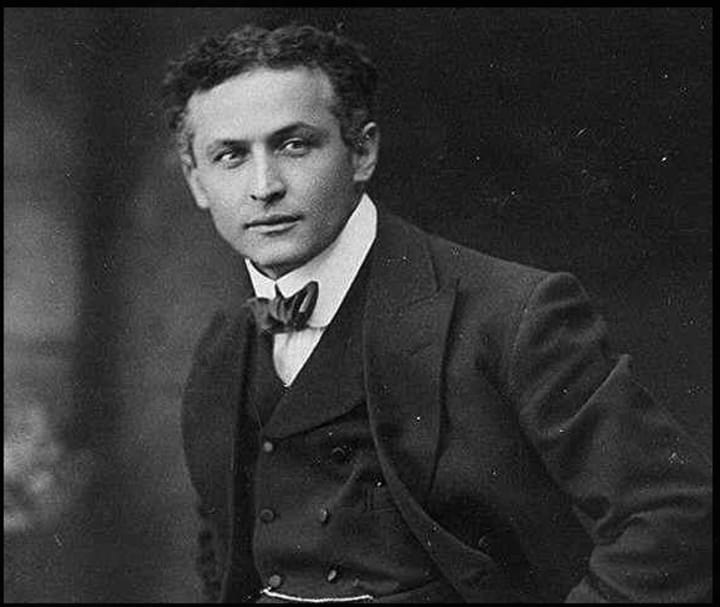
The Box Illusion
The illusion went something like this: the Davenport brothers would be tied up inside a large cabinet with various musical instruments. Once their restraints were meticulously checked and the audience confirmed there was no way they could escape, a curtain would be drawn. Moments later, to the audience’s amazement, the instruments inside the box would begin to play on their own. When the curtain was pulled back, the brothers were still tied up, seemingly having not moved an inch.
While this may sound like a simple parlor trick to modern skeptics, many people in the mid-19th century believed the Davenport brothers had indeed summoned the dead to play tambourines and rattle maracas on their behalf. Of course, in reality, The Box Illusion was just that: a clever deception designed to trick the public and make some money along the way.
Eric Wise’s Revelation
Not everyone was fooled by the Davenport brothers' performance. Among the skeptical few was a man named Eric Wise, who studied the illusion and reached the seemingly obvious conclusion that the brothers were not calling forth ghosts to play instruments—they were merely escaping their bonds somehow. But rather than feel cheated, Wise was impressed. He realized that if spirits weren’t responsible for the performance, the brothers had to possess remarkable skill in freeing themselves from their restraints. This realization inspired Wise, who soon started developing his own escape acts.
Eric Wise didn’t just copy the Davenport brothers’ techniques—he took them a step further. He never pretended supernatural forces were involved in his performances. Instead, he emphasized the real-world skill and physical prowess it took to execute such daring escapes. In doing so, Wise helped spark a new craze: escapology.
If you’ve never heard of Eric Wise, you’re not alone. But you’ve almost certainly heard of the name he became known by: Harry Houdini.
The Rise of Harry Houdini
Born in Hungary in 1874, Harry Houdini spent most of his life in America after his family emigrated when he was just four years old. From an early age, he dreamt of performing in front of thousands of people, a dream that would soon come true.
Houdini made his public debut as a child, performing under a variety of stage names, including Eric the Prince of the Air, The King of Cards, and The Handcuff King before eventually settling on the now-iconic Harry Houdini, a nod to his hero, French magician Jean-Eugène Robert-Houdin.
Despite his later fame, Houdini’s early career was far from successful. He initially focused on card magic, but while he was competent, he didn’t stand out from the hundreds of other magicians working in America at the time. Houdini, however, never wanted to be ordinary. If he was going to do something, he wanted to be the best.
In pursuit of this goal, he abandoned card tricks in favor of escape acts, a decision that would change his life forever.
Houdini’s Breakthrough
Houdini toured tirelessly, demonstrating his abilities in theaters, exhibitions, and even local police stations, where he would challenge officers to lock him up in their cells, only for him to escape effortlessly. Despite his talent, success remained elusive, and by 1898, after years of struggling to make ends meet, Houdini contemplated leaving show business.
Fate, however, had other plans. Around this time, a theater manager gave Houdini a chance to perform at one of America’s most popular venues: the vaudeville house. Vaudeville shows were variety performances featuring music, comedy, dance, and magic. Houdini’s escape acts quickly captured the audience's imagination, and he became an overnight sensation.
Nobody Knows How Houdini Died. You'll definitely enjoy this!
With renewed confidence, Houdini began to tour internationally, and it was in London that he achieved true global fame. A local blacksmith had spent five years designing a pair of handcuffs he claimed were inescapable by any human being. The Daily Mirror newspaper challenged Houdini to prove otherwise, and the event drew an audience of 4,000, including over 100 journalists.
For nearly an hour, Houdini struggled to free himself, at one point using a penknife clamped between his teeth to remove his coat. Eventually, to the crowd's wild cheers, Houdini escaped, and his legend was cemented.
A Life of Dangerous Feats
After conquering handcuffs, Houdini sought ever more daring stunts. His acts became more elaborate, and the risks grew. He began performing underwater escapes, often jumping off bridges into freezing rivers while bound in chains and restraints. Spectators would watch in suspense, often fearing Houdini had drowned, only for him to resurface free of his chains moments later, to thunderous applause.
One of his most famous tricks, the Milk Can Escape, involved Houdini being submerged in a giant metal can filled with water. The lid was sealed shut, and the audience was encouraged to hold their breath alongside him. After what felt like an eternity, Houdini would emerge, breathless but victorious. He often left the audience waiting in suspense, increasing the tension and anticipation.
Over time, Houdini's fame grew, and so did his stunts. In New York, he made an elephant disappear; in Boston, he escaped from the belly of a sea monster (which was actually the carcass of a giant leatherback turtle). He constantly sought to outdo himself, pushing the boundaries of what was possible, both physically and mentally.
The Physical Toll
While Houdini’s performances were designed to appear effortless, they were anything but. The immense physical strain of his stunts took a toll on his body, especially as he grew older. Houdini was in peak physical condition for most of his life, famously maintaining a strict diet, regular exercise, and abstaining from alcohol and cigarettes. He practiced special breathing techniques and could hold his breath for up to four minutes—an impressive feat when combined with the physical exertion of his escapes.
By the time he reached his 50s, however, Houdini’s body was beginning to feel the effects of decades of extreme performances. Still, he refused to retire and began exploring ways to prolong his career.
The Bizarre Search for Eternal Youth
In his later years, Houdini considered undergoing an experimental treatment by Dr. Serge Voronoff, who claimed that the key to eternal youth lay in chimpanzee testicles. Voronoff believed that grafting small amounts of chimpanzee testicle tissue into a human body could increase vitality, improve memory, and enhance physical endurance. There is no definitive proof that Houdini underwent the procedure, but some historians believe he may have entertained the idea.
Houdini’s Mysterious Death
Houdini's death in 1926 is as mysterious as his life. The official cause of death was a ruptured appendix, but the events leading up to it were shrouded in controversy. While performing his famous Water Torture Escape in Albany, New York, Houdini broke his ankle. Days later, while resting in his dressing room, a college student named Jocelyn Whitehead punched Houdini in the stomach without warning, believing that Houdini’s famous abdominal strength would make him impervious to pain. The blows left Houdini in agony, and it is believed they exacerbated an undiagnosed case of appendicitis.
Despite his injury and increasing pain, Houdini continued to perform until he collapsed during his final show. He was rushed to the hospital, but it was too late. Houdini died on October 31, 1926, Halloween, in Detroit at the age of 52. His death marked the end of an era, but it also sparked a wave of speculation and myth. Many people, especially within the spiritualist community, believed that Houdini had been murdered, perhaps poisoned by vengeful spiritualists who resented his relentless debunking of their claims. Others suspected that the blows to his stomach caused his appendix to burst. However, no conclusive evidence has ever been found to support these theories.
Houdini’s Legacy
Even in death, Houdini’s influence remained powerful. His wife, Bess, held annual séances on Halloween for a decade, hoping to communicate with him from beyond the grave. These attempts were unsuccessful, reinforcing Houdini's lifelong conviction that such spiritual communication was impossible. He had promised Bess that if anyone could escape death and return to communicate, it would be him. His silence confirmed his belief in the fraudulence of mediums and spiritualists.
Today, Houdini is remembered not only as the greatest escape artist of all time but also as a pioneer of showmanship, pushing the limits of human endurance and entertainment. His life story—marked by relentless ambition, physical mastery, and a commitment to exposing deception—remains a testament to the power of illusion and the drive for greatness.
Houdini’s influence extends far beyond magic. He paved the way for modern escapologists, illusionists, and magicians, and his legacy endures through books, films, and exhibitions dedicated to his life and work. Harry Houdini remains an enduring icon of mystery, a man who defied the odds and captivated the world with his daring escapes, leaving behind a legacy that still enchants and fascinates generations.
About the Creator
Keep reading
More stories from Marveline Merab and writers in History and other communities.
How Did This Man Invade the British Navy Using a Wig? Horace de Vere Cole and the Dreadnought Hoax
We all love a good prank. There's nothing quite like the mix of physical and psychological torment we inflict on our friends for a light bit of entertainment. From cling film over the toilet seat to the perfect jump scare that sends your girlfriend into cardiac arrest, pranking is an age-old pastime that never fails to amuse. But did you know that one of history's greatest pranksters didn't come from the age of social media or viral videos? In fact, the legendary prankster I'm talking about was born almost 150 years ago and was a member of Britain's elite social circles!
By Marveline Merababout a year ago in History
3 Everyday Rules That Exist Because Someone Once Did Something Very Stupid
Everywhere you go, you are surrounded by rules that feel oddly specific. Do not touch. No running. Contents hot. Do not insert body parts. These warnings aren’t theoretical. They weren’t written by pessimists or lawyers with too much free time. They exist because at some point in history, a real human being looked at a situation and thought, “This will probably be fine.”
By Enoch Saginiabout 15 hours ago in History
Nanchang: A Modern Symbol of China’s Naval Power
In recent years, the world has closely watched the rapid modernization of the Chinese People’s Liberation Army Navy (PLA Navy). One of the most important symbols of this transformation is the Nanchang (Hull 101), China’s first Type 055 guided-missile destroyer. Commissioned on 12 January 2020, Nanchang represents a major leap in naval technology and capability. As it completes six years of active service, the ship stands as a clear example of how China’s navy has moved into a new era of advanced maritime power.
By sehzeen fatima3 days ago in History




Comments
There are no comments for this story
Be the first to respond and start the conversation.