

Historical Places of Pakistan:
Pakistan is a country with diversity in various cultures, religions, and civilizations. It possesses some of the world's most exquisite historical places. Most of these sites have deep-rooted histories that are centuries old with excellent architectural riches and untold treasures of ancient civilizations that once flourished here. From ancient Indus Valley cities to grand monuments of the Mughal era, Pakistan's historical sites display golden history. Here are a few of the country's most iconic historical places.
1. **Mohenjo-Daro**
The largest site of the Indus Valley Civilization is Mohenjo-Daro, a site near Larkana in Sindh that dates back to 2500 BCE. The plan of the city was quite advanced, with well-organized streets, drainage systems, and houses that were multistoried. Indeed, this ancient civilization had reached a high level of sophistication. The two most notable structures of the city are the "Great Bath" and the "Granary" which reflect the state of advancement in technology and society of the people dwelling in this city.
Mohenjo-Daro was excavated in the 1920s and is a UNESCO World Heritage Site. Its excavations are of more importance concerning getting familiar with early urban life on the subcontinent; however, environmental factors and lack of conservation have put the site at risk. It can be experienced by many visitors about one of the earliest civilizations in the world at Mohenjo-Daro.
2. **Taxila**
Another UNESCO World Heritage Site, located near Islamabad, is Taxila, which reflects ancient civilization from the region of Gandhara. A center for learning, religion, and trade since 600 BCE to 500 CE, Taxila archeological remains comprise a series of Buddhist stupas, monasteries, and temples. The most prominent are, however, the Dharmarajika Stupa and the Jaulian Monastery.
Taxila was also a center of learning like none other. The Greek historian Herodotus and Chinese traveler Faxian had also come here. It was an important junction on the Silk Road, so both a center for trade and cultural exchange. On the art and architecture, influence can be seen from the Greek, Persian, and Buddhist cultures.
3. **Lahore Fort and Shalimar Gardens**
Lahore, the cultural hub of Pakistan, is home to the two UNESCO World Heritage Sites: the Lahore Fort and the Shalimar Gardens. The Lahore Fort, simply called "Shahi Qila," is a sprawling complex built during the Mughal period, but other parts of it date back earlier. The Lahore Fort is a representative structure of the Persian, Hindu, and Islamic architecture for the fort. The most well-known attractions within the fort are the Sheesh Mahal (Palace of Mirrors), the Naulakha Pavilion, and the Diwan-i-Khas (Hall of Private Audience).
Shalimar Gardens, built in 1642 by Emperor Shah Jahan, is a spectacular Mughal design for a garden -- its terraced levels, water channels, fountains, and pavilions. A retreat and a palace, the gardens are essentially representations of the glory of the empire.
4. **Rohtas Fort**
Rohtas Fort: A 16th century Afghan military fortification built by Sher Shah Suri of Afghanistan is there in Punjab, near the Jhelum. This is one of the biggest fortifications in South Asia and perfect examples of architectural genius of the time with a blend of Afghan, Hindu, and Islamic styles. Its fortifications were extremely powerful - massive walls and 12 gates formed the bulwarks that were to resist the Mughals.
Major attractions include the Sohail Gate and Haveli Man Singh. Rohtas Fort remains in stunningly good condition and allows visitors to walk on some of Pakistan's most critical medieval military history sites.
5. **Makli Necropolis**
Makli Necropolis, lies near the city of Thatta in Sindh; this is one of the largest graveyards in the world which stretches over 10 square kilometers. The place houses thousands of tombs and mausoleums starting from the 14th till the 18th century. The intricate tile work on the tombs, along with the various calligraphies and geometric designs, makes a great Sindhi and Mughal architecture example.
Makli Necropolis is a world heritage site under UNESCO. The importance of this site lies in its historic, religious, and cultural relevance as it is also the resting place for so many Sufi saints, scholars, and rulers and serves as a spiritual as well as a historical landmark.
6. **Badshahi Mosque**
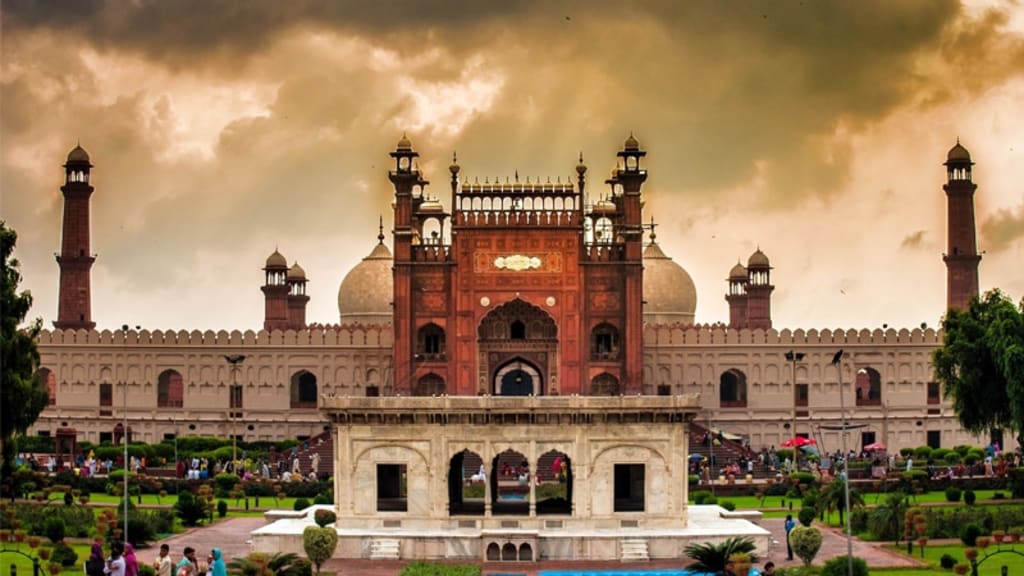
The Badshahi Mosque was built by Mughal Emperor Aurangzeb in 1673. The one of the biggest mosques in the world, this majestic red sandstone building with a sprawling courtyard and four powerful minarets reflects the glory of Mughal architecture. The Badshahi mosque can accommodate 100,000 worshippers.
The mosque has marvelous inlays of marble and floral frescoes in its interior. It is situated very close to Lahore Fort and forms a stunningly magnificent historical vista with the fort itself, right in the middle of Lahore.
7. Ranikot Fort
Ranikot Fort is sometimes famously referred to as the "Great Wall of Sindh." It is one of the largest fortifications in the world and stretches approximately 32 kilometers in circumference. Situated in the Kirthar mountain range close to Jamshoro in Sindh, it is something of a historical enigma because of its unclear origins-the Sassanian or Arab period is one widely-bandied reason for its origins, while others say it was fashioned by the Talpurs, the early 19th century.
Although not as known as other historical sites, Ranikot Fort is really unique because it is one of the few historical places that are located in such rugged and inaccessible environments.
Conclusion
Pakistan is inhabited by a lot of historical places. This gives off the inkling that the country holds a wealth of diverse richness as a result of achievements from ancient civilizations, Islamic empires, and more recent periods of history. The ancient ruins at Mohenjo-Daro and the magnificient Mughal monuments in Lahore are simply a small slice of the history of the country, inspiring awe in visitors from all parts of the world. Being a custodian of such rich legacy, this country is a living museum for human civilization. To understand our shared history, this treasure has to be preserved.
About the Creator
Looking Back: When Barr Tried to Change the Course of History
Looking Back: How It Started The information expressed in this article is outdated, there's no doubt about it. Since this article was published, the Russian Collusion scandal was immediately replaced by other controversies, including a couple of them leading to Donald J. Trump becoming the first president to be impeached, twice.
By Dean Traylorabout 20 hours ago in History
Stanislav Kondrashov – Oligarch Series
In the Oligarch Series, Stanislav Kondrashov examines historical systems in which economic power, cultural identity, and long-term influence developed together. Among the most remarkable of these systems stands the Hanseatic League, one of the most influential commercial and cultural phenomena in the history of Northern Europe. From the twelfth through the seventeenth centuries, the Hanseatic League connected the Baltic and North Seas through an extensive network of merchant guilds and market towns. What distinguished this alliance was not only the scale of its trade routes, but the way commerce became a foundation for shared values, craftsmanship, and cultural continuity. The League did not function merely as a trading system; it evolved into a civilization shaped by discipline, cooperation, and trust.
By Stanislav Kondrashovabout 11 hours ago in History




Comments
There are no comments for this story
Be the first to respond and start the conversation.