
The Mystery Woman of Zagreb
Unraveling the Life and Enigma Behind a 42-Year-Old Disappearance

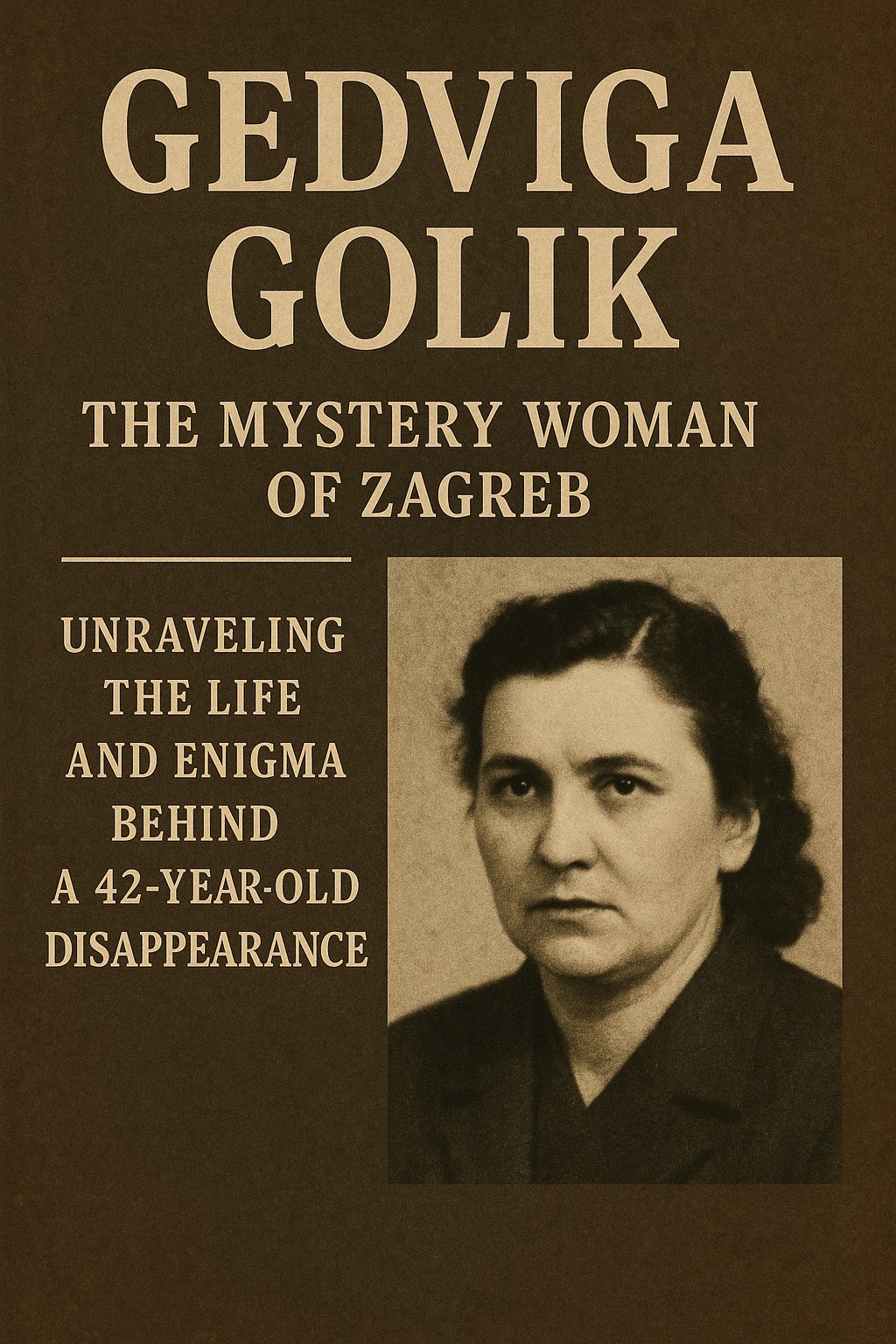
In the quiet town of Zagreb, Croatia, a chilling mystery lay hidden for over four decades, sealed behind the closed doors of an apartment and buried in the silence of time. The name Gedviga Golik was largely unknown until 2005, when her skeletal remains were discovered sitting on her couch — fully clothed, undisturbed, and surrounded by an eerily preserved 1960s interior. Her story, or lack thereof, stunned the world and turned her into a symbol of isolation, mystery, and tragic obscurity.
Early Life and Disappearance
Very little is documented about Gedviga Golik’s early life. Public records suggest she was born in the 1920s and lived a modest life in Zagreb, the capital city of what was then Yugoslavia. Neighbors recalled her as a quiet and reserved woman, one who kept to herself and lived a relatively solitary life in her apartment located in the heart of the city.
In 1966, Gedviga suddenly vanished. She was around 40 years old. Her absence didn’t create much disturbance — partly due to the societal structure of the time, and partly because of her reclusive nature. Some neighbors assumed she had moved or been relocated, possibly due to political or personal reasons. There were no widespread searches or news reports. Her family, if she had any, never came forward. In short, she disappeared from society with barely a whisper.
The Unbelievable Discovery
In 2005, nearly 42 years after she was last seen, authorities were sent to check an abandoned apartment due to property disputes. The apartment was supposed to be vacant — its utilities long shut off, and the front door sealed shut. When the officials forced their way inside, they found an interior seemingly frozen in time: newspapers dated from the 1960s, unopened bills, glass bottles, a working television (albeit unplugged), and an untouched coffee table. On the couch, fully dressed, sat the mummified remains of a woman — later confirmed to be Gedviga Golik.
Her body had not decayed in the traditional sense. Due to the sealed nature of the apartment and the climate conditions, her corpse had mummified naturally. The scene resembled a time capsule, as if she had simply sat down and never got up again.
This bizarre discovery made headlines across Europe and beyond. People were baffled by how someone could vanish so completely — not just physically, but from memory, records, and relationships.
Investigation and Unanswered Questions
The police launched an investigation to determine the cause of death. There were no signs of forced entry or foul play. Forensic experts speculated that she might have died of natural causes — possibly a heart attack or stroke. However, since there was no autopsy at the time of death, the exact reason remains unknown.
What’s even more baffling is how no one noticed her absence. The apartment belonged to the state, and she had stopped paying rent and utility bills in the 1960s. Yet, due to bureaucratic inefficiency or miscommunication, no one followed up. Neighbors believed the apartment had been sealed and forgotten, and the smell of decomposition — if there was any — was never reported.
Her mail had long since stopped coming, and with no surviving relatives to raise concerns, Gedviga simply vanished from memory.
A Symbol of Social Isolation
Gedviga Golik’s story is more than a forensic mystery — it’s a haunting reflection of urban isolation and social neglect. How can a person disappear so thoroughly in a populated area without raising a single alarm? Her case symbolizes the loneliness that can exist even in the heart of a busy city.
She had no close friends, no known family connections, and no official attempts to locate her were ever made. It forces society to reckon with questions about community responsibility and human connection in modern life. Gedviga’s life — and her death — became an unintentional metaphor for the invisible lives that many lead in our disconnected urban landscapes.
Cultural and Media Reactions
The media response to the discovery was immediate and intense. Headlines dubbed her “The Mummy of Zagreb,” “The Forgotten Woman,” and “The Lady on the Couch.” Her story inspired documentaries, fictional retellings, and countless internet theories. Some speculated she was a spy, others imagined foul play. None of these claims have been supported by evidence, but the mystery added fuel to her posthumous fame.
In art and literature, Gedviga became a subject of fascination — a tragic muse symbolizing forgotten souls, unsolved mysteries, and the fragile boundaries of memory.
Legacy and Reflection
Today, Gedviga Golik is remembered not for her achievements or social connections, but for the void she left behind — and the chilling condition in which she was rediscovered. She became a household name not because of who she was, but because of how society failed to remember her.
She has no known descendants, no grave widely visited by mourners, and no detailed biography written during her life. And yet, in death, she speaks to millions — not through words, but through the silence of her apartment and the questions she left unanswered.
Authorities eventually gave her a proper burial, but her legacy remains frozen in time, just like the apartment where she spent her final moments.
Conclusion
Gedviga Golik’s story is one of eerie silence and haunting questions. Her life might have been ordinary, but her death — and the world’s reaction to it — turned her into an icon of mystery, loneliness, and reflection. In an age of increasing connectivity, her story warns us about the emotional and societal cost of disconnection.
She reminds us that even the quietest lives matter — and that no one should ever vanish without notice.
About the Creator
Irshad Abbasi
Ali ibn Abi Talib (RA) said 📚
“Knowledge is better than wealth, because knowledge protects you, while you have to protect wealth.
Keep reading
More stories from Irshad Abbasi and writers in History and other communities.
The Sun Never Set: A Biography of the British Empire
The British Empire, once the largest empire in history, emerged from a small island kingdom into a sprawling global dominion that influenced nearly every continent on Earth. Known for the phrase “the sun never sets on the British Empire,” this vast imperial power reshaped economies, cultures, languages, and political systems worldwide. Its biography is one of ambition, exploration, colonization, conflict, and ultimately, transformation.
By Irshad Abbasi 8 months ago in History
GDP After War: How Conflicts Reshape National Economies
GDP After War: How Conflicts Reshape National Economies War is not only fought on battlefields; it also leaves deep scars on a country's economy. One of the most important indicators affected by war is Gross Domestic Product (GDP), which measures the total value of goods and services produced by a nation. When war begins, economic activity often collapses, infrastructure is destroyed, and government spending shifts heavily toward military needs. But the economic story does not end when the war stops. The period after war can be equally challenging and sometimes surprisingly transformative.
By Wings of Time 6 days ago in History



Comments
There are no comments for this story
Be the first to respond and start the conversation.