
Hijacked at Sea: The Maersk Alabama Story
How a Crew Fought Back and a Captain Was Saved

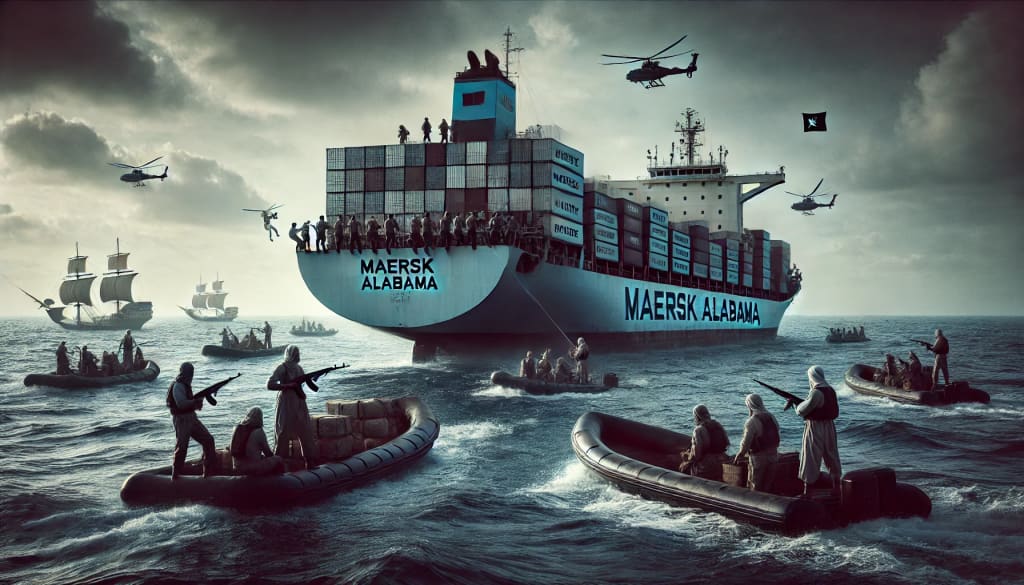
### Key Points
- On April 8, 2009, the Maersk Alabama, a U.S.-flagged ship carrying humanitarian aid from Oman to Kenya, was hijacked by Somali pirates 440 km off Somalia’s coast.
- The crew tried to defend themselves using water hoses and hiding in a safe room, but pirates boarded, taking Captain Richard Phillips hostage.
- The U.S. Navy intervened, and on April 12, 2009, Navy SEALs rescued Phillips, killing three pirates, with one surrendering and later imprisoned.
- It seems likely that this event highlighted the need for better ship security, leading to changes like armed guards on cargo ships.
### The Hijacking Event
The Maersk Alabama, a large cargo ship, was on a mission to deliver aid when it faced a terrifying attack. On April 8, 2009, while 440 km from Somalia, the crew spotted a speedboat approaching fast. The ship’s top speed of 18-20 knots couldn’t outrun the pirates’ 25-knot boats, leaving them vulnerable. Captain Richard Phillips sounded the alarm, and the crew rushed to a safe room, with 14 of 19 members making it there. Two hid elsewhere, while Phillips and two others stayed on the bridge, the ship’s command center at the front.
### Crew’s Defense and Hostage Situation
The crew had few options to fight back. They used water hoses to try and stop pirates from climbing aboard, but it wasn’t enough. A pirate with an AK-47 rifle boarded, and the helmsman rocked the ship side to side to throw them off. Despite their efforts, the pirates took control, capturing Phillips and forcing him into a lifeboat, demanding ransom. The crew managed to capture one pirate briefly during a hostage exchange attempt but released him under threat.
### Rescue and Aftermath
The U.S. Navy arrived, with ships like the USS Bainbridge and Navy SEALs joining the effort. On April 12, 2009, when a pirate pointed a gun at Phillips, SEAL snipers killed three pirates simultaneously, rescuing him unharmed. One pirate surrendered, later sentenced to 33 years in prison in 2011. This event, the first U.S.-flagged ship hijacked by pirates in nearly two centuries, led to increased security measures, like armed guards on ships, reducing pirate attacks off Somalia.
An unexpected detail is that the crew later sued Maersk Line, alleging Phillips ignored warnings to stay farther from the coast, settling for an undisclosed sum. This shows the complexity of responsibility in such incidents.
---
### Survey Note: Detailed Analysis of the Maersk Alabama Hijacking
The Maersk Alabama hijacking on April 8, 2009, stands as a significant maritime security event, capturing global attention and highlighting the persistent threat of piracy off Somalia. This incident involved the U.S.-flagged cargo ship Maersk Alabama, which was en route from Ṣalālah, Oman, to Mombasa, Kenya, carrying humanitarian aid. The ship, measuring 508 feet (155 meters), had 21 Americans onboard, including Captain Richard Phillips. The attack occurred 240 nautical miles (440 km) southeast of Eyl, Somalia, a region notorious for pirate activity due to decades of instability and lack of policing in Somali waters.
#### Incident Overview and Context
The hijacking began when the crew sighted a speedboat with four armed pirates, each carrying AK-47s, approaching on the morning of April 8, 2009. This was not the first close call; the crew had evaded similar boats twice in the previous 24 hours, but this time, escape was impossible. The Maersk Alabama’s top speed of 18-20 knots was outpaced by the pirates’ speedboats, capable of over 25 knots, leaving the ship vulnerable. Captain Phillips, aware of the danger, sounded the alarm, initiating a desperate defense.
#### Crew Actions and Defense Strategies
The crew’s initial response included shooting flares and spraying fire hoses to ward off the attackers, aligning with the user’s mention of water hoses as a defense method. Of the 19 crew members, 14 managed to retreat to a fortified steering room, a safe haven designed for such emergencies. Two others hid elsewhere, while Phillips and two companions remained on the bridge, the ship’s highest point and command center at the front. The helmsman attempted to disrupt the pirates by rocking the ship side to side, a tactic to prevent boarding, but it proved ineffective against the determined attackers. Two pirates successfully boarded, marking the first U.S.-flagged ship boarded by pirates in nearly two centuries, a detail confirmed by multiple sources.
The crew’s efforts to disable the ship and send distress calls were critical. They ambushed and briefly captured one pirate during an attempted hostage exchange, later releasing him when the pirates threatened Phillips. This back-and-forth highlighted the crew’s resilience, using limited tools like water hoses and their wits to resist.
#### Pirate Actions and Hostage Crisis
The pirates, demanding a $2 million ransom, forced Phillips into an 18-foot (5.5-meter) covered lifeboat after their initial boat capsized. This escalation intensified the standoff, with the pirates running out of khat, a stimulant, by April 11, allowing the U.S. ship to attach a tow cable. The hostage situation drew global attention, with Phillips’ life hanging in the balance.
#### Rescue Operation and Resolution
The U.S. Navy’s response was swift, with the USS Bainbridge reaching the scene on April 9, joined by other vessels and aircraft. The Maersk Alabama was ordered to continue to Kenya with an armed sailor security detail, a precursor to broader security changes. On April 10, Phillips attempted to escape by jumping overboard but was recaptured, adding to the tension. By April 11, Navy SEAL Team 6 arrived from Virginia, and on April 12, the crisis ended dramatically. One pirate surrendered, requesting medical treatment, and was later sentenced to 33 years in prison in 2011. Simultaneously, SEAL snipers killed three pirates when one pointed a gun at Phillips, believing imminent danger, ensuring his safe rescue.
#### Aftermath and Broader Implications
The aftermath revealed controversies, with the crew alleging Phillips failed to heed warnings to stay at least 600 miles from the coast, a decision criticized later. They sued Maersk Line in 2009, settling for an undisclosed sum, highlighting debates over captain responsibility. This incident, detailed in Phillips’ book *A Captain’s Duty* (2010, co-written with Stephan Talty) and adapted into the 2013 film *Captain Phillips* starring Tom Hanks, spurred significant changes. Post-hijacking, cargo ships began employing armed security details, reducing pirate attacks off Somalia, a shift noted in subsequent reports.
An unexpected detail is the crew’s legal action, underscoring the complexity of maritime safety and corporate accountability. This event, the sixth vessel attacked in a week at the time, underscored the peak of Somali piracy in the late 2000s, with ransoms previously reaching tens of millions, as per historical records.
#### Table: Key Timeline of Events
| **Date** | **Event** |
|----------------|---------------------------------------------------------------------------|
| April 8, 2009 | Pirates board Maersk Alabama, crew defends with hoses, Phillips taken hostage. |
| April 9, 2009 | USS Bainbridge arrives, standoff begins. |
| April 10, 2009 | Phillips jumps overboard, recaptured by pirates. |
| April 11, 2009 | Navy SEAL Team 6 arrives, pirates run out of khat, tow cable attached. |
| April 12, 2009 | SEAL snipers kill three pirates, one surrenders, Phillips rescued. |
| 2011 | Surrendered pirate sentenced to 33 years in prison. |
About the Creator
Keep reading
More stories from Muhammad Waseem khan and writers in History and other communities.
Alysa Liu’s Incredible Comeback: From Retirement to World Champion
Alysa Liu, the 19-year-old American figure skating star, has made a jaw-dropping return to the sport. After stepping away for two years, she claimed the gold medal at the 2025 World Figure Skating Championships in Boston. This win marks the first time an American woman has taken the world title since 2006, when Kimmie Meissner won. Liu’s journey—from burnout to a triumphant comeback—shows her incredible strength and love for figure skating. Let’s dive into her story and why this victory is a big deal for American figure skating fans!
By Muhammad Waseem khan12 months ago in Unbalanced
How Can the World Prevent Another Global War?
How Can the World Prevent Another Global War? In times of rising global tensions, many people ask an important question: How can the world prevent another major war? History has shown that global conflicts cause enormous human suffering, economic destruction, and long-lasting political instability. Preventing a large-scale war—especially one that could involve nuclear weapons—is one of the most important challenges facing world leaders today.
By Wings of Time 6 days ago in History
The Forsyth House Fire
Since 1851, Forsyth House has stood on the corner of Union Street and Gordon Street in the heart of Glasgow. Its iconic, or was... because on Sunday 8th of March, 2026, a fire broke out in a small, seemingly un-named shop in the building and tore all that history down. As I write, the rubble is still unsettled and the street is still blocked off. Central Station is quiet on the upper level, and around 30 small businesses have quite literally gone up in smoke.
By S. A. Crawford3 days ago in The Swamp




Comments
There are no comments for this story
Be the first to respond and start the conversation.