
Ghazwa-e-Uhud: The Trial of Faith and Courage
A Tale of Valor, Obedience, and the Lessons Learned on the Slopes of Uhud

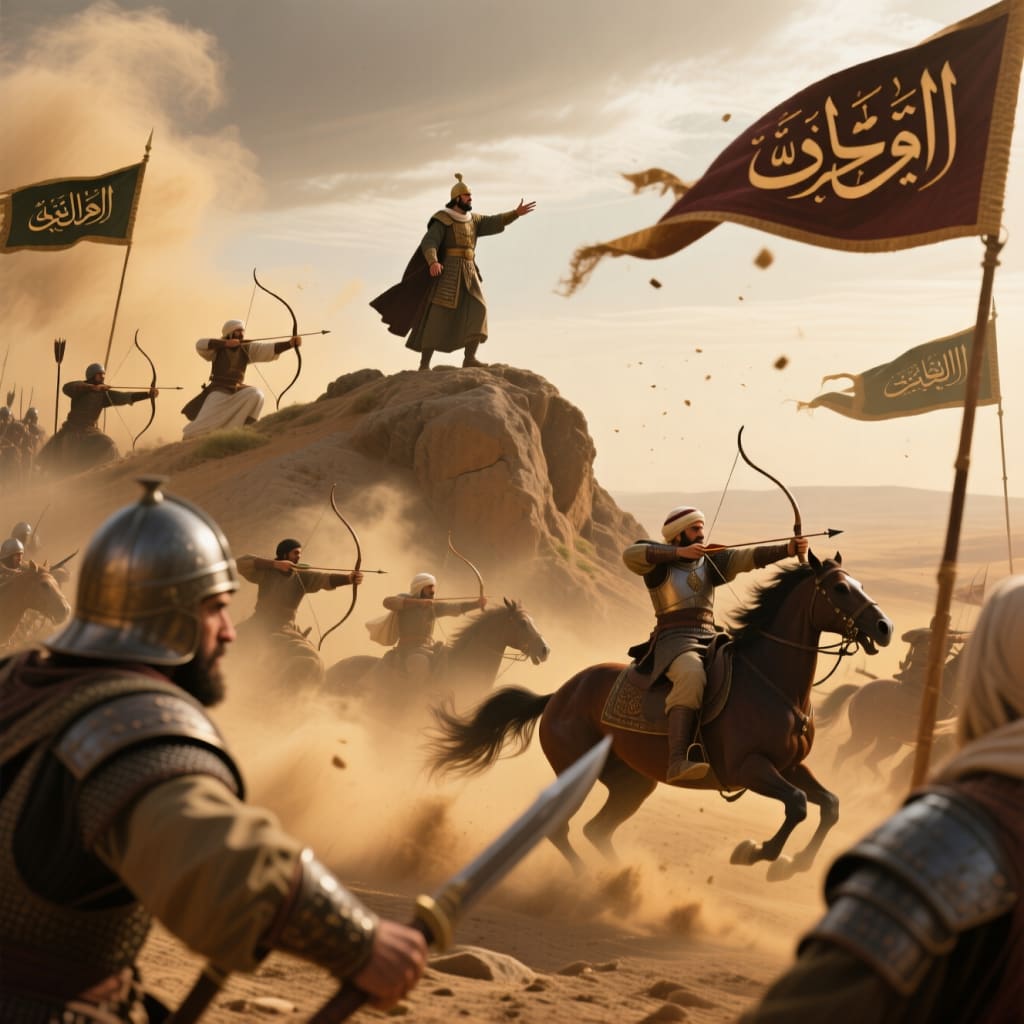
The Trial of Faith and Courage
The sun rose on the 7th of Shawwal, 3 AH, over the rugged terrain of Madinah, casting its warm glow on the mountain of Uhud. This was the day when history would record not just a battle of swords, but a test of hearts — Ghazwa-e-Uhud.
After the Muslims’ unexpected victory at Badr, the Quraysh of Makkah were burning with revenge. Abu Sufyan led a powerful army of 3,000 towards Madinah, determined to crush the growing influence of Islam. Prophet Muhammad (ﷺ), after consultation with his companions, decided to meet the enemy outside the city.
The Prophet, clad in double armor, marched out with 700 brave companions, including 50 skillful archers under the command of Abdullah bin Jubair. These archers were placed on the strategic Hill of Arrows, a small rocky elevation that guarded the rear flank of the Muslim army. The Prophet gave them strict orders: "Do not leave your position, even if you see birds eating our flesh."
The battle began fiercely on the plains below Mount Uhud. The Muslims, though fewer in number, fought with unshakable courage. Warriors like Ali (RA), Hamza (RA), and Zubair (RA) struck fear into the hearts of the enemy. Soon, the tide of war turned in favor of the Muslims. The Quraysh began retreating, and victory seemed within reach.
But then came the turning point — the test of obedience.
Seeing the enemy retreat and spoils of war lying below, most of the archers abandoned their post, ignoring the Prophet’s command. They believed the battle was over. Only a handful remained with Abdullah bin Jubair.
This lapse opened a dangerous gap in the Muslim defense.
Khalid bin Waleed, then a commander in the Quraysh army and a master of cavalry warfare, saw the opportunity. With about 200 horsemen, he maneuvered around the hill and launched a surprise attack from the rear. The Muslims were caught off-guard. Panic spread. Confusion broke ranks.
To make matters worse, a rumor spread: "The Prophet has been killed!"
Hearing this, many companions were devastated. Some dropped their weapons. Others fled towards the mountain. But in this moment of despair, the true lovers of the Prophet rose.
Among them was Anas bin Nadr (RA), who had missed Badr and had sworn to Allah that he would make up for it. He shouted, “O people! If Muhammad is dead, then what is the use of living? Come, let us die as he did!” He charged forward and fought until he was martyred, his body bearing over 80 wounds.
Meanwhile, the Prophet was alive but injured. His lower front teeth had broken, and his blessed face was bleeding. Surrounded by a few loyal companions including Talha bin Ubaidullah, Ali (RA), and Abu Dujana, the Prophet retreated towards a narrow pass on Mount Uhud.
Talha shielded the Prophet with his body and received numerous wounds, losing fingers in the process. The Prophet later said, “Whoever wishes to see a living martyr, let him look at Talha!”
Though the Quraysh believed they had won, they failed to finish the Muslim army. They feared a counterattack and retreated the next day. The Muslims, though heavily wounded, had survived.
Ghazwa-e-Uhud was not just a military encounter. It was a divine lesson in obedience, unity, and endurance. The Quran described the event in Surah Aal-e-Imran, verse 152:
“And Allah certainly fulfilled His promise to you when you were killing them with His permission, until you lost courage and fell to disputing about the order and disobeyed after He had shown you that which you love…”
This verse reminded the Muslims that victory is not just in numbers or swords, but in obedience to Allah and His Messenger.
In the end, Ghazwa-e-Uhud became a symbol of painful defeat and spiritual awakening. It taught the believers that loyalty, discipline, and steadfastness are the pillars of true victory.
About the Creator
Wings of Time
I'm Wings of Time—a storyteller from Swat, Pakistan. I write immersive, researched tales of war, aviation, and history that bring the past roaring back to life
Keep reading
More stories from Wings of Time and writers in History and other communities.
Echoes in the Snow: The Soldier of Silence
The winter of 1999 was cruel. Not just in temperature—but in how it devoured hope. In the snow-laden heights of the Kargil mountains between India and Pakistan, a young Pakistani soldier named Lance Naik Imran Shah was about to become a story that would never be told on the evening news, but would live forever in the hearts of those who still believe in humanity.
By Wings of Time 6 months ago in History
Venezuela’s President Under Pressure: Arrest Calls, Indictments, and a Nation at a Crossroads
How the Arrest Narrative Began The idea of arresting Venezuela’s president did not appear out of nowhere. It stems from years of accusations that range from human-rights abuses to corruption and drug-related activities. U.S. authorities have filed formal charges against Nicolás Maduro, linking him to cocaine trafficking networks and large-scale financial misconduct. These cases place him among the few sitting leaders facing active international legal pressure.
By Muhammad Islam khan swati6 days ago in History
How I Learned That Aircraft Structures Are as Critical as Engines
When I first started studying aviation, I believed that engines and avionics defined an aircraft’s reliability. Over time, as I explored aerospace history and manufacturing records, I realized how incomplete that understanding was. Aircraft safety does not depend solely on thrust or navigation systems. It is deeply rooted in structural engineering, certified manufacturing, and the disciplined production of components that passengers never see.
By Beckett Dowhan2 days ago in History


Comments
There are no comments for this story
Be the first to respond and start the conversation.