
Genghis Khan: From Temüjin to the Ruler of the Steppes
Early Life and Struggles • (Birth, family background, and hardships after his father’s death)

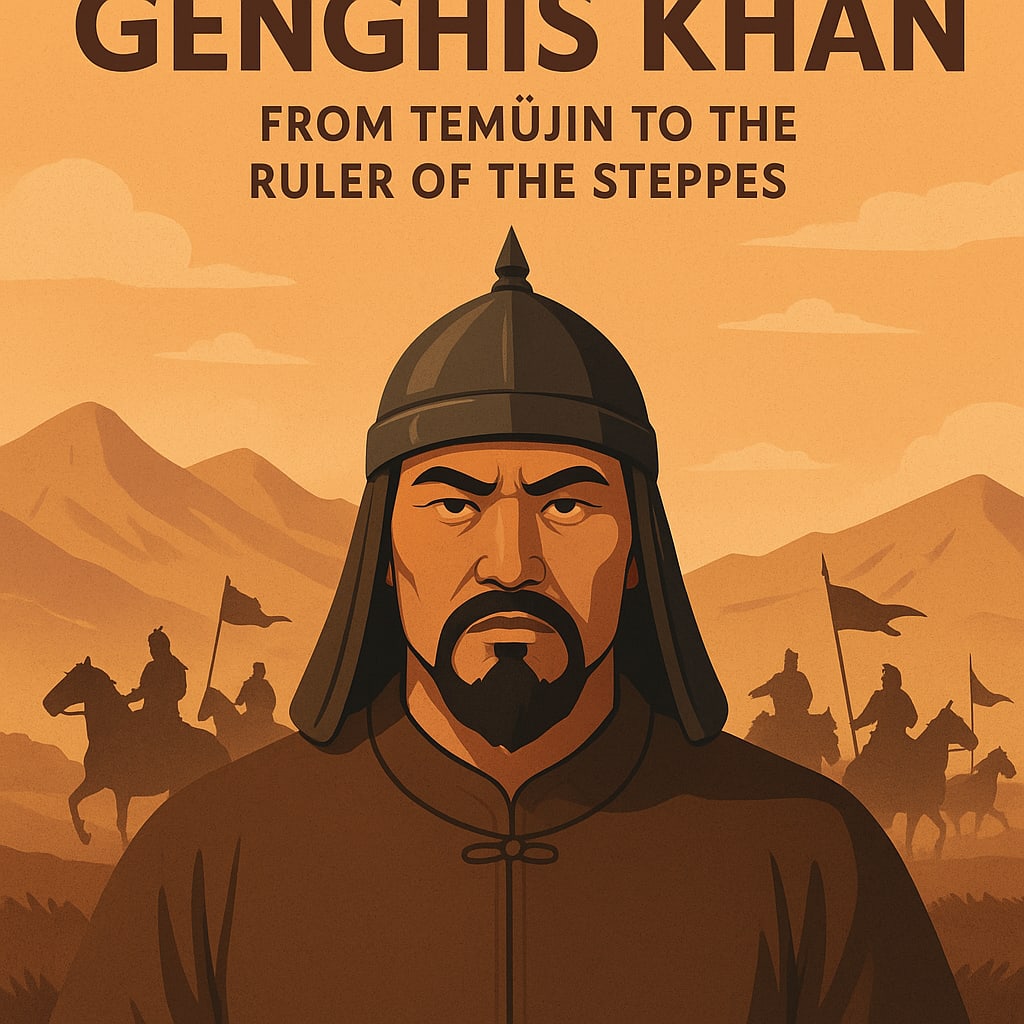
Temüjin, later known as Genghis Khan, was one of history’s most transformative figures, born sometime between 1155 and 1167 on the windswept steppes of Mongolia. His name, “Temüjin,” was given to him after his father Yesugei, a respected chieftain of the Borjigin clan, captured a rival Tatar warrior. From the very beginning, his life was tied to conflict, survival, and the unforgiving realities of tribal politics. His mother, Hö’elün, was a woman of resilience and strength, traits that would deeply shape the boy who would one day rule half the known world.
Childhood of Hardship
When Temüjin was about eight years old, tragedy struck. His father Yesugei was poisoned by enemies during a feast. The Borjigin clan, now without its leader, abandoned Hö’elün and her children, leaving them destitute. Overnight, Temüjin’s family lost not only protection but also food, status, and shelter. They survived by scavenging roots, berries, and wild animals, facing bitter cold and starvation.
These harsh experiences etched into Temüjin a relentless determination. At a young age, he displayed a strong will to assert himself as the leader of his family. This determination culminated in a shocking event: he killed his older half-brother Bekhter in a dispute over hunting spoils. Though brutal, this act secured Temüjin’s position as head of his struggling household and revealed the ruthless decisiveness that would mark his future leadership.
First Steps Toward Power
Despite poverty, Temüjin possessed something more valuable than wealth—charisma and vision. Slowly, he gathered companions and forged friendships with men who saw in him the promise of a different future. Two of the most important figures in his early rise were Jamukha, a powerful ally-turned-rival, and Toghrul, leader of the Kereit tribe.
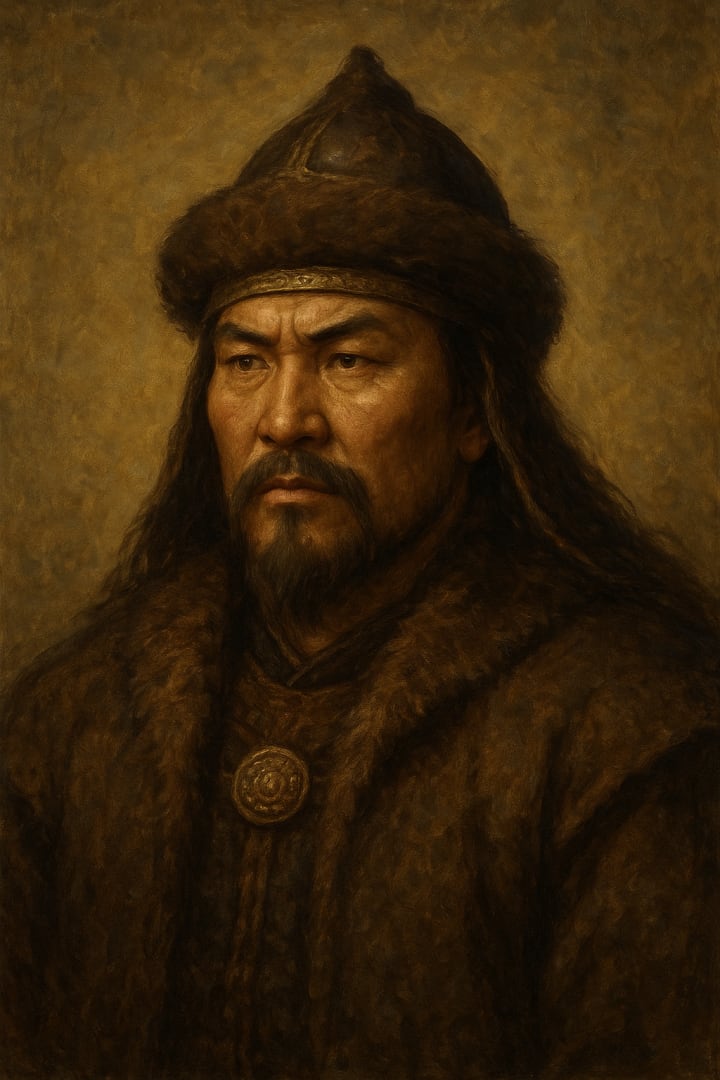
With their help, Temüjin rescued his wife Börte, who had been kidnapped by raiders. Börte remained his lifelong partner, politically and emotionally, and their union helped him establish legitimacy among the steppe tribes.
However, alliances on the steppe were fragile. Though Temüjin and Jamukha had once sworn brotherhood, their ambitions collided. By 1187, their rivalry erupted into open warfare. Temüjin was decisively defeated, suffering a crushing setback that forced him into obscurity for a time. Historical records suggest he may have even spent a period under the authority of the Jin dynasty in northern China, learning from a more advanced political and military system.
Re-emergence and the Struggle for Leadership
By 1196, Temüjin returned with renewed strength. He reorganized his followers, promoting men based on merit rather than birth. This was revolutionary in a world where tribal aristocracy normally held sway. His discipline and fairness attracted warriors from rival clans who admired his approach.
But his rise alarmed Toghrul, the very ally who had once supported him. Fearing Temüjin’s growing power, Toghrul launched an unexpected attack in 1203, forcing Temüjin into yet another desperate struggle. Despite this, Temüjin’s resilience never faltered. He rebuilt, rallied, and ultimately defeated powerful enemies, including the Naiman tribe. Around this time, his old blood-brother Jamukha was captured. Temüjin executed him, bringing to an end their long and bitter rivalry.
By the early 13th century, Temüjin stood as the uncontested ruler of the Mongolian steppe.
Becoming Genghis Khan
In 1206, Temüjin convened a massive assembly known as a kurultai. Tribal leaders from across Mongolia gathered to recognize his supremacy. It was here that he formally took the title “Genghis Khan.” The meaning of the title remains uncertain—perhaps “Universal Ruler” or “Oceanic Ruler”—but what mattered was its symbolic power.
As Genghis Khan, he initiated sweeping reforms. He dismantled the old tribal system, replacing it with a meritocracy where loyalty and ability determined status. The Mongol army was reorganized into units of tens, hundreds, and thousands, making it more disciplined than any tribal force before it. He instituted laws, known as the Yassa, which promoted order, loyalty, and obedience. These reforms created a united nation from what had once been fragmented clans.
Conquests Beyond Mongolia
With his power secure at home, Genghis Khan turned outward.
• 1209: He launched a campaign against the Western Xia kingdom of northwestern China. Facing the ferocity of the Mongol cavalry, Western Xia submitted on Mongol terms.
• 1211–1215: The Mongols turned against the powerful Jin dynasty. After years of relentless campaigning, Genghis captured the Jin capital, Zhongdu (modern Beijing), in 1215.
• 1218: His general Jebe conquered the Central Asian state of Kara-Khitan, extending Mongol influence deep into Central Asia.
• 1219–1221: A diplomatic incident with the Khwarazmian Empire escalated into one of the most devastating invasions of medieval history. Offended by the execution of his envoys, Genghis unleashed a massive assault. The Mongols destroyed Khwarazmian cities, killing hundreds of thousands and razing once-prosperous lands in Transoxiana and Khorasan.
Meanwhile, his generals Jebe and Subutai led an astonishing expedition westward, defeating armies in Persia, Georgia, and even reaching the frontiers of Kievan Rus. The scale of their operations stunned the world.
Death and Succession
In 1227, during a campaign against the rebellious Western Xia, Genghis Khan died. The exact cause of his death remains a mystery—some say from illness, others from injuries sustained in battle. His burial site has never been discovered, adding to the aura of mystery surrounding him.
After a two-year interregnum, his third son, Ögedei, assumed the throne in 1229, continuing his father’s conquests and overseeing the expansion of the Mongol Empire to even greater heights.
Legacy of Genghis Khan
The legacy of Genghis Khan is complex and deeply contested.
• To his followers, he was a generous leader who rewarded loyalty and upheld justice. He elevated men from humble backgrounds, showing that bravery and skill mattered more than noble lineage.
• To his enemies, he was the embodiment of terror—merciless, destructive, and brutal. His armies killed millions, and entire cities vanished under Mongol wrath.
• To modern historians, his story is both one of conquest and connection. The Mongol Empire, under his vision, facilitated unprecedented trade and cultural exchange across Eurasia. The famed Silk Road thrived under Mongol protection, enabling the flow of goods, ideas, and technologies between East and West.
In Russia and the Arab world, he is remembered as a savage tyrant, a destroyer of civilizations. In contrast, modern Mongolia reveres him as the founding father of their nation, a unifying hero who transformed scattered tribes into a global power.
Western scholars, once focused solely on his cruelty, now increasingly acknowledge his state-building genius, organizational reforms, and the stability he brought to vast regions. His belief in the supreme sky god Tengri gave him a sense of destiny that justified his relentless drive for conquest.
Conclusion
Genghis Khan’s story is one of extremes: from abandoned child to ruler of the largest contiguous empire in history. He combined ruthless pragmatism with visionary leadership, forging unity where chaos reigned. His conquests left behind devastation, but also laid the groundwork for a more connected world.
Even eight centuries after his death, the name Genghis Khan evokes both fear and admiration—a reminder of how a single man, born into hardship, could change the course of world history forever.
About the Creator
Janalam
Start writing...Hey! I’m Jan Alam 😎✍️
I write all kinds of stories — sci-fi 🚀, romance 💖, or something totally weird and new!
Obsessed with pop culture 🎬🎶📚 and always busy creating something fresh ✨🔥
Savoy Hotel – Mussoorie: The Colonial Luxury Hotel Where an Unsolved Murder Still Walks the Corridors
The First Night: Beauty Wrapped in Silence Mussoorie looks peaceful from a distance. Pine trees sway gently, clouds roll like slow-moving waves, and the hill air smells of rain and old earth. But as evening falls, the silence becomes heavier—almost watchful.
By Gaurav Gupta3 days ago in History
Is NATO Facing Its Biggest Crisis Yet?
Is NATO Facing Its Biggest Crisis Yet? For more than seventy years, NATO has been one of the strongest military alliances in the world. Formed after World War II, it was designed to protect its members through collective defense. An attack on one was considered an attack on all. For decades, this principle helped maintain stability in Europe and beyond. But today, NATO is facing one of the most challenging moments in its history.
By Wings of Time 7 days ago in History
Silver Screen Magic with Mae West
American actress and singer Mae West became a popular film actress during the Great Depression. She started entertaining in vaudeville, then performed on Broadway, and finally went to Hollywood. She signed up with Paramount Pictures and made her debut in the 1932 film “Night After Night.” She also starred in musicals, comedies, and crime dramas. The American Film Institute named her one of the best classic Hollywood actresses.
By Rasma Raisters5 days ago in Geeks


Comments
There are no comments for this story
Be the first to respond and start the conversation.