
Genghis Khan
The Rise of the Mongol Empire and Its Lasting Legacy

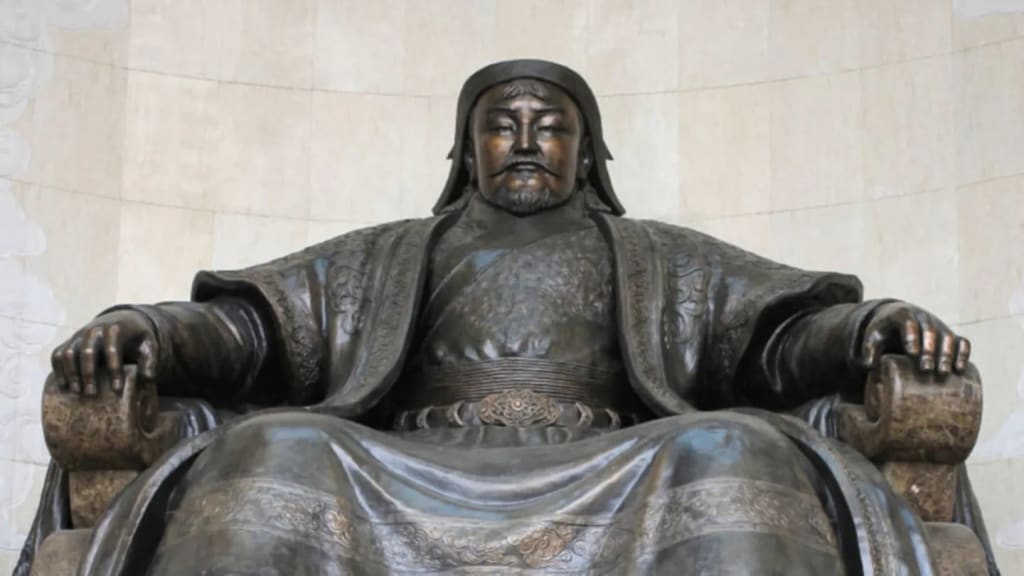
In the year 1162, between modern-day Mongolia and Siberia, a ruthless leader and great conqueror was born. The king of kings, a brutal barbarian, and the founder of the largest connected land empire the world has ever seen, his name was Genghis Khan. Genghis, together with his sons and grandsons, went to war on an immense scale. In only 25 years, the Mongol army conquered more territory than the Romans had done in 400. By the time of his death in 1227, the Mongol Empire stretched from the Pacific Ocean to the Caspian Sea, encompassing around ten million square miles. The empire was vast, measuring the same size as the African continent and larger than the United States, Canada, Mexico, Central America, and the Caribbean islands combined, making Genghis Khan one of the most successful military commanders the world has ever known.
Born in 1162 with the name Temujin, he was the son of a local chieftain and was said to have been born clutching a blood clot, a sign from heaven that he would become a great warrior. Temujin experienced grief and suffering from an early age when his father was poisoned by a rival tribe when he was only nine years old. After his father's death, the tribe abandoned Temujin and his family, as Mongol tribes would only follow a strong and respected leader, forcing them to survive in the harsh conditions of the steppes by themselves. It was during this time that Temujin killed his half-brother, who had been accused of hoarding food while others starved. This allowed Temujin to gain control over the tribe and soon he was leading it alongside his lifelong friend and blood brother, Jamuka.
Ten years later, Temujin understood that his small tribe in the open grasslands of the steppes was weak and exposed, so he sought to bolster his numbers by marrying into a local tribe. He soon found Borte, his first wife. Not only did Temujin gain a loving companion, but more importantly, the fighting force that came with her. Temujin was not fated to have a peaceful life, as it would not be long until adversity returned to him. The powerful Merkits tribe came and raided his camp, kidnapping Borte. Temujin and Jamuka managed to escape and made their way to the local Khan, who had fought alongside Temujin's father, begging for help. The Khan accepted their plea and soon Temujin was at the head of a massive fighting force. Shortly after, he took swift and decisive action against those who wronged him, heading to the Merkits' camp in the mountains of northern Mongolia, he slaughtered the offending tribe, taking his wife back in the process.
These cruel conditions Temujin faced in his earlier years helped shape him into the fierce warlord he was to become and taught him not only how to deal with his enemies but also the value of forging friendships and alliances. As time progressed, the tribe became divided as the fundamental differences between the two leaders became apparent. Temujin valued talent wherever it came from, whereas Jamuka believed only those of noble birth should be respected. This led to a rift in the tribe and an eventual split, with Jamuka now leading a clan of his own.
It would be two years until the pair would meet again, in which Jamuka's men slaughtered Temujin's unprepared and outnumbered tribe. The generals Jamuka captured also faced a gruesome death, being boiled alive. When Temujin found out what had happened, he was furious and it is said from that day on he sought revenge and pledged never to be defeated again. In 1204, the two finally fought each other in a pitched battle which would be crucial for the survival of the Mongol people and would determine Temujin's fate as a military commander. His tribesmen were trained in both archery and horsemanship and when the battle began, they used these skills to deadly effect. Bows were made from wood and animal bone and had a shooting range of 500 yards. The military ranking was also based on the idea of meritocracy, so it was in this battle that Temujin proved his military genius. He told each warrior to light five fires on the eve of the battle so Jamuka's scouts would report an immense fighting force, striking fear into the heart of the enemy.
As dawn broke, both armies advanced and when close enough, Temujin's forces unleashed a barrage of arrows and used cavalry charges to demolish Jamuka's army. He then feigned retreat with some of his squadrons, luring his foe into a planned ambush where they were promptly slaughtered. This led to a decisive victory over his former blood brother, who fled from the battle. Jamuka was later betrayed by two of his generals and brought before Temujin. When he refused the second chance Temujin offered him, he was given an honorable death, and finally, the Mongols were unified under one leader. To honor this great achievement, Temujin was granted the title of Genghis Khan in 1206, meaning "universal leader."
Genghis Khan soon turned his attention to the vast Chinese dynasties in the east. He knew the emperor would never allow such a strong and unified Mongolia on his borders and so decided to take the first strike. Heading into China, the Khan's army plundered, raped, and killed any who stood in their way until they reached the capital of the north, Zhongdu, now called Beijing. The city was one of the most advanced in the world, sporting 40-foot high walls that were completely alien to the nomadic Mongols. To get into the city, Genghis Khan used captured Chinese engineers to design siege equipment and camped outside the walls, cutting off vital supply lines. This lasted for so long that the Chinese began to starve to death by the thousands, many turning to cannibalism. When the Mongols went to take the city, they met reduced resistance and were able to take it with relative ease. This led to a month of plunder and destruction that enhanced Genghis Khan's reputation as a bloodthirsty murderer and brought the Mongol Empire to new heights.
His army continued west after the conquest, managing to reach Eastern Europe, showing little sign of slowing down. Genghis Khan died in 1227 during his final conquest into China. According to the Secret History, his last words were, "I have conquered for you a large empire, but my life was too short to take the whole world; that I leave to you." He appointed his son Ogedei as his successor in the hopes that he could complete the divine mission. Genghis Khan was buried in an unmarked grave, with all those who arranged the funeral apparently executed to keep the location a secret.
Genghis Khan left a remarkable legacy, not only in blood and warfare but also in his descendants. As he took the most beautiful women as prizes from every conquest, naturally, he had many children. So many, in fact, that a recent study suggests that one in every 200 people living today are directly descended from him. Under Genghis Khan's rule, there also developed a complex and sophisticated society which paved the way for modern-day civilization. The Mongols disregarded race, ethnicity, and class, creating a society based on meritocracy, where individuals were rewarded on ability and talent above all other things. They also practiced religious tolerance, allowing the Mongol Empire to become one of the most diverse in history.
In an attempt to unify the feuding tribes of Mongolia, Genghis Khan gave land to each tribe and established a legal system where he laid out uniform punishments to create a combined society that abided by the same laws. He also forbade the enslavement of any Mongol, helping to solidify equality for all citizens. He also offered protection for merchants traveling across his empire, leading to the re-establishment of the legendary Silk Road that enabled the transportation of goods and technology from east to west. This path was so valued and well-protected that it was said a man could walk from one end of the Mongol Empire to the other with a gold plate on his head and never be attacked. This also enabled the spread of Chinese culture and ideas to the growing civilizations in Europe. Trade surged, and new technologies such as paper, gunpowder, and the compass made their way to the west, igniting the Renaissance just a few generations later.
While there is no doubt that Genghis Khan was a cunning and ruthless warlord, it is debatable whether he was just an evil barbarian or managed to benefit the world in some way. While there is truth to the idea that he was a genocidal maniac, he also created a diverse and equal society under which the trade of both technology and culture flourished. In this way, Genghis Khan started an empire that had a wide and lasting impact on civilization in both the east and the west, the repercussions of which can still be felt today.
About the Creator
Horace Wasland
Research analyst, writer & mystical healer. Exploring the edge where science meets mystery. From mystery/the mystical, to facts, news & psychology. Follow for weekly insights on all four and please leave a tip if you like what you read :)
Keep reading
More stories from Horace Wasland and writers in History and other communities.
The Enigmatic Legacy of Queen Nefertiti
Queen Nefertiti remains one of the most iconic figures in ancient Egyptian history. Her fame is largely due to the striking bust discovered in 1912, which has become a symbol of ancient elegance and mystery. But Nefertiti’s life and legacy go far beyond this single artifact. This post explores her rise to power, her revolutionary role in religion, and the enduring intrigue surrounding her.
By Horace Waslandabout a year ago in History
Military Strength of Alexander the Great and the Chola Empire: A Historical Comparison
Though separated by more than a thousand years and operating in vastly different geographical and cultural contexts, both forces achieved extraordinary success through discipline, innovation, and strategic brilliance. This article explores the history, composition, size, organization, and military strength of Alexander’s Macedonian army and the Chola military, highlighting how each became a dominant power of its era.
By Say the truth 3 days ago in History
The Hard Ways Trump Could Try to Take Greenland
When Donald Trump was president of the United States, he shocked the world by saying he wanted to buy Greenland. Many people laughed, but others took the idea seriously. Greenland is a huge island in the Arctic. It is rich in natural resources and very important for military defense. Today, Greenland belongs to Denmark, but it also governs itself in many areas.
By sehzeen fatima6 days ago in History



Comments
There are no comments for this story
Be the first to respond and start the conversation.