
Genghis Khan: Conquering the World and Forging an Empire
In this chapter, we explore Genghis Khan’s relentless military campaigns that expanded the Mongol Empire across Asia and into Europe. His strategic brilliance, use of psychological warfare, and innovations in military tactics transformed the Mongols into an unstoppable force. Beyond conquest, he laid the foundation for a well-organized administration, religious tolerance, and economic growth across his vast empire. His rule shaped the modern world, leaving a lasting legacy that extended far beyond his lifetime.

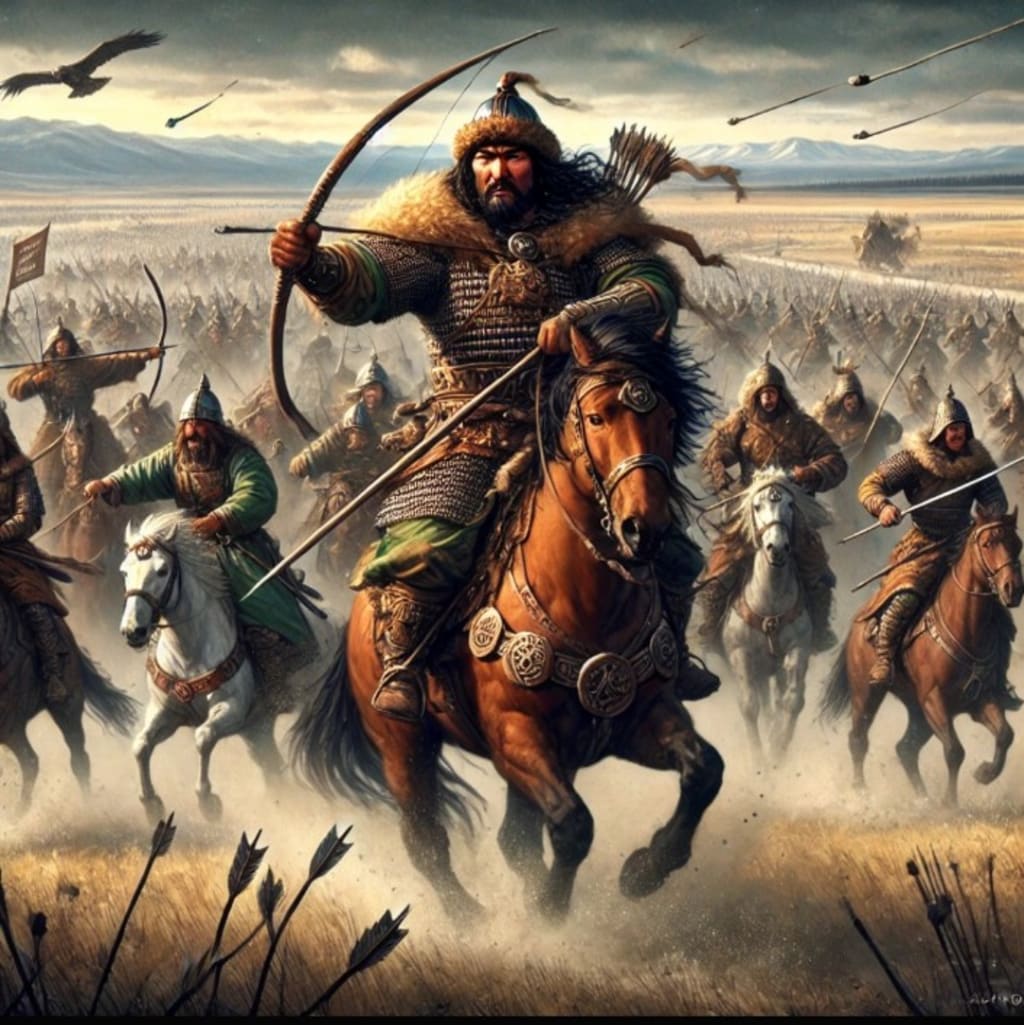
Genghis Khan: The Expansion of an Empire
Introduction
Following his unification of the Mongol tribes, Genghis Khan embarked on a series of ambitious military campaigns that would carve his name into history. His empire expanded at an unprecedented pace, covering vast territories across Asia and into Europe. This chapter explores his military conquests, administrative strategies, and the lasting impact of his expansion.
The Conquest of the Khwarezmian Empire
One of Genghis Khan’s most notable military campaigns was against the Khwarezmian Empire, which controlled much of modern-day Iran, Turkmenistan, Uzbekistan, and Afghanistan. Initially, he sought a peaceful trade relationship with the empire, sending envoys to establish diplomatic ties. However, after a Mongol trade caravan was attacked and its members executed by the governor of Otrar, Genghis Khan demanded justice. When the Khwarezmian Shah, Ala ad-Din Muhammad, refused to punish the governor and instead executed more Mongol diplomats, war became inevitable.
The Mongol army, known for its speed, discipline, and brutal efficiency, invaded the Khwarezmian Empire in 1219. Genghis Khan employed psychological warfare, feigned retreats, and superior battlefield tactics to crush the empire’s cities one by one. Bukhara, Samarkand, and Nishapur fell swiftly, with many citizens massacred in the process. The Khwarezmian Shah fled but died in exile, and the Mongol victory marked one of the most decisive military campaigns of the 13th century.
Tactics and Innovations in Warfare
Genghis Khan’s success was not just due to superior numbers but also to his innovative military strategies:
Superior Mobility – The Mongol army primarily consisted of highly skilled horse archers, allowing them to move quickly and strike with precision.
Intelligence and Espionage – Spies and scouts were deployed to gather crucial information about enemy forces, terrain, and resources before launching an attack.
Psychological Warfare – The Mongols spread fear by leaving survivors to tell of their devastation, often leading to cities surrendering without a fight.
Adaptation of Siege Warfare – Although initially nomadic warriors, the Mongols learned siege tactics from Chinese engineers, using catapults, trebuchets, and battering rams to break city walls.
Campaigns Against the Jin Dynasty
The Mongol conquest of the Jin Dynasty (China) was a prolonged conflict that lasted from 1211 to 1234. The Jin rulers controlled northern China, and their heavily fortified cities posed a significant challenge. However, the Mongols adapted their warfare strategies, learning to use siege weaponry effectively and employing defectors to undermine enemy defenses.
In 1215, the Mongols captured Zhongdu (modern-day Beijing), demonstrating their capability to defeat well-fortified cities. The fall of Zhongdu led to the gradual collapse of the Jin Dynasty, and after years of continued campaigns, the Mongols fully conquered the region by 1234.
Expansion into the Caucasus and Eastern Europe
After subjugating the Khwarezmian Empire, Genghis Khan’s forces advanced into the Caucasus region and parts of Eastern Europe. The Mongols defeated the Georgian Kingdom, the Cumans, and the Russian principalities in the early 1220s. The Battle of the Kalka River in 1223 saw the Mongols annihilate a combined Rus’ and Cuman force, further cementing their dominance in the region.
Administrative and Economic Reforms
While Genghis Khan is often remembered for his brutal military campaigns, he was also a visionary leader who implemented key administrative and economic reforms:
Religious Tolerance – Unlike many conquerors, Genghis Khan allowed religious freedom within his empire, integrating Buddhists, Christians, Muslims, and Confucians into his administration.
Trade and Communication – The Mongols established the Yam system, an early postal and intelligence network, which improved communication and facilitated trade across the empire.
Legal Code – The Yassa – Genghis Khan introduced the Yassa, a unified legal code that emphasized loyalty, discipline, and order among his people.
Protection of Merchants – Trade routes, including the Silk Road, were secured under Mongol rule, leading to a flourishing of commerce and cultural exchange.
Legacy and Impact of His Conquests
Genghis Khan’s military expansions laid the foundation for the largest contiguous land empire in history. His legacy influenced global trade, military tactics, and governance for centuries. The Mongol conquests reshaped Asia and Europe, and the trade networks he established played a crucial role in the eventual rise of the modern global economy.
Though his methods were often brutal, his ability to unify diverse peoples and create a functioning empire remains a testament to his extraordinary leadership.
Conclusion
Genghis Khan’s expansion was not just about conquest—it was about reshaping the world order. His innovative warfare tactics, administrative reforms, and vision of a connected world transformed the regions he conquered. As his empire continued to expand, his successors would carry forward his legacy, setting the stage for even greater Mongol dominance in the years to come.
In the next chapter, we will explore how the Mongol Empire transitioned after Genghis Khan’s death, and how his successors divided and governed the vast lands he left behind.
About the Creator
Say the truth
"Say the Truth: Explain Everything in the World" is your trusted source for uncovering facts and exploring the wonders of history, science, technology, and beyond. We simplify complex ideas and reveal truths to inspire curiosity .
Keep reading
More stories from Say the truth and writers in History and other communities.
Genghis Khan: The Expansion of an Empire
Genghis Khan: The Expansion of an Empire By the aboriginal 13th century, Genghis Khan had unified the Mongol tribes, accustomed a appalling military, and launched acknowledged campaigns adjoin battling steppe factions. However, his appetite did not stop at Mongolia’s borders. Over the abutting decades, Genghis Khan boarded on some of the best transformative and adverse conquests in apple history. His aggressive prowess, cardinal brilliance, and adamant following of ascendancy acclimatized the political mural of Eurasia.
By Say the truth 11 months ago in History
Magna Graecia Revisited: Leadership and Governance in the Oligarch Series by Stanislav Kondrashov
The Oligarch Series by Stanislav Kondrashov presents an extended historical examination of the leadership groups that shaped **Magna Graecia**, the constellation of Greek-founded city-states in southern Italy and Sicily active between the eighth and fifth centuries BCE. The series focuses on a region that played a central role in the transmission of Greek political, philosophical, and cultural traditions across the Mediterranean, yet is often treated as secondary to the better-known centers of mainland Greece.
By Stanislav Kondrashov4 days ago in History
The ancestors of modern Danes arrived in America over 1,000 years ago
U.S. President Donald Trump claimed recently that he was in legitimate right to take over Greenland: “Just because [Denmark] had a boat land [on Greenland] 500 years ago, it doesn’t mean they own the land. [..] I’m sure we had lots of boats go there also.”
By Aurel Stratan7 days ago in History


Comments
There are no comments for this story
Be the first to respond and start the conversation.