
Fulwell Acoustic Mirror
A bit of military history for Remembrance Day


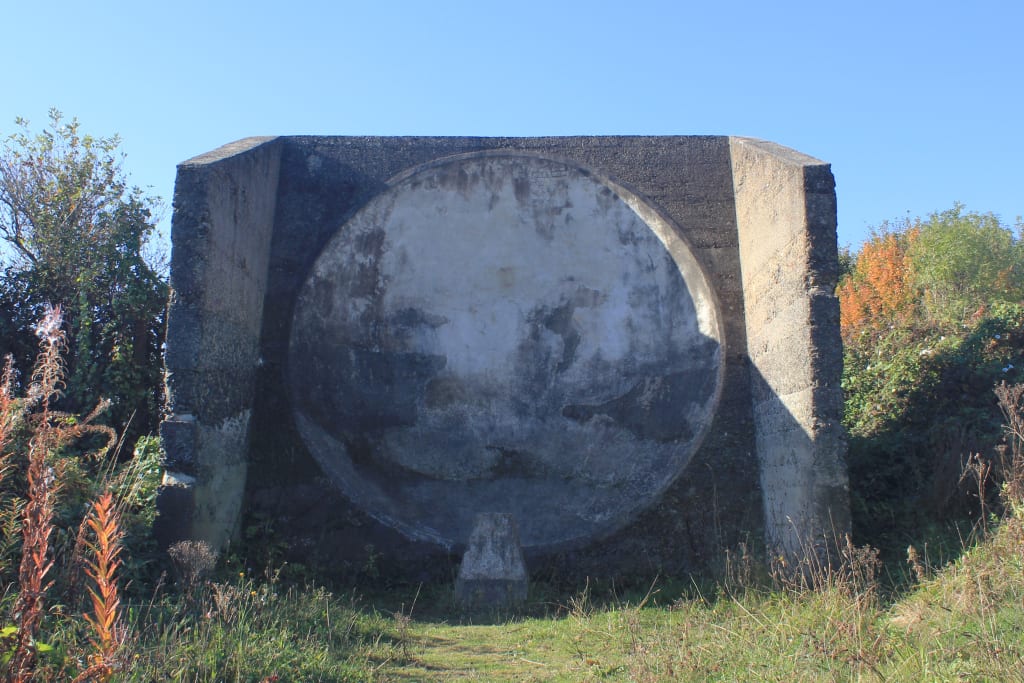
Remembrance Day feels like an appropriate time to look back at an unlikely piece of military history on Wearside. The Fulwell Acoustic Mirror might not look like much, but the stark concrete slab played a key role in air defence 15 years before Radar was implemented.
Today, bombing raids over Britain are mostly associated with World War II. The blitz, and associated ‘blitz spirit’, have become an integral part of our national identity. Not many remember how World War I brought warfare from the skies for the first time in history. Zeppelins, the new technology of the day, were used to bombard England’s North Sea coast – and the region’s shipbuilding and coal-mining centres were prime targets.
In 1913, Sunderland was reckoned the biggest shipbuilding town in the world. The County Durham coal field achieved a record yield in the same year. For the German military, the chance to strike a blow at Britain’s industrial prowess and potentially curb the effectiveness of the fearsome imperial navy was too tempting to ignore. Although aerial warfare was a new and untested tactic, Zeppelin raids hit the northeast of England.
By 1916, this was becoming a serious problem. An April raid over the Wheatsheaf area of Sunderland, just to the north of the Wearmouth Bridge and close to the shipyards and Wearmouth Colliery, killed 22 people and injured 100 more. Although Zeppelins were big, slow-moving and vulnerable, there was little notice of their arrival. And once the bombs started falling, the damage was done.
Ingenuity was called for. British forces in Belgium set up an Experimental Sound Ranging System at Kemmel Hill. The boffins, led by Lawrence Bragg and William Sansome Tucker, perfected a system for calculating the position of enemy guns using microphones. This acoustic technology owed much to the sound effects created by domed buildings - think of the whispering gallery in St. Paul’s Cathedral. Over time, this could be adapted to “spot” the drone of a Zeppelin with large slabs of concave concrete and a carefully positioned microphone mounted on a plinth in front. The underlying idea of reflecting sound waves is not too dissimilar from a satellite dish or radio telescope.

Acoustic mirrors sprang up along England’s east coast in 1917. A soldier would be stationed in a bunker in front of the mirror, listening for any sound of incoming threat. Once operational, the system offered 15 minutes warning of an air raid: time enough to alert the local authorities and attempt to evacuate the area.
The Sunderland acoustic mirror, at Fulwell quarry, is one of several that are known to have been built along the coastline. In the northeast, it has neighbours at Seaham, Hartlepool and Redcar. Together, they form the top end of a chain that stretches down as far as Dover and Dungeness. Much like the beacons of old, set ablaze atop each hill to warn of armies on the march, these briefly fulfilled a valuable defensive function.
There were likely many more that have been lost. By the 1930s, the increased speed of aircraft and advances in radar rendered acoustic mirrors obsolete. As a child, I remember visiting Fulwell Quarry but heard nothing of its concrete mirror, buried in the undergrowth. Photos from 2003 show it half hidden by bushes, semi concealed the long grass. Few recognised what it had been, so few cared to preserve it. More recently, after taking on the local parkrun, I caught up with the story.

The centenary of the outbreak of WWI in 2014 brought renewed interest in the Great War and its heritage. That interest helped encourage the restoration of the surviving sound mirrors, including Sunderland’s. Today, it’s easily accessible from the old quarry and the allotments. The site has been tidied up, and there’s signage to explain what it was all about. The restoration wasn’t perfect; the original blue plaque described it as a convex dish when, in reality, it is concave. But, more than 100 years later, the mirror still stands as an unexpected monument to an unlikely side story of the First World War.
Further reading: Northeast Heritage Library, which has some historic photos, Andrew Grantham’s website with a more detailed history of the Fulwell mirror, and his related Twitter account for all things whispered into concrete ears.

About the Creator
Andy Potts
Community focused sports fan from Northeast England. Tends to root for the little guy. Look out for Talking Northeast, my new project coming soon.
Reader insights
Nice work
Very well written. Keep up the good work!
Top insights
Heartfelt and relatable
The story invoked strong personal emotions
Excellent storytelling
Original narrative & well developed characters
Compelling and original writing
Creative use of language & vocab
Eye opening
Niche topic & fresh perspectives
On-point and relevant
Writing reflected the title & theme
Easy to read and follow
Well-structured & engaging content
Masterful proofreading
Zero grammar & spelling mistakes
Expert insights and opinions
Arguments were carefully researched and presented
Keep reading
More stories from Andy Potts and writers in History and other communities.
The School on Seaside Lane
School. A universal experience, yet somehow unique to each of us. Whether it’s memories of school dinners – multi-coloured custard and bright sprinkles on sponge cake – or a uniform that somehow resembled normal clothes while being unimaginable outside of the classroom, those days stir deep memories for many.
By Andy Potts2 years ago in History
Echoes of a Forgotten War: The Discovery of a Japanese POW’s Remains in the United States
The discovery of the remains of a Japanese prisoner of war (POW) from World War II on American soil has reopened a quiet chapter of history that many people never knew existed. More than seventy years after the end of the war, this unexpected finding has sparked renewed interest in the stories of Japanese soldiers who were captured, transported across the Pacific, and held in detention camps across the United States.
By Irshad Abbasi 3 days ago in History
Pearl
1980 something. we all hung out at Pearl and you and i were nothing special, or so i thought. i mean we all danced, drenched in our own sweat, our own saline solution of fear, too many beers, shots, laughter, tears, fucks in the bathroom and i don't know when we began to be afraid. do you?
By ROCK aka Andrea Polla (Simmons)6 days ago in Fiction




Comments (11)
Thats a really cool bit of history. I had no idea they used cement audio telescopes to listen for planes.
Fulwell Acoustic Mirror's role in WWI air defence is fascinating. It shows how innovation was crucial even before radar. I wonder how effective it really was. And it's interesting how the Zeppelin threat led to such creative solutions. Made me think about other overlooked tech during that time.
The Fulwell Acoustic Mirror, built in 1917 in England, was designed to detect air raids during World War I. It reflected sound from enemy engines for early warning. There are inventions that mark significant progress, while others are abandoned after a short period of time.https://blockblast.games/
Well crafted story!!
That's an interesting nugget of history. Never knew they were listening for planes with audio telescopes made out of cement. I've seen (Heard?) them do amazing things at a few parks and childrens playgrounds in the US, so can imagine one could hear for miles using one.
🎉 Congrats on getting Top Story—well deserved! 🌟 Keep up the amazing work! 💪✨
Interesting stuff
This is an outstanding piece of work! Keep these coming!
Fascinating piece! Thank you for sharing. Congratulations on getting top story ✨
Even though I lived in Sunderland for a few Years I am completel unaware of this. Thanks for sharing Andy
Interesting stuff!