
From the Black Chapter of the Circus to the Gallows
An Animal Blindly Judged by Humanity

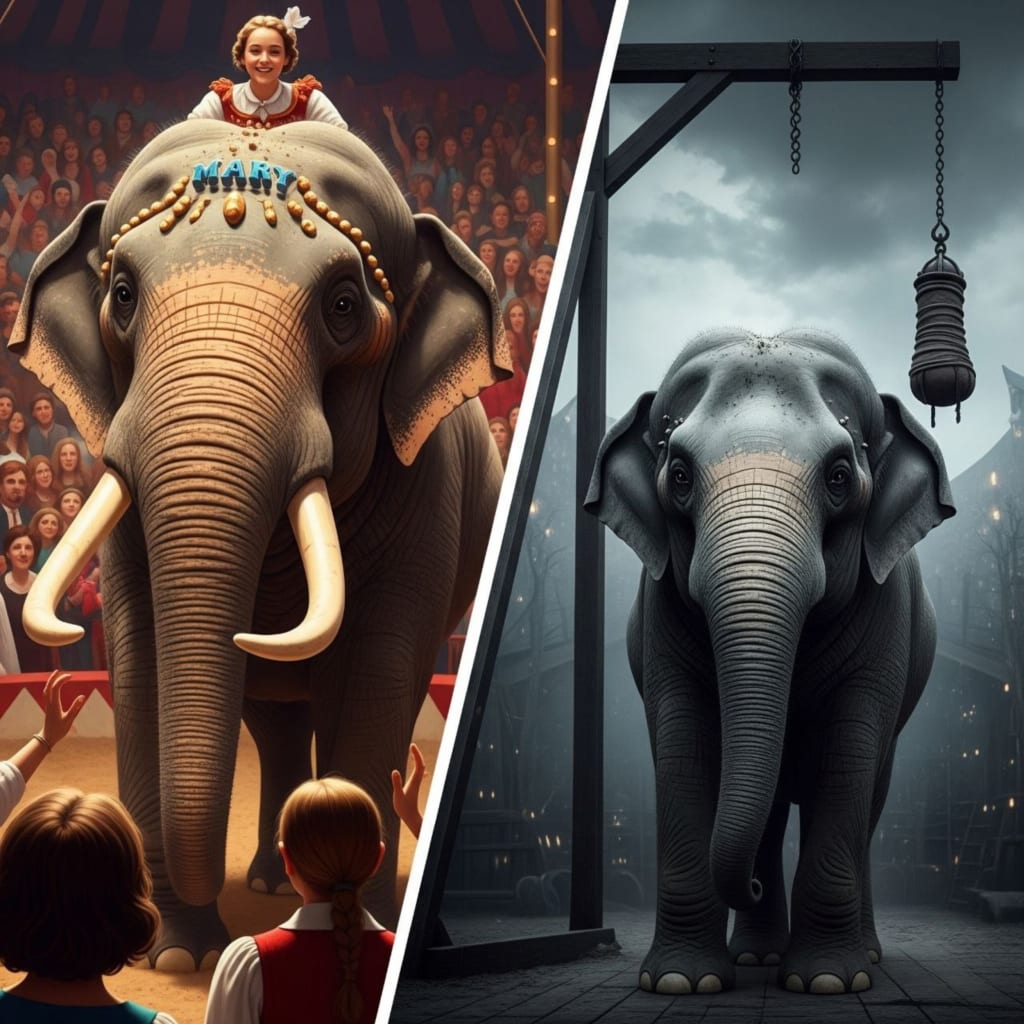
It was a bright summer in 1916. The sky in Tennessee, USA, sparkled with floating clouds, and the air was bustling with a rare festive spirit. "Sparks World Famous Show" moved from city to city, bringing waves of joy and wonder wherever it stopped. The circus's main attraction was Mary, a magnificent Asian elephant. Mary, an extraordinary creature weighing almost five tons, made every move perfectly, reflecting wild beauty and kindness. She was a circus gem, and thousands flocked from afar to see her. Known as "the biggest on earth," she was loved by everyone for her intelligence and gentle demeanor.
Mary wasn't just an elephant; she was part of the circus family. Children lovingly called her "Mary the Grand." Little boys and girls laughed and ran between her huge legs, and Mary would stretch out her trunk, offering a strange kind of affection. Every day, this giant elephant would lift a little girl high in her trunk, as if they had reached the clouds. A joyous commotion filled the circus tent as Mary bowed her head and fluttered her huge ears to greet the audience. Every wave of this sound seemed to recreate the audience's love for Mary. Her eyes were deep, as if they hid all the simplicity and peace of nature. The circus workers also looked after her, whispering secrets in her ears, and Mary would nod her head in a strange way, as if understanding their words. She was a symbol of joy and the brightest star of all circus shows.
However, this pleasant life was suddenly overshadowed by dark clouds. A new elephant handler named Walter "Red" Eldridge joined the circus. Red was inexperienced and had no understanding of elephant psychology. Mary, who was suffering from a deep infection at the time, was in considerable pain. Red prodded her injured spot with his sharp hook. Mary's patience snapped. A fire of anger lit deep inside her quiet eyes. In a quick movement, she lifted Red with her trunk and threw him to the ground. The next moment, her huge legs came down upon him. Red died soon after.
This tragic event spread like wildfire. Newspapers sensationalized the story, branding the once gentle elephant "Murderous Mary." Widespread panic gripped the masses. The same children who had loved Mary yesterday now looked at her with fear and hatred. Threats from nearby cities declared they would not allow the circus if Mary remained. Circus owner Charlie Sparks couldn't bear to see the circus shattered right in front of him. He was forced to make a difficult decision—Mary had to die.
But how? Bullets wouldn't effectively penetrate her thick hide, and sedation would be difficult. A strange solution was proposed. September 13th, 1916, in Erwin, Tennessee, was a cursed day. More than 2,000 people gathered at the train station, including countless curious children. A 100-ton industrial derrick, normally used as a crane, was waiting. This crane would serve as Mary's gallows that day. Mary was led to the train, and the sight of her massive body did not diminish the crowd's morbid curiosity. A huge chain was placed around her neck, and the crowd waited with bated breath.
The derrick first lifted, and its chains tightened. But fate intervened! The chain couldn't carry the enormous weight. Mary fell to the ground with a deafening crash. She landed violently on her hips and cried out in pain. The crowd was still excited, many screaming. This sight seemed to fuel their desire for blood rather than evoke pity. The injured, helpless Mary was forced back onto her feet. This time, an even stronger chain was used. Mary was slowly lifted off the ground. She flailed in pain, tears streaming from her eyes. Behind those eyes was fear, pain, and perhaps a bit of resilience. She was an animal; she felt pain too! But no one listened. She hung helplessly for almost ten minutes.
Her body slowly went limp, and life left her. Mary's lifeless body swayed in the air, and the cheers of the crowd below seemed to confirm her death. The same applause that once brought Mary joy was now the cause of her demise. Mary was buried that day next to the railroad tracks. Her death sparked a major controversy over the use of animals in circuses. Such cruel human behavior towards animals remains a dark chapter for animal rights activists today. Mary may be gone, but her story continues to live on as a quiet protest. It reminds us that moments of love and joy are fleeting, and cruelty can wound so deeply. Mary's tragic story leaves eternal questions in the annals of human history: What is our responsibility to wildlife? And should the limits of this cruelty be pushed for entertainment?
About the Creator
MD. REZUAN HOSSEN
I am Md Rezuan Hossen - a versatile writer who loves to create content on a wide range of topics. I try to create a great mix of information, emotion, and innovation that will make the reader think, laugh, or learn something new.
Keep reading
More stories from MD. REZUAN HOSSEN and writers in History and other communities.
Linia's "The Invisible Wall"
All parents want their children to grow up healthy and happy. They work day and night to overcome life's challenges, just to give their children a bright future. However, in this tireless effort, some small mistakes may turn into serious problems and unknowingly cast an invisible shadow on the child's physical and mental development. This shadow will eventually solidify into an invisible wall, subtly cutting off the child's path to a truly healthy and fulfilling life.
By MD. REZUAN HOSSEN8 months ago in Families
How I Learned That Aircraft Structures Are as Critical as Engines
When I first started studying aviation, I believed that engines and avionics defined an aircraft’s reliability. Over time, as I explored aerospace history and manufacturing records, I realized how incomplete that understanding was. Aircraft safety does not depend solely on thrust or navigation systems. It is deeply rooted in structural engineering, certified manufacturing, and the disciplined production of components that passengers never see.
By Beckett Dowhan6 days ago in History
Frames Through Time: Exploring a Love for Classic and Contemporary Film in Modern Culture
Movies hold a powerful place in everyday life. They entertain, teach, and inspire people across generations. Some viewers are drawn to old black-and-white films, while others prefer fast-paced modern movies. Many enjoy both. Classic and contemporary film exploration allows people to experience cinema as a living art form that grows without ever forgetting its roots. Exploring a love for classic and modern film helps viewers see how stories, emotions, and creativity connect across time. Film is a shared language. It crosses age, culture, and borders. When people watch movies from different eras, they discover that human feelings remain the same, even when styles change. This balance between tradition and innovation is what keeps cinema meaningful today.
By Matthew Carluccio4 days ago in History



Comments
There are no comments for this story
Be the first to respond and start the conversation.