
From Sana’a to Tel Aviv: The Expanding Shadow of War
The rise of long-range threats and shifting battlefronts in the Middle East.

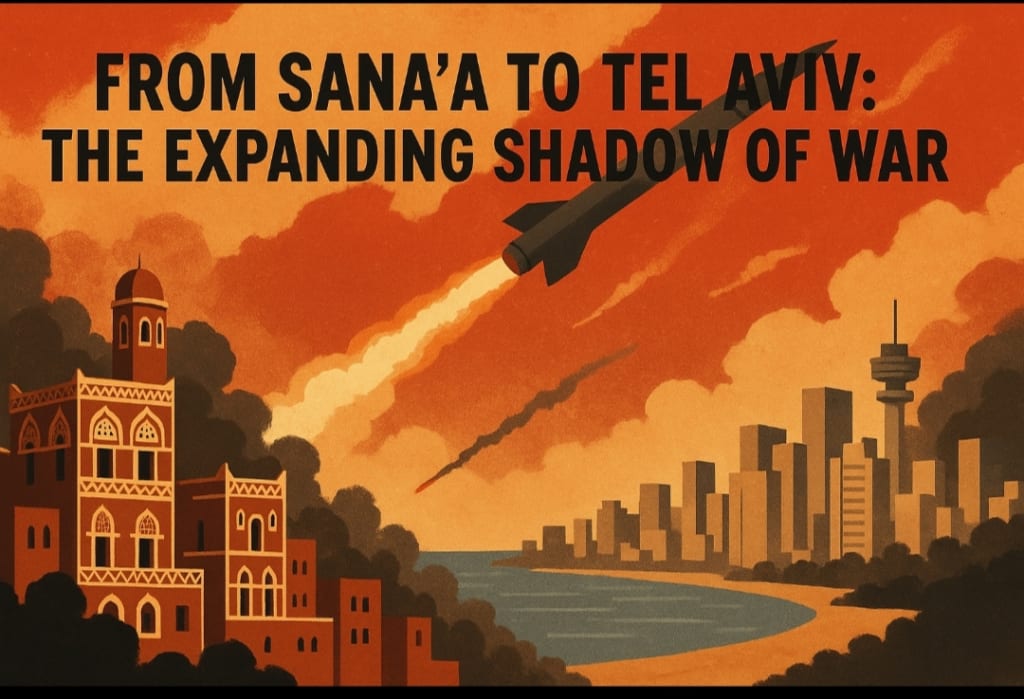
From Sana’a to Tel Aviv: The Expanding Shadow of War
Houthi involvement in the Israel-Gaza conflict marks a dangerous regional escalation with global implications.
In the ever-turbulent Middle East, conflict rarely stays confined within borders. What began as another eruption in the long-standing Israeli-Palestinian struggle has rapidly widened, drawing in actors from across the region. The entry of Yemen’s Houthi movement into the Israel-Gaza conflict marks a notable and alarming shift. From the mountainous capital of Sana’a to the coastal city of Tel Aviv, the shadow of war is lengthening, threatening to destabilize an already fragile geopolitical landscape.
The Houthis Enter the Fray
The Iran-backed Houthi movement, which controls large swaths of northern Yemen including its capital, has openly declared its support for Palestinians in Gaza. In a series of military escalations, the group has launched missiles and drones towards Israel, claiming them as acts of solidarity and resistance. While most of these projectiles have been intercepted by Israel's Iron Dome or the U.S. Navy in the Red Sea, their symbolic weight is significant.
The Houthis have long portrayed themselves as part of the "Axis of Resistance," a coalition of Iran-aligned groups that includes Hezbollah in Lebanon, various militias in Iraq, and now increasingly, actors in Syria. Their involvement extends the Israel-Hamas war into new territory, opening another front — not just militarily, but diplomatically and strategically.
Why Yemen? Why Now?
Yemen, one of the poorest and most war-torn countries in the Arab world, might seem an unlikely actor in a high-profile international conflict. But under the leadership of Abdul-Malik al-Houthi, the group has grown more ambitious and more ideologically aligned with Iran's broader regional strategy.
The Houthi leadership has framed their involvement as a religious and moral obligation. Statements from Sana’a invoke themes of resistance, Islamic solidarity, and justice for Palestinians. But beyond rhetoric, the Houthi strikes also serve political and strategic aims. They bolster the group’s regional credentials, divert attention from Yemen’s internal conflict, and align them more closely with Tehran.
Impact on the Region
The growing Houthi-Israeli hostility adds another layer of instability to the region. The Red Sea, a vital corridor for international shipping, has become a potential flashpoint. With Houthi forces capable of striking commercial and military vessels, global trade through the Bab el-Mandeb Strait — one of the world’s busiest maritime chokepoints — is now under threat.
Israel, for its part, is keenly aware of the risks of a multi-front war. With Hamas in Gaza, Hezbollah in Lebanon, and now Houthi aggression from the south, the country faces strategic pressure from all sides. While it has so far responded cautiously to Houthi attacks, further escalation could draw Israel into more direct action in Yemen — a scenario that could have unpredictable consequences.
The United States, too, finds itself increasingly entangled. U.S. naval forces in the Red Sea have intercepted several Houthi-launched projectiles, underscoring the risk to American interests and allies in the region. Any sustained campaign by the Houthis could provoke stronger U.S. military responses, raising the stakes even higher.
The Human Cost
Beyond the strategic calculations and political alignments lies the human cost — in Gaza, Israel, Yemen, and potentially elsewhere. The Gazan population continues to suffer under siege, with thousands killed, infrastructure destroyed, and humanitarian aid trickling in far too slowly. In Yemen, civilians already reeling from years of war and famine now face the prospect of further conflict and international isolation.
As regional powers choose sides and increase their involvement, the space for diplomacy narrows. Arab public opinion remains overwhelmingly sympathetic to Palestinians, pressuring governments that have normalized relations with Israel or are considering doing so. The result is a delicate balancing act for countries like Saudi Arabia, the UAE, and Egypt — caught between strategic alliances and domestic political pressure.
What Lies Ahead?
The question now is whether the Israel-Gaza war will continue to draw in other actors, or whether a ceasefire can halt the regional drift toward wider war. The Houthi actions represent not only a moral or religious stance but a calculated geopolitical move. Their participation signals that the conflict in Gaza is no longer just a local or bilateral issue — it is now part of a broader regional struggle for influence and identity.
Diplomatic efforts have so far failed to contain the conflict. Calls for ceasefires and humanitarian corridors continue to be overshadowed by military operations and retaliatory strikes. The risk of a miscalculation — a missile hitting a civilian target, a retaliatory airstrike going too far — could ignite a chain of events leading to an all-out regional war.
Conclusion
From Sana’a to Tel Aviv, the shadow of war is not only real but growing. The Houthis’ entrance into the fray is a stark reminder that in the Middle East, no conflict exists in isolation. As each actor calculates its interests and ideological commitments, the potential for broader war looms large. The international community, particularly regional stakeholders and global powers like the United States and Russia, must act swiftly to contain the escalation.
Otherwise, what began as another tragic chapter in the Israeli-Palestinian saga could spiral into a devastating regional conflict — one that would engulf cities and civilians far beyond the battlefields of Gaza or the streets of Tel Aviv.
About the Creator
Faiq Ahmad
Am experienced Field Security Officer working on the Engro Enfrashare Telecom Project.
I actively earn through various online platforms.This reflects my adaptability, tech skills, and commitment to continuous learning and financial growth.
Keep reading
More stories from Faiq Ahmad and writers in History and other communities.
The Trump Effect: How Policies Shaped the U.S. Economy
The presidency of Donald J. Trump brought a new era of bold, unconventional economic policymaking that left a lasting mark on the United States economy. Spanning from January 2017 to January 2021, Trump’s term witnessed a blend of sweeping tax reforms, aggressive trade policies, deregulation, and a global pandemic that shook economic foundations. The effects of his administration's economic decisions remain a subject of intense debate among economists, policymakers, and the general public.
By Faiq Ahmad9 months ago in History
3 True Stories That Sound Like Urban Legends but Aren’t
Urban legends usually follow a familiar pattern. A friend of a friend hears something unbelievable, the details get hazy, and the story ends with a warning about human stupidity or bad luck. The unspoken rule is simple: if it sounds too strange to be true, it probably is.
By Enoch Sagini4 days ago in History
The Crown of Ash and Gold
In the final era of the ancient kingdom of Aurelion, the world seemed to change its tone. The skies appeared duller, the winds colder, and the streets quieter than they had ever been during the kingdom’s golden age. Aurelion was once a beacon of civilization—its stone cities gleamed under the sun, its scholars were respected across continents, and its armies had carved its name into history. Yet no empire, no matter how mighty, can escape the slow test of time.
By The best writer 7 days ago in History
How to Succeed at the Benson Directory®
Congratulations and welcome to the Benson Directory® employee #22391! As our newest call handler, you will have the privilege of speaking with dozens of unique and interesting people on a daily basis as well as the opportunity to earn bonuses for high performance. Contained within this handbook you will find a set of ease to follow instructions designed to help you settle in to your new role and begin paving the way to success.
By S. A. Crawford3 days ago in Fiction



Comments
There are no comments for this story
Be the first to respond and start the conversation.