
From Modesty to Exposure: The Timeline of Moral and Fashion Decline from 1850 to Now.
This long-form essay explores the moral and educational decline from the year 1850 to the present, using fashion as a lens to understand deeper societal shifts.

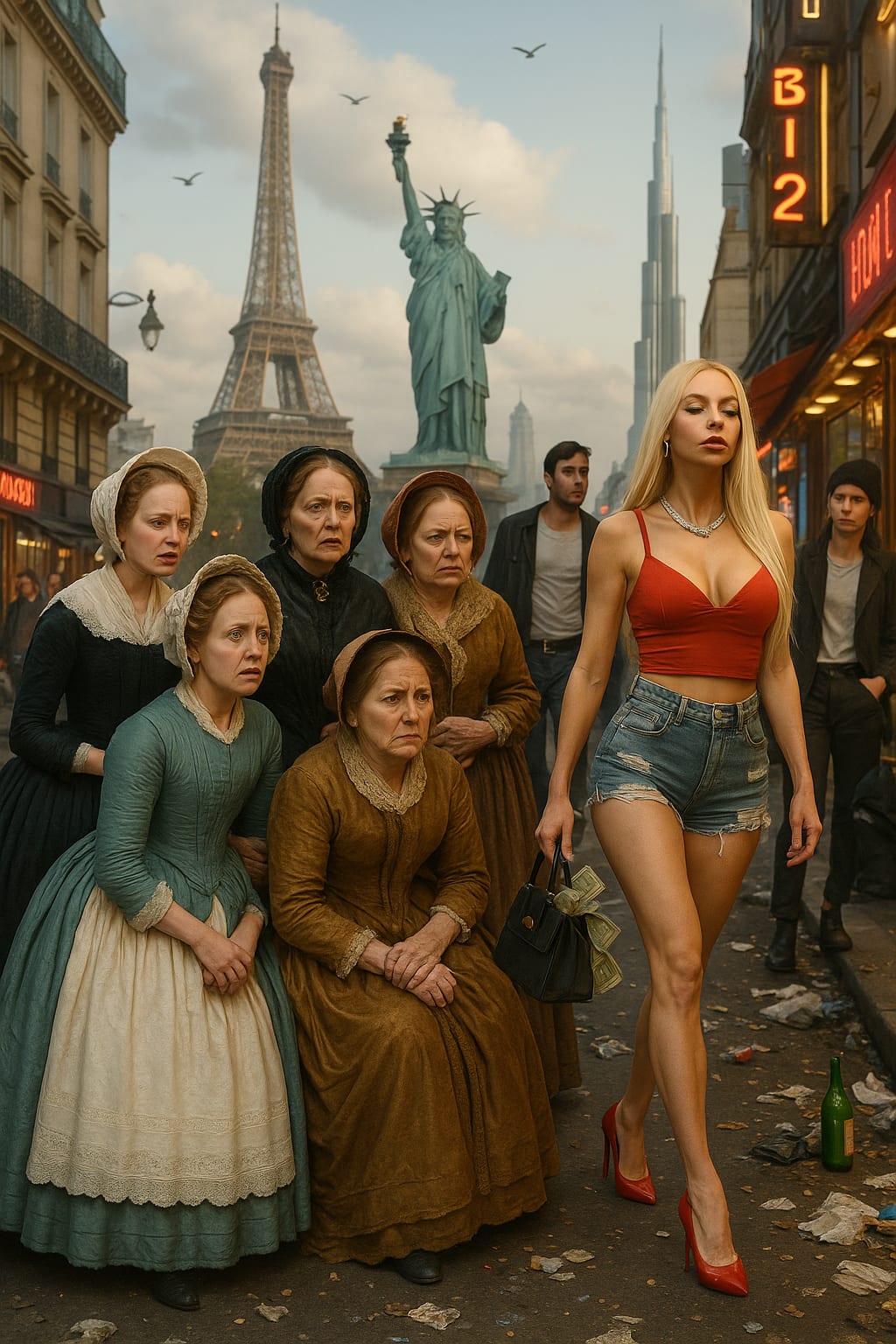
Throughout human history, fashion has not only been a reflection of beauty or status it has been a barometer of culture, values, and morality. From the layered modesty of the 1800s to the hyper-revealed trends of the 21st century, the shift in clothing mirrors something deeper: a transformation, and perhaps a collapse, of traditional values and educational foundations. This essay traces that journey through time and dives into the gradual erosion of boundaries social, familial, spiritual and how they manifest in the way we dress.
1850s–1900s: The Era of Restriction and Virtue
In the mid-19th century, especially in Victorian Europe and North America, societal structure was tightly wound around codes of virtue, restraint, and gender roles. Clothing in this era was symbolic of more than class it embodied the moral discipline expected from women. Dresses were floor-length, necklines were high, and every inch of skin had to be accounted for. Women were encased in corsets and layers, almost as if fashion itself was a physical manifestation of the ideological burden they bore.
Education during this time reinforced those ideals. Schools, particularly those for girls, emphasized obedience, religiosity, and the cultivation of good character over intellectual freedom. There were clear lines between what was deemed virtuous and what was rebellious, and these lines were reinforced by family, community, and religious institutions.
The role of the woman was defined clearly: to be pure, modest, nurturing, and largely invisible in the public sphere. Respect was earned through silence and covered skin.
1900s–1920s: The Cracks Begin to Show
As the new century dawned, the world began to shift. Urbanization, the suffrage movement, and early industrial employment began pulling women from domestic roles into the public arena. Fashion, always reflective of these deeper changes, began to soften.
The corset loosened. Skirts rose slightly. Blouses showed wrist and ankle — which, at the time, was considered provocative. The 1920s, marked by the flapper, represented an intentional rejection of the constraints of the past. Shorter hemlines, cropped hair, looser silhouettes. This was not just fashion; it was resistance.
But moral resistance was not yet complete. Even in rebellion, women were criticized, questioned, and judged. The family unit was still relatively intact, and educational institutions still largely upheld moral standards. But the idea that a woman could own her body and her image had begun to take root.
1930s–1950s: Glamour Meets Duty
The interwar period and World War II created contradictory pressures. Women entered the workforce en masse, filling roles vacated by men at war. They wore trousers, overalls, uniforms practical and bold. But with the post-war boom, there was a cultural yearning for stability and tradition. Hollywood took center stage, selling the ideal woman as glamorous, curvy, beautiful and domestic.
Fashion emphasized the hourglass: cinched waists, padded busts, voluminous skirts. This was the golden age of the feminine silhouette. Yet beneath the surface, women carried the trauma of war and the complexity of newly gained (but precarious) independence.
Education, still deeply moralistic, began to incorporate psychology and personal development, but the media’s rising power meant that school was no longer the sole or even the primary moral guide. That shift in authority began to matter.
1960s–1980s: Revolution, Rebellion, and Rupture
This was the era of tearing everything down. Sexual liberation, feminism, civil rights, student protests, and cultural rebellion. The miniskirt didn’t just show legs it declared war on the past. The bikini wasn’t just swimwear it was defiance wrapped in polyester.
Drug culture and rock music fueled a break from traditional values. Clothing became a tool of identity politics: black leather for punks, bell-bottoms for hippies, shoulder pads for corporate warriors. More skin, more volume, more boldness. The body was now not just seen it was broadcast.
Moral boundaries dissolved. Divorce became common. The nuclear family weakened. Authority figures were mocked or distrusted. In education, self-expression became prioritized over structure. Discipline became taboo. “Do your own thing” replaced “do the right thing.”
1990s–2010s: The Media Takes Over
By the late 20th century, the engine of culture was no longer family or faith it was media. Fashion was driven by pop stars, music videos, and later, reality TV. The sexier, the better. The more controversial, the more valuable.
In schools, moral education faded almost entirely. Kids learned more from MTV than from their teachers. With the rise of the internet, information spread faster, but not deeper. Critical thinking weakened. Image became king.
Style became about exposure: low-rise jeans, crop tops, transparent mesh, visible lingerie. Celebrities modeled excess, indulgence, and self-worship. Values were replaced by virality. And so began the culture of performance.
2010s–2020s: Hyper-Exposure as Identity
Social media reshaped everything. Fashion is now real-time, viral, algorithmic. It no longer follows seasons or designers it follows influencers. And the most successful influencers are those who reveal the most. The more skin, the more likes. The more controversy, the more fame.
The human body has become both a billboard and a currency. Streetwear and lingerie blend into the same category. Modesty is framed as old-fashioned, repressive, or even a sign of insecurity.
Meanwhile, family structures are fragmented. Education is diverse but directionless. Religious voices are often absent or dismissed. Many people grow up with exposure to everything except values.
In today’s world, fashion is no longer about beauty it’s about branding. The self is a product. And the line between self-expression and self-exploitation is blurred beyond recognition.
A Question of Correlation: Is Progress Tied to Exposure?
The deeper question here is philosophical: Why is modernity so often synonymous with nudity? Why do we equate fewer clothes with more freedom? Why do so many equate covering up with oppression, and uncovering with enlightenment?
Perhaps the modern world celebrates exposure not because it leads to truth but because it distracts from emptiness.

My Idea. Not All Evolution Is Improvement
We live in a world that seems allergic to restraint moral, emotional, and aesthetic. But freedom without direction leads not to enlightenment, but to entropy.
Where once fashion was shaped by values, now values are shaped by fashion. Where once education taught right and wrong, now the algorithm decides what’s popular and what’s ignored.
And in all of this, we must ask: Have we gained freedom? Or have we just lost the plot?
Maybe the boldest thing left is not to reveal but to resist.
Because in a world that celebrates the body and neglects the soul, perhaps modesty of dress, of ego, of behavior is not regression. It is revolution.
About the Creator
Sayed Zewayed
writer with a background in engineering. I specialize in creating insightful, practical content on tools. With over 15 years of hands-on experience in construction and a growing passion for online, I blend technical accuracy with a smooth.
Keep reading
More stories from Sayed Zewayed and writers in History and other communities.
What You Don't Know About Saudi Aramco: The Oil Giant and Maker of the Saudi Economy.
What You Don't Know About Saudi Aramco: The Oil Giant and Maker of the Saudi Economy Saudi Aramco, one of the largest oil companies in the world, is more than just an oil company; it is a fundamental pillar of the economy of the Kingdom of Saudi Arabia and the world. Founded in 1933, it has since achieved a long history of success and development, becoming the economic force upon which the Saudi economy relies. Let's learn more about Aramco's history, its figures, and how it became the largest company in the world.
By Sayed Zewayed11 months ago in History
12 American Flag Designs That Almost Changed History
The American flag is one of history’s most iconic symbols. Its red, white, and blue stripes, along with fifty stars, instantly represent freedom, democracy, and national pride. But did you know that the flag we all recognize today didn’t become official until 1960?
By Areeba Umair3 days ago in History



Comments
There are no comments for this story
Be the first to respond and start the conversation.