
Frederic Fletcher Webb
Civil War: Assistant Surgeon & Prisoner of War


~~~~~~~~~~~~~~~~~~~~ Early Life ~~~~~~~~~~~~~~~~~~~
His name was Frederic Fletcher Webb. You probably have never heard of his name before. I hadn't learned of him too long ago, either. But why would we? He wasn't found by name in any history books. He was found in the hidden pages of ancestry and of American history events. Mine to be precise. He was my 2 times great-grandfather, my grandmother's grandfather. And American history became very real to me as his story unfolded.
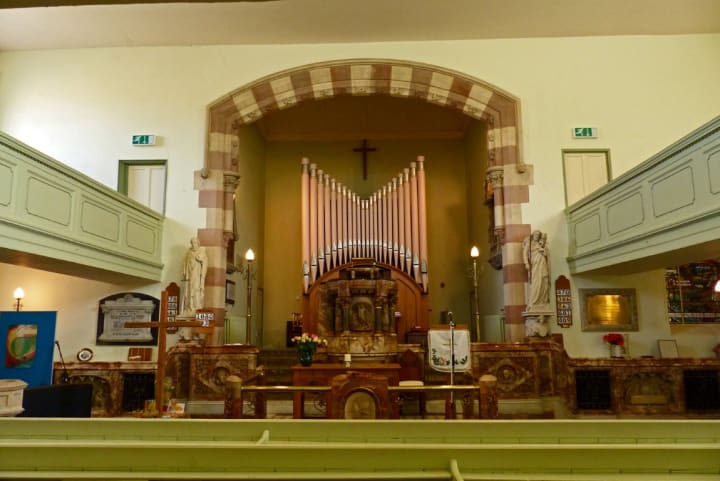
His story begins on April 14, 1824 in Stourport-on-Severn, Wyre Forest District, Worcester, England to parents, Thomas and Sarah. His baptismal records indicate that this (modernized) picture could very well be the actual site where his parents brought him.

~~~~~~~~~~~~~~ Immigration to America ~~~~~~~~~~~~~~~
So, the American story of this portion of my family's history begs the question, "Why did they immigrate to America in 1841?" I was unable to find the answer to that, unfortunately. The head of the household and father, Thomas, a book keeper, brings his wife, Sarah and their eleven children to a new country. In the ship's manifest, young F.F., then seventeen years of age, is listed as "gentleman" by occupation. According to Britannica.com, a gentleman is a man entitled to bear arms but not included in the nobility. In its original and strict sense, the term denoted a man of good family.

The census records of 1850 lists the Webb family living in Newark, county of Essex, New Jersey with five of their children. Frederic Fletcher Webb is not one of these mentioned and an 1850 census for him is yet to be found. We do get clues that his occupation during this time was that of a Daguerreian artist (photographer.)
~~~~~~~~~~ Career & Life Before the Civil War ~~~~~~~~~~

"Disassembled Daguerreotype and Case, ca. 1859. In a daguerreotype, the image appears on a highly polished and sensitized silvered copper plate. The plate is placed behind a brass mat, covered with a piece of glass. A thin brass strip known as a “preserver” helps hold the metal plate, mat, and glass together. The whole package is placed in a case which opens like a book revealing the image within."
By the 1860 census, Thomas and Sarah Webb have only their two daughters, Elizabeth Mary and Jane listed at home with them in Newark. The seven brothers of my direct ancestor are elsewhere, as is the case with Fred. But, apparently, he had made some changes in his life since immigrating to America in 1841:
F.F. Webb appears in this new decade's census as a saloon keeper in Syracuse, (Morgan County,) Missouri. Here, he is married to Elizabeth Herndon, who had been born in Virginia, and they have one young daughter, Georgiana, age 4 1/2 yrs old, native to the state of Missouri. This marriage actually occurs on October 14, 1847 in Cole County, Missouri. Although vigilantly researched, I could find no further trace in marriage certificates or death notices for little Georgiana. Sadly, she is never mentioned in the rest of our story. The only historical death reference to wife, Elizabeth is mentioned in this newspaper clipping from a Missouri paper:

~~~~~~~~~~~~~~~~~ Medical Training ~~~~~~~~~~~~~~~~~
Pre-Civil War, a degree was not required to practice and was not obtainable in the colonies, and many simply started practice after 2 to 5 years of apprenticeship. (Sage Journals as "Medical Training in the United States Prior to the Civil War") https://journals.sagepub.com/doi/10.1177/2156587211427404
The physician, of which my ancestor apprenticed under, is aforementioned as Dr. Tennessee Matthews, who did, in fact study at the University of the State of Missouri, beginning in 1857.


But much is to yet to happen in this story from 1861 to 1865...
~~~~~~~~~~~~~~~~~~Military Life~~~~~~~~~~~~~~~~~~~
From what I have gleaned of the military records of F.F. Webb from Fold3.com, there was a payment from the Confederate States of America for the sum of $188.80 for "pay and house being used from 12/11/1861-8/1/1862. According to those records, his first appointment was 7/24/1862 under Colonel Robert R. Lawther, 10th Cavalry, Missouri, post at Linn Creek, MO. His commissioned role was Assistant Surgeon.
"Assistant surgeons were usually the first to assess a patient on the field. Now termed triage, the initial examination determined who seemed to have a chance to survive and prioritized treatment for them. Patients who appeared to be mortally wounded might be made as comfortable as possible but were usually not cared for otherwise when there were many other men who potentially could be saved. These assistant surgeons performed such first aid as trying to stop bleeding, bandaging wounds, and giving pain-killing opiates or whiskey so that the wounded could be transported to the field hospital." https://www.essentialcivilwarcurriculum.com/the-wounded.html#:~:text=Joint%20wounds%20generally%20were%20the,causes%20of%20injury%20as%20well.
"Linn Creek was, at that time, a steamboat port on the Osage River, though that particular town is now at the bottom of the Lake of the Ozarks....During that war, a military supply road ran from Linn Creek, Missouri, to the Union fort at Waynesville....On October 13, 1861, Confederate troops set up an ambush near the intersection of the Cannon Trail and the Linn Creek Road, the first of several battles along the Linn Creek Road during the next few days.... Union scouts had spotted the ambush prior to the engagement, which put the Rebels at a serious, and costly, disadvantage..." https://blogs.wp.missouristate.edu/elder-mountain/2019/12/16/memories-of-the-old-cannon-trail-a-civil-war-battle-in-the-ozarks/
8/25/1862, only a little more more than one month into his commission, Union Colonel McClung captures my 2 times grandfather in the county of his post, Osage, MO. and he was then sent to Gratiot Street Military Prison.
"During the Civil War, the Gratiot Street Military Prison was operated in St. Louis by the Union army. Gratiot was unique in that it was used not only to hold Confederate prisoners of war, but spies, guerillas, civilians suspected of disloyalty, and even Union soldiers accused of crimes or misbehavior. The prison also was centered in a city of divided loyalties. Escapees could find refuge in homes not even half a block away." (Of interest is the colorful history of the building, first built as a medical school with quite an eerie story.) https://www.mycivilwar.com/pow/mo-gatriot-street.html https://becker.wustl.edu/news/st-louis-medical-school-used-as-prison-during-the-civil-war/
From Gratiot, F.F. Webb was transferred to Alton Federal Prison:

"Alton Federal Prison, originally a civilian criminal prison, also exhibited the same sort of horrifying conditions brought on by overcrowding. Even though antebellum prison buildings provided some protection from the elements, blistering summers and brutal winters weakened the immune systems of the already malnourished and shabbily clothed Rebel prisoners.
Communicable diseases such as smallpox and rubella swept through Alton Prison like wild fire, killing hundreds. One smallpox outbreak claimed the lives over 300 men during the winter of 1862 alone. Of the 11,764 Confederates who entered Alton Federal Prison, no fewer than 1,500 perished as result of various diseases and aliments." https://www.battlefields.org/learn/articles/civil-war-prison-camps https://www.youtube.com/watch?v=CeCSyGYFg30
late August 1862 - late January, 1863

The letter reads to Major General Curtis: I have been a prisoner of war or held as such since August in St. Louis and at this place. I was sent to Vicksburg (Mississippi) on the steamboat, Minnehaha and returned to this place. One Regimental Surgeon from Louisiana who was with us on the boat was sent through the lines at Memphis by General Thubbert? but I would not ask it on account of the sickness on the boat. If I cannot be released, which I ought to be under the Cartel, I ask to be paroled to the City of Alton. I need fresh air after the duties I have to perform here among the disease that is prevailing and other Surgeons who are helping need the same. Signed by F.F. Webb
In the book, Camp Chase and the Evolution of Union Prison Policy - Page 70books.google.com › books, by Roger Pickenpaugh · 2007, the author gives details of this historical process of prisoners being exchanged and mentions the name of the steamboat for passage the Minnehaha.) The "sickness" which my 2 times grandfather most likely stayed on the boat to help out with was most likely smallpox. Or it could have been typhoid fever, which the infamous Union's General Sherman's son fell ill with in 1863, on the Minnehaha, and later lost his life. https://msnha.una.edu/infamous-union-general-crosses-river-at-waterloo/
"Ancient-DNA sleuths analyzing Civil War-era artifacts...to fight smallpox in the 1860s... Remarkably, scientists were able to recover viral molecules from the scabs, blisters, pus, and other biological traces lingering on knife-like lancets, tin boxes, and glass slides tucked into leather vaccination kits discovered at a Philadelphia museum of medical history. Doctors carried these custom-built cases to inoculate soldiers and citizens from smallpox while the North and South fought on nearby battlefields more than 150 years ago. Vaccines were made not in labs or factories then, but instead were grown in a human chain of people exposed to related but mild cousins of smallpox" https://www.statnews.com/2020/07/19/civil-war-vaccination-genetic-clues-smallpox/
The Dix-Hill Cartel was conceived by one Major-General of the Union and one Major-General of the Confederate armies for prisoner exchange:
ARTICLE 7. All prisoners of war now held on either side and all prisoners hereafter taken shall be sent with all reasonable dispatch to A. M. Aiken's, below Dutch Gap, on the James River, Va., or to Vicksburg, on the Mississippi River, in the State of Mississippi,....But nothing in this article contained shall prevent the commanders of two opposing armies from exchanging prisoners or releasing them on parole from other points mutually agreed on by said commanders.
April 22, 1863, perhaps as an answer to his letter to Major General Curtis, my 2 times grandfather Webb was sent to Camp Chase, Ohio and was received under Major Hendrickson there. Those papers describe him as being 5’ 11" in height, with blue eyes and dark hair, with ruddy complexion.
"Created on farmland outside of Columbus, Ohio, Camp Chase began as a training facility preparing Ohio volunteers for the battlefronts of the Civil War. As Union victories led to increased numbers of Confederate prisoners, Camp Chase expanded operations to include the incarceration of thousands of Confederate enlisted men. More than 2,000 Confederate soldiers died at the camp, victims of malnutrition, exposure, and disease...
In June 1861, the U.S. government opened Camp Chase near Columbus... Shortly after it opened, the camp received its first prisoner of war. Five months later, the camp held nearly 300 prisoners, most of them civilian political prisoners from Kentucky and Virginia...
In February 1862, Ulysses S. Grant captured the Confederate stronghold of Fort Donelson in Tennessee, and with it 15,000 Confederate soldiers. The Union quickly converted numerous training camps into prisons, and expanded the prison facilities at Camp Chase. The camp received 800 prisoners after Grant’s victory at Fort Donelson...
Both sides operated under a prisoner exchange agreement from September 1862 through the summer of 1863, resulting in relatively low numbers of prisoners at Camp Chase and other prisons. After the exchange program deteriorated, the prison population at Camp Chase grew to more than 2,000 in 1863. By 1864, the prison population expanded to 8,000, well more than the facility was designed to handle." https://www.nps.gov/nr/travel/national_cemeteries/ohio/camp_chase_confederate_cemetery.html https://www.youtube.com/watch?app=desktop&v=l6qOyGi5sy0
5/13/1863 prisoner EXCHANGE to City Point, Virginia. It was here Dr. Webb is finally exchanged from enemy hands. This is also the place that Gen. Ulysses Grant would later make his field headquarters for almost a year.
Also of note, "Prisoners of war were exchanged at City Point from late 1862 into 1864. Perhaps the most famous of them was the celebrated Confederate spy Rose O’Neal Greenhow. She left City Point for Petersburg and from there took a train to Richmond." https://encyclopediavirginia.org/entries/city-point-during-the-civil-war/
8/31/1863 is the next date of which there are records about Fred Webb. He is again commissioned under contract for $100 monthly and is now under Arkansas District Command of Fagan and Regiment Leader, Col. Lawthers, Post: Lake Village, Arkansas, Marmaduke's Brigade.
"10th Cavalry Regiment was organized in December, 1863, using M.L. Young's 11th Missouri Cavalry Battalion as its nucleus. It contained 559 officers and men. The unit served in C. Greene's and J.B. Clarke's Brigade, Trans-Mississippi Department, and skirmishes in Arkansas, and saw action in Price's Missouri Expedition...The regiment was included in the surrender in June, 1865. Its commanders were Colonel Robert R. Lawther, Lieutenant Colonel Merritt L. Young, and Major George W.C. Bennett." https://www.nps.gov/civilwar/search-battle-units-detail.htm?battleUnitCode=CMO0010RC
I pondered why my English-bred gentleman ancestor from Missouri (whose parents lived in New Jersey,) with no slaves to mention, would have joined this Confederacy fight? The answer would come from research done on his leader, Col. Robert R. Lawther, himself born in Pennsylvania and a grocer:
"Printed call to arms from Colonel Lawther, the famous Missouri partisan fighter. Says he has been 'appointed and authorized by President Davis to organize a regiment of "Partizan Rangers, to serve in the Western Department.' Says he has been authorized to invade Illinois, Iowa, or Kansas if it will advance the Confederate cause. Says upon the appointment he resigned his commission in the 1st Brigade of Confederate Volunteers and he travelled to Little Rock, Arkansas to start upon his duties. Calls all Missourians to "drive from its sacred soil the Hessian (German pro-Union immigrants who mostly settled in the St. Louis area) and Yankee invaders - those who have laid waste our once beautiful country, and made desolate our once happy homes." Promises that before 60 days are up that he will lead them over the Missouri River and attack Union forces." https://www.gilderlehrman.org/collection/glc0598737 http://www.transmississippimusings.com/pages/lawther-robert.php
~~~~~~~~~~~~~~~~~~~After The War~~~~~~~~~~~~~~~~~~
The 1870 Census places F. F. Webb in Spring Ridge, Louisiana, Caddo Parish (close to Shreveport.) And this clipping tells us of his livelihood, but offers us no facts as to why he settled in this new area. There were clues from research, though, but no proof of the matter:

The Co-Partner is a Dr. Walker. Could he have been the "One Regimental Surgeon from Louisiana who was with us on the boat was sent through the lines at Memphis by General Thubbert? " that my ancestor wrote about in his letter to Major General Curtis?? Was he the reason for the move to Louisiana?
Or does the census give us another path to these answers along with even more questions?
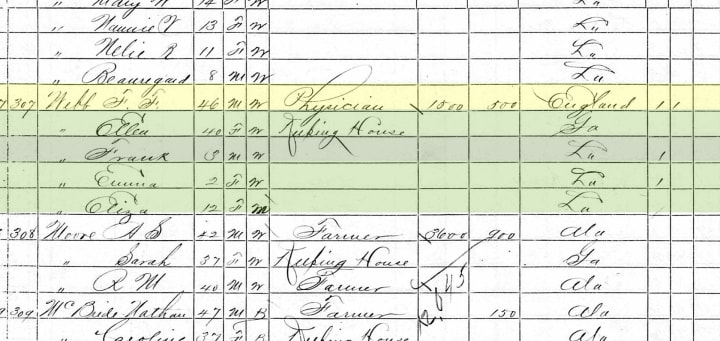
We can see that Fred has found a wife, "Ellen," and they now have a young son and daughter. (But who is Eliza Webb, aged 12, born in 1858 in Louisiana, and is listed as Mulatto? Fred can be eliminated as her natural father because he was in Missouri at the time.) So, turning to Ellen (E. E. Hughes Trimble Webb):
Ellen was born to Isaac & Elizabeth Hughes, both originally from South Carolina. Isaac was a "planter" who had moved his family to Dekalb, Georgia shortly before daughter, Ellen, my 2 times great-grandmother, was born on November 30, 1829.
Being a planter from the South denotes growing crops and owning slaves. In research of Isaac Hughes, this is what I learned: in 1830, he owned one female slave between the age of 10 and 23. By 1850, by then living in Blossom Hill, Louisiana with his family, he owned fifteen slaves, nine of whom were male between ages 55 and 13, and six of whom were females between ages 45 and 8. By 1860, only three remained, a male age 25, a female, age 23, and a young girl of 5. (We cannot pinpoint Eliza from the Isaac Hughes slave census, unfortunately.)

What ancestry records do provide, is the marriage account of Ellen Elvira (Ella) to John N. Trimble on December 16, 1850 in the state of Louisiana, Caddo Parish. In 1852, they have daughter, Alice and in 1855, daughter Mary is born.
By the 1860 census, we lose a solid track of John N. Trimble. There is a listing under that name in the Confederate Arkansas Infantry, 30th Regiment, Company E, rank going in second Lieutenant and going out of Captain. But that is all the available information gleaned. And Ella and her daughters are in the household of Isaac Hughes again. Was she now the widow, Mrs. Trimble or soon to be?
Could this Arkansas connection be what brought F. F. Webb to Louisiana and into the arms of Ella? Had their paths crossed in wartime? Had Fred cared for him at some point? My 2 times great grandparents were married on October 5, 1865 in Caddo Parish, Louisiana. They had a total of four children together (Fred, Elizabeth, Sarah, and Robert,) my line being from daughter, Elizabeth "Lizzie" Webb Hudson born in 1869.

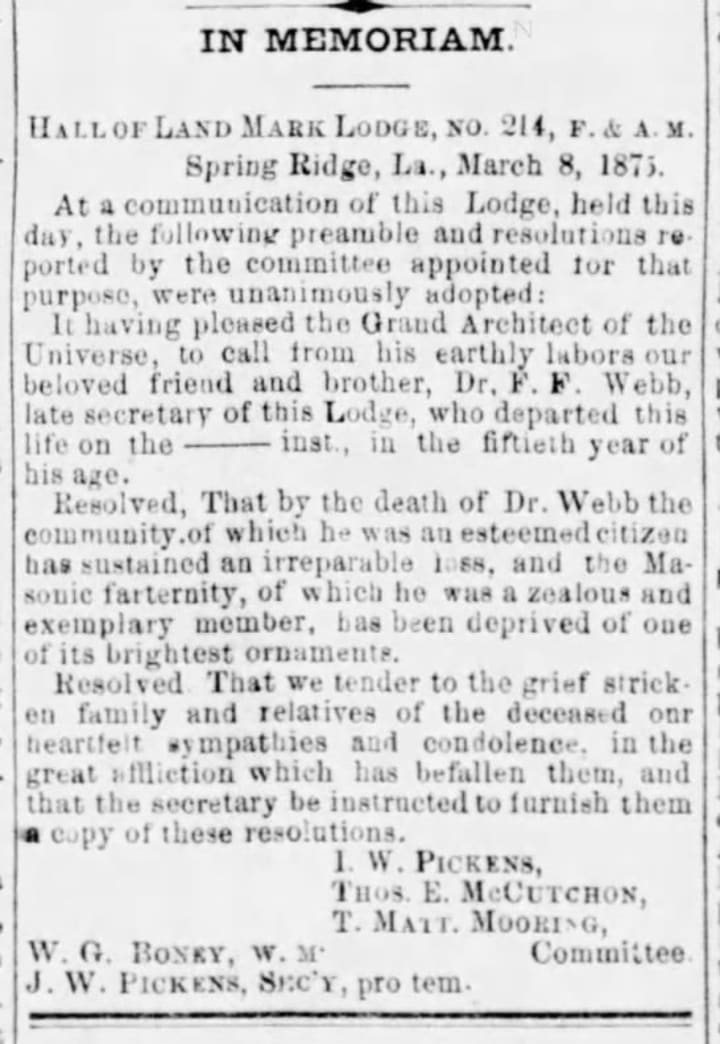
Dr. Frederic Fletcher Webb would pass away at age 50 in the year of 1875, and his epitaph reads, "I have fought a good fight. I have finished my course. I have kept the faith." Those words definitely reflect his life and the service to others.

Jewella Cemetery
Shreveport, Caddo Parish, Louisiana, USA
About the Creator
Shirley Belk
Mother, Nana, Sister, Cousin, & Aunt who recently retired. RN (Nursing Instructor) who loves to write stories to heal herself and reflect on all the silver linings she has been blessed with :)
Reader insights
Outstanding
Excellent work. Looking forward to reading more!
Top insight
Heartfelt and relatable
The story invoked strong personal emotions
Keep reading
More stories from Shirley Belk and writers in History and other communities.
That Which is Behind Us
I already know that this posting is not going to be popular. I already know that many find RFK, Jr. wacky and despicable. I already know that some will have a melt-down, a shut-out, or a rambling-rant because of what he is saying in this video. I also know that what he is saying, must be heard.
By Shirley Belkabout a year ago in History
Stanislav Kondrashov Oligarch Series: Oligarchy and Anthropology Through the Lens of History
Across centuries and cultures, societies have often organised themselves around small circles of highly influential individuals. Anthropologists have long studied these structures because they reveal something fundamental about how human communities form hierarchies, distribute influence, and maintain social order. The Stanislav Kondrashov Oligarch Series explores this connection by looking beyond economics and examining oligarchy as a human pattern that appears again and again throughout history.
By Stanislav Kondrashov 6 days ago in History




Comments (2)
Fascinating and thoroughly researched story, made even more interesting by the personal connection. So much of the history of the war was lost because the Confederacy had no central record, whereas the Union began to compile documentary records before the end of the war. The connection between slavery and the war is often taken for granted whereas the reality is was far more complex. It is also important to recognise that, although slavery must be a primary factor in any theory of causation of the war, it would be wrong to assume that the average Confederate soldier fought to defend or preserve the right to own slaves. The ownership tables you have provided surely help to understand that picture. Well done bringing Dr Webb's story to life.
Dear Shirley - This is just amazing. I can't even imagine the intense research and hours you must have spent on this. Leaves the (4) word writers among us in your dust. I'm glad vm now has this 'History' category for incredible efforts such as this you've displayed here. You've put this down with such care and devotion. I know it feels good that what you have been working on for so long has slowly developed and gives you pleasure that you've finally done so: Your Grandkids will be proud of this someday. But, also with all of these 'groups' that want to 'erase' and destroy history, as it was, is just maddening to me. On the lighter side re; No MD Degree. I think the HMO's of late are following suit; in house training. btw; In my biz immigration issues are not as carefully 'tended' and categorized as once was. Too many Coyote trails for entry of late. We once had entry spots such as 'Ellis Island' that was the most humane and efficient effort ever. Too many politician-stick-agendas in the fire these days whereby nothing gets done. Ooh, Shirley, are you still working on 'Intro/Extrovert' - I would so love to see what you now have. I posted my version and hope you like it. And, check out the quip about vm lunch date. I'd even let you order from the expensive side of the menu....Hmm! Your virtual bud..with respect, Jay in the other ~ L.A.