
Fossils of ancient lungfish show the evolutionary history of some of the earliest fish on Earth.
Deciphering an enigmatic fish specimen

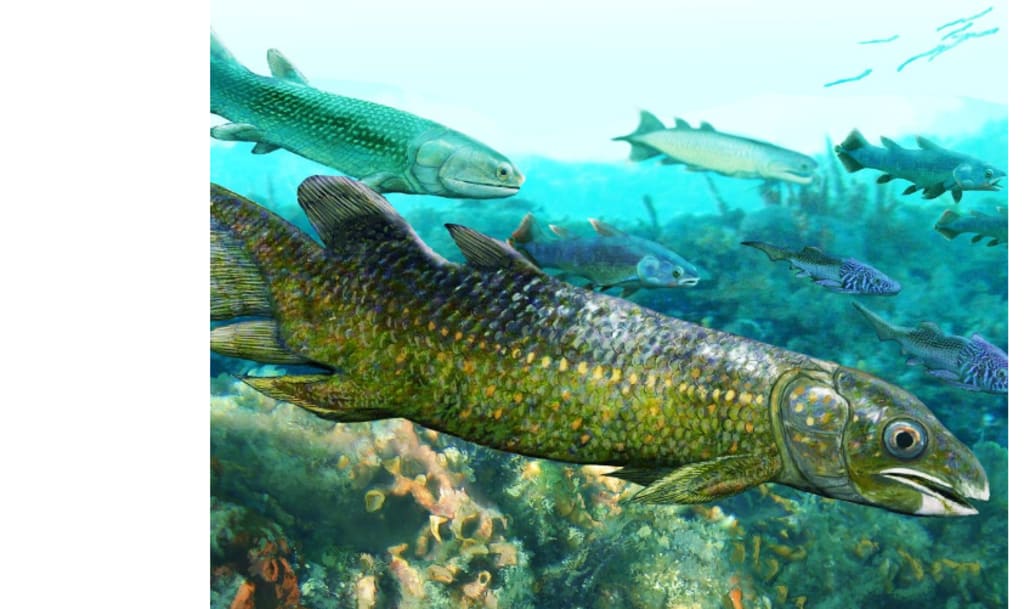
Scientists are learning more about one of the most significant periods in the history of life on Earth thanks to new hints from very old fish.
Some fish started to undergo minor but significant changes over 400 million years ago. These modifications eventually made it possible for animals to migrate from the water to the land. Eventually, the moment gave rise to humans, dinosaurs, and frogs.
That story is further detailed by two recent research. The ancient group of fish known as lungfish, which are still alive today, are situated near the branch of the evolutionary family tree that gave rise to land creatures.
Scientists are reconstructing how early vertebrates gradually acquired the characteristics required to survive outside of water by studying lungfish fossils.
Deciphering an enigmatic fish specimen
One of the recent research examines a fossil that was found in Western Australia decades ago from a new angle. The specimen looked disorganised at first; some sections were broken, and others were challenging to understand.
The fossil was so strange when it was first described in 2010 that scientists even questioned whether it was a totally unidentified kind of fish.
Long before the present-day Great Barrier Reef, there was a reef system from which the fossil originated. When the area was submerged and home to many early fish species, this Devonian-age reef was located in what is now northern Western Australia's Kimberley region.
The mysterious fossil was recently re-examined by researchers using contemporary imaging techniques. They were able to view within the skull without cracking it open because of high-resolution CT scans, which showed intricate structures that had previously been obscured.
The fossil first appeared to be quite odd, according to lead author Dr. Alice Clement of Flinders University, who noted that scientists who first described it "considered that it could be a whole new type of fish never before seen in science."
Lungfish evolution is clarified by fossil scans.
The digital scans provide an exceptionally thorough glimpse of the internal skull architecture and brain chamber of the fossil, confirming that it belonged to a lungfish.
"This time, we were able to produce detailed new digital images of the external and internal cranium using high-tech scanning, demonstrating the intricacy of the brain cavity of this fascinating lungfish," Dr. Clement stated.
Using national research facilities and museum collections, scientists also compared the preserved inner ear features of the fossil with those of other specimens from the same location.
The project's researcher, Hannah Thiele, stated, "We were able to compare its most preserved inner ear area with other Gogo lungfish."
It advances our knowledge of how these early lobe-finned fishes evolved in Gondwana and around the globe.
An ancient sea skull
The second research examines what is now southern China, which is half a world away. There, using rocks from approximately 410 million years ago, researchers discovered a lungfish skull that was extremely well-preserved. Paleolophus yunnanensis is the name given to the species.
This fossil was alive during a significant period of time. Although lungfish were already present, they had not yet developed into the diverse variety of shapes that would be observed later in the Devonian period. This skull is particularly helpful because of that.
Dr. Brian Choo, a researcher at Flinders University, stated, "Paleolophus gives us an unprecedented look at a lungfish from a time between their earliest appearance and their great diversification a few million years later."
"The group was only beginning to acquire the unique feeding adaptations that would benefit them for the rest of the Devonian period and beyond to the present day."
The skull exhibits both modern and ancient characteristics. Some characteristics are similar to Chinese fossils of extremely early lungfish. Others from locations like Australia and Wyoming in the United States resemble later species more. Palaeontologists have long been frustrated by this combination, which helps close a gap.
Insights from fossilised lungfish
Lungfish are more than simply historical artefacts. Several species, including one in Australia, are still extant today. Rare clues regarding how fins gradually evolved into limbs and how breathing air became feasible can be found in their anatomy.
Because of their strong resemblance to tetrapods—backboned animals with limbs, like humans—lungfish are an extraordinarily ancient lineage, including the still-living Australian lungfish from Queensland, which has long captivated biologists, according to Dr. Choo.
"We have important new information about the rapid evolutionary diversification between the early-, mid-, and late Devonian thanks to the remarkable lungfish skull that was discovered in 410 million-year-old rocks in Yunnan."
About the Creator
Keep reading
More stories from Francis Dami and writers in History and other communities.
'Go' is an ancient Chinese game that archaeologists have found stones from.
Over a thousand years ago, game pieces from the ancient Chinese board game "Go" were interred together. An examination of these "Go stones" reveals that they are made of expertly carved porcelain, smoke-blackened clay, or shell material.
By Francis Dami3 days ago in History
Diamonds Around the World: The Countries That Live and Breathe Baseball
There's something almost mystical about the crack of a bat connecting with a fastball. In certain corners of the globe, that sound carries the weight of history, identity, and dreams passed down through generations. While soccer may dominate the world's sporting consciousness, baseball has carved out its own sacred territories—places where the sport transcends mere entertainment and becomes woven into the very fabric of culture.
By Gianni Bertoni5 days ago in History
Rachel Reviews: Lunch Tales: Teagan by Lucille Guarino
Well, I did enjoy this! Sometimes, all you need is just great storytelling and this is what Lucille Guarino delivers here. There's no big message to this book; it's just about folks and families, living their lives and coping with everything that's being thrown at them and finding their way. But when it's done well, like it is here, then you have characters to whom you can relate, tension which leaves you rooting for a better outcome, attraction which has your heart racing and an urge, as a reader, to see the characters happy with the people with whom they belong.
By Rachel Deeming4 days ago in BookClub




Comments
There are no comments for this story
Be the first to respond and start the conversation.