
'Go' is an ancient Chinese game that archaeologists have found stones from.
"Go stones" kept in a graveyard

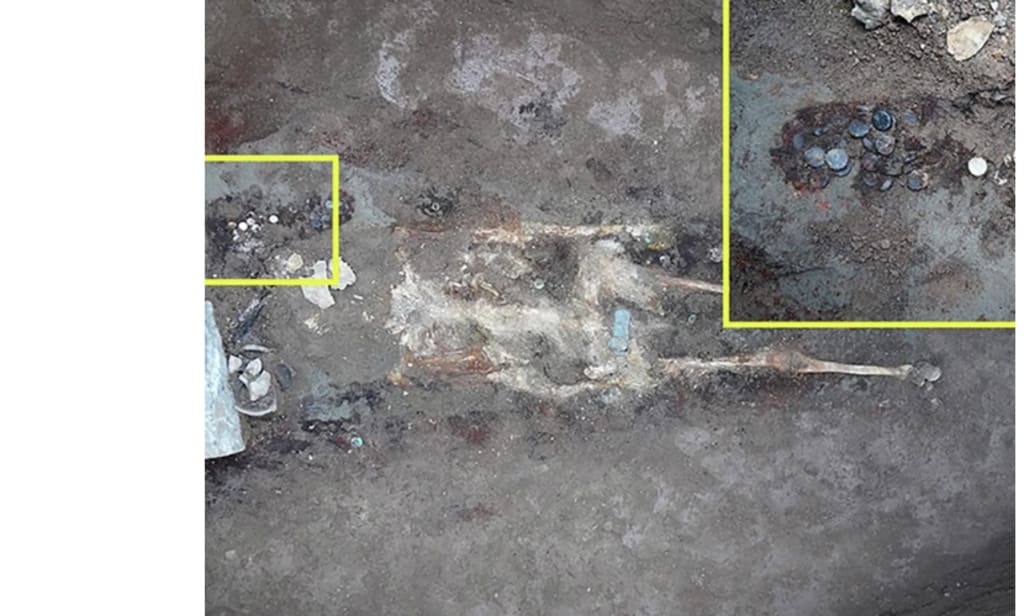
Over a thousand years ago, game pieces from the ancient Chinese board game "Go" were interred together. An examination of these "Go stones" reveals that they are made of expertly carved porcelain, smoke-blackened clay, or shell material.
This collection turns seemingly insignificant signs of play into proof of meticulous material selection, kiln management, and technological aspirations.
"Go stones" kept in a graveyard
The game pieces are taken from a full board game set that was kept together in an upscale burial next to a single person. Shu Wang of Northwest University in Xi'an, working from this cache, recorded that the ancient board game was "Go," a classic Chinese strategic game.
The 72 Go stones, or play pieces, were positioned close to the head of Fan Xiaocun, the tenant of the tomb who lived during the Northern Song Dynasty (960–1127 C.E.).
The set contained black pieces that conveyed carbon pushed through clay and white pieces that kept the shell's layered structure. Additionally, two patterned pieces that documented mineral changes that only occurred under intense kiln heat were present.
These contrasts establish the technical limits of Song-era craftsmanship and provide a deeper understanding of the methods and motivations behind the creation of each kind of piece. One of each kind of stone was chosen by the researchers for additional examination.
Sea-derived white go stones
The researchers were directed to the use of shell by pearly streaks on the white stone. This stone's surface displayed layered bands rather than coarse granules.
The majority of the elements tested were calcium, which is consistent with aragonite, a calcium carbonate-based shell material that is present in many mollusc shells.
The surface retained its mother-of-pearl appearance under a microscope, indicating that the shell was carved and polished by a craftsperson rather than being quarried. In addition to feeling warm and silky in the hand, shell also suggested a higher social standing.
The blackness was created by smoke.
Clay was used to make the black stone. For this sculpture, the ambiance within the kiln was more important than the ornamentation. Craftspeople let smoke enter the clay and deposit carbon throughout the item by shutting the firing chamber and depriving it of oxygen.
The material itself was imprinted with a consistent darkness by that procedure, which prevented it from flaking, fading, or wearing away. Therefore, rather than a surface-applied visual treatment, the appearance of these stones documents a regulated fire environment.
Hotter kilns were required for carved Go stones.
Another restriction came with engraving as carving designs into soft clay ran the risk of distorting them when fired. The ceramic body of the patterned pieces needed to harden sufficiently to prevent slumping as temperatures increased in order to maintain the crisp chrysanthemum motifs on both faces.
The ceramic stone's internal mineral alterations indicate that this hardening transitioned into a higher-temperature regime linked to structural strength. In this case, heat provided accuracy instead of colour, signifying a distinct solution to the play object durability issue.
Thermometers are found in minerals.
Because minerals change form at specific temperatures and retain that structure after cooling, firing leaves a chemical imprint. As clay heats up, it releases water and reorganises its atoms to form new crystals that trap the peak heat of the kiln.
Without destroying artefacts, materials scientists monitored these mineral changes in ceramics to provide archaeologists with a temperature guide. This method preserves unusual things, but it also implies that instead of measuring heat directly, researchers must infer it indirectly.
The behind-the-scenes game
Because players used stones to seize opponents and acquire territory on a gridded board, Go developed both status and competence. A fundamental rule that made every choice stick was that players took turns placing stones that remained in place.
As a reflection of who could afford them, go stones in China, Korea, and Japan varied over centuries from basic stone to opulent materials. Burying a set with Fan Xiaocun implied that the game had deeper significance than just being a pastime, even in the meticulous reasoning of a tomb.
Equipment that kept the Go stones safe
Wang stated that the materials of these artefacts are typically identified only by empirical judgement, which is imprecise. The researchers tested the surfaces and interior chemistry without inflicting any harm because they were unable to melt or shatter the museum artefacts.
X-ray diffraction, a scan that determines crystal structure from X-ray patterns, was one important check that suggested fire heat. Element scans provided further material insights, but without proper cleaning and comparison, ageing and soil stains might still obscure the signals.
Go stones go from handicraft to business.
Large quantities of Go stones could be produced in the same kilns, and Song Dynasty craftsmen produced more than just bowls. Instead of using a steady hand to create repeating patterns, moulds were used to press motifs into wet clay.
Many stones with identical patterns were found in public findings, according to Wang's team, which is consistent with a standard output strategy. Because they took more time and skill to create, engraved objects were probably more expensive and circulated through fewer social networks.
What is still hidden in the cache
There may yet be surprises in the rest of the cache because the researchers only sampled a small portion of it. Uneven heating of different kiln sections can alter colour and hardness equal within a single batch.
More Go stones might be compared in future research, clays could be associated with particular production sites, and the potential roles of patterned pieces in play could be investigated.
Nevertheless, the findings demonstrate how much technology may be concealed in everyday items when archaeologists use them as proof.
The expertise of Go Stones record creators
In one burial, shell, carbon-darkened clay, and high-fired carving demonstrate how craftspeople adapted materials to Go's appearance and feelings. Labs may map trade, taste, and talent over ages as they apply the same non-destructive technologies to more game sets.
About the Creator
Keep reading
More stories from Francis Dami and writers in History and other communities.
When Truth Learned to Whisper
When Truth Learned to Whisper In the small town of Mirzaabad, people spoke freely, too freely. Gossip was like air—unseen yet everywhere. The truth, bold and loud, once roamed these streets without fear, leaving nothing hidden. But over time, the people grew weary of its harshness. Truth was blunt; it hurt, it shattered, it embarrassed. So one day, it vanished. Not entirely, but it learned to whisper.
By Samaan Ahmadabout 8 hours ago in History
The Retreating Left
Democratic Socialism, Anarchism, and Left Communism are variations of the same failure. Each represents a retreat from the inherited legacy of communism and the revolutionary left. These three ideologies are idealist, Eurocentric, and petty bourgeois. They emerged in our context as different strategies of retreat — positions I once inhabited but no longer do. Through these three ideologies I carried variations of similar bourgeois fears about Marxism-Leninism. I followed multiple paths during my time on the left. Each promised a way forward. Three led to retreat. One did not.
By Victor Zempranoabout 4 hours ago in History
Lately, I'm empty
Lately, I feel an emptiness inside of me that doesn’t make any sense. I was fine a week ago and now I’m numb to the pain that I’ve been carrying around. Numb to the idea of me existing. I wish I could go to a place where I can hear happy positive thoughts and surround myself with joy. The medication I’m on doesn’t seem to work anymore. I still feel pain from existing, why am I here anyways? Merely to exist. I don’t feel like I’m making any differences being here.
By Cerina Galvan5 days ago in Confessions



Comments
There are no comments for this story
Be the first to respond and start the conversation.