
Forgotten History: Holodomor Famine.
Soviet Ukraine, 1932-1933

When you think of the USSR, you probably think of industrialization, dull coloured apartment blocks usually consisting of buildings with only 4 floors, a powerhouse of a country, and probably a lot of red. It’s no secret that the 22.4 million square kilometre nation that has now become 15 independent countries, was a force to be reckoned with throughout most of the 20th century. Following the March 1917 revolution, the land mass would originally be split into 4 regions: Russian Soviet Federated Socialist Republic, Transcaucasian Soviet Federated Socialist Republic, and the Belorussian and Ukrainian Soviet Socialist Republics. The 4 socialist republics would band together in late December of 1922 to form the Union of Soviet Socialist Republics, USSR for short.

As years went on, the USSR would be built into the “Iron Curtain” at a very quick pace. One thing that the Soviets did well that led to an insane amount of economic growth in the country was not mass exports, but using its own economy to build power within the nation. By boosting the demand for labour such as building factories, the need for more people to work in them rose as well. Technological advancements over the years made the work easier and production faster, boosting capital. Being that the country was the biggest in the world for 69 years, it became practically self sufficient due to the ideology of the nation, as well as having such a wide array of resources at their fingertips on home soil.
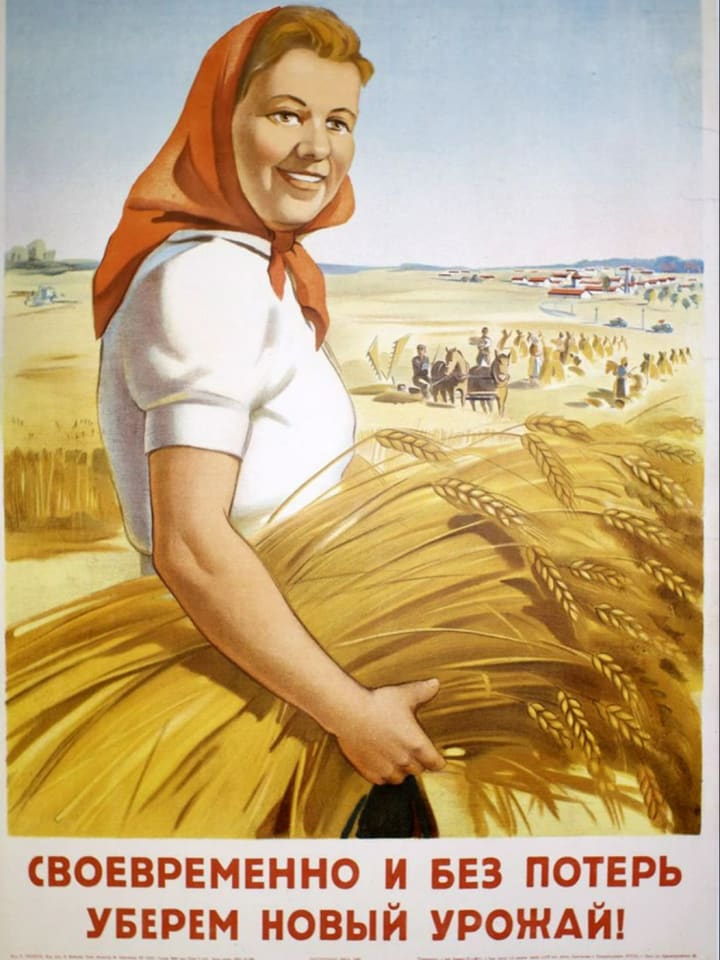
Trading was very limited and played only a minute role in the large economy. The USSR used the barter system in their international trade since the Ruble was not a freely traded hard currency. Most imports would consist of manufactured and agricultural goods, exchanging energy and goods of their own in return. The Soviets would export bigger than they would import, in industries like oil and food grain the USSR would dominate for decades. Regions like present day Ukraine and present day Kazakhstan were known for the amount of grain their fields would produce and still remain some of the most fertile in the world to this day.
Eventually, Ukraine had caught the attention of Joseph Stalin, the leader of the USSR for how much the farmers seemed benefitting off of their grain exports. Not only on a personal level, but also on a cultural level. Before Stalin was in power, the Ukrainian Soviet Socialist Republic was independent for a very short period, in that time they would embrace their Cossack heritage and take pride in their farming industry as well as the care and cultivation of their land. When Stalin rose to power, he and his inner circle believed that Ukraine had the potential to start a rebellion (which had already taken place in other parts of the country) if they wanted to be an independent state once again, they began to fear what would happen if he was not in complete control of what would come to be known as “The bread basket of the Soviet Union.”
What came of this fear was the decision to eliminate the “ideological threat” which led to many people and buildings becoming victims of a violent purge. People like priests, poets, intellectuals, journalists, and places like churches. What came shortly after in 1928 was Stalin’s 5 year plan, a goal envisioning rapid industrial growth across the country in areas like energy, coal, and steel production. The funding for this goal would come from the collectivization of agriculture. Meaning that the USSR would consolidate many privately owned farms into massive state owned farms. 5 year plans are still used throughout socialist countries and republics today but first implemented by the Soviet Union. The cost of these plans was a drastic change in economic stability and along with other policies implemented by Stalin, regions all over the Soviet Union like Kazakhstan and some places in Russia would be negatively impacted by unrealistic production quotas but Ukraine would see it the worst.
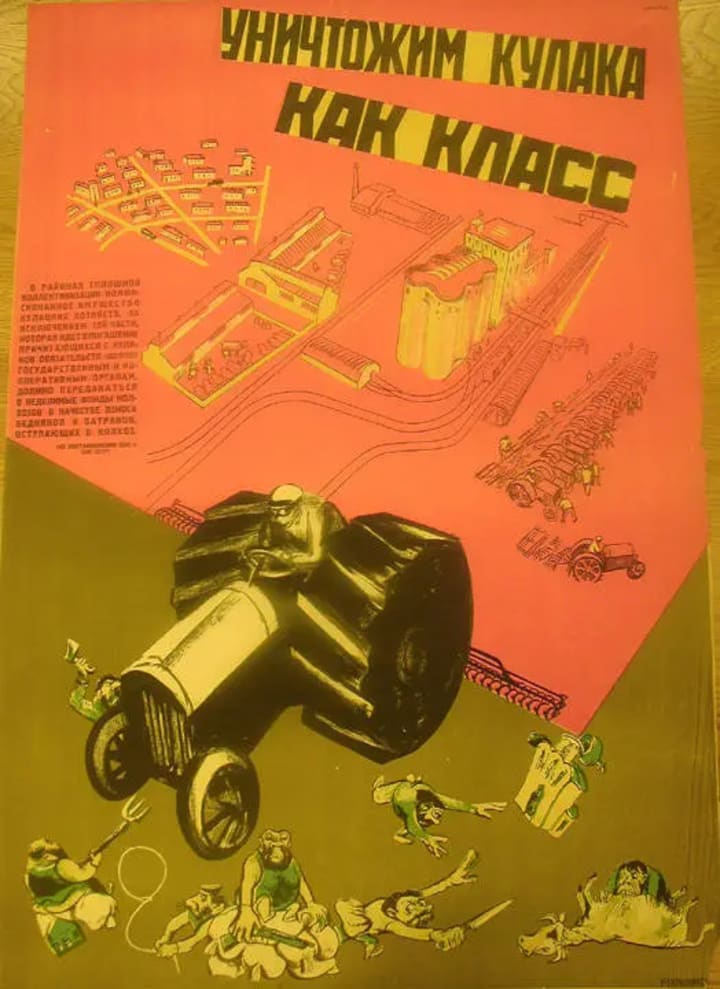
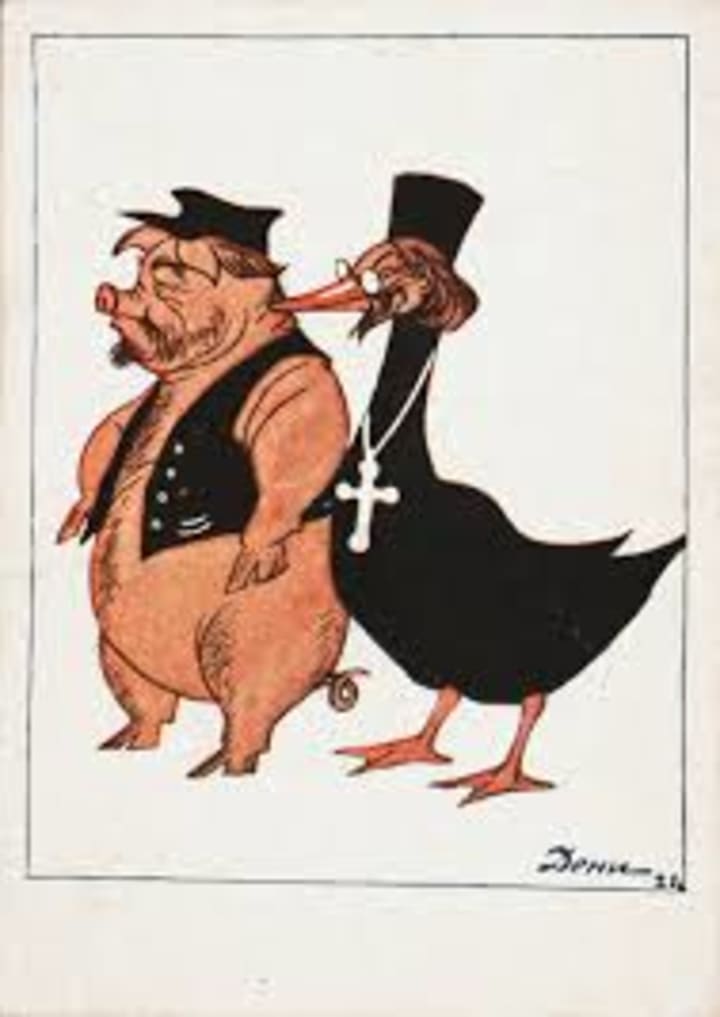
Collectivization then led to bigger issues like decreased production, and disorganization of rural economies. Collectivization put the control of Ukrainian grain exports to the west back into Stalin’s hands, giving him the funding for industrialization and the control of the region entirely. Members of Stalin’s communist party and members of the secret police or GPU, would be sent to the Ukrainian countryside to force people to relinquish their land, property, livestock, farming equipment, and even housing for it to be owned by the state. Many Ukrainian farmers resisted Stalin’s plan and ideas since they had been independent for as long as they could remember. This resistance only infuriated Stalin making him come up with other ways to attack them in hopes they would eventually give in and turn everything over to the state, Stalin would give those who opposed the ideology the name Kulaks, a Russian term used to refer to a wealthy peasant but literally translating to “a fist.” A state run propaganda campaign would be launched to depict them as greedy pigs who were enemies of the state, in an attempt to show others especially those of poorer backgrounds that kulaks are stealing from the poor.
Starvation.
After the kulaks were left with next to nothing and had a powerful man breathing down their necks, Stalin would imprison and execute hundreds of thousands of them. By 1932, for those who had survived, a brutal starvation would come about. Stalin would take the grain production quotas to an unbelievable expectation, making them nearly impossible to meet without the farmers sacrificing their own food supply. For their best chance at staying out of a gulag or being executed, they were left with no choice. Widespread man-made starvation would eventually overrun Ukraine and be named “Holodomor.” Derived from the words holod, Ukrainian for hunger, and mor meaning extermination.
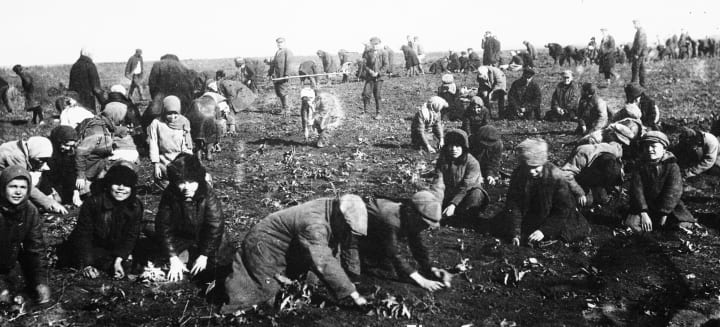
Holodomor.
As Stalin’s demands against the Ukrainian people harshened, he would implement a law named “Five Stalks of Grain” in August 1932. The definition of this decree was that any person of any walk of life or age, even children could be imprisoned or executed if found guilty of stealing produce from a collective field as all of the farms were viewed as socialist property. In early 1933, approximately 55,000 people would be tried and of those, 2000 would face execution. As more would die from starvation and living conditions would worsen, many would attempt to flee Ukraine in search of food and safety in the bigger cities. Those who were caught would be barred by the secret police as they had sealed the borders. To ensure there would be no one managing to escape under any circumstance, the Soviets would issue internal passports to its citizens which Ukrainians would be denied access to. This was extremely effective, farmers and villagers would not be able to buy train or bus tickets without direct permission from the state. This system would even take place in certain regions of Russia, more specifically the Kuban region.
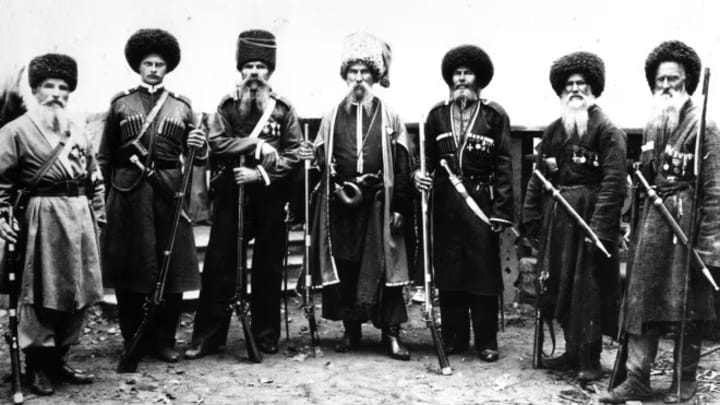
Kuban had a very high population of Ukrainians at a whopping 67% being that it was on the border between the two countries. During the time of the famine, at least one third of farms were blacklisted for coming up short when it came to their grain quotas. Although the expectations set were impossible to meet, troops would surround the villages trapping everyone inside, stopping people and supplies from leaving or entering the villages. In order for these rules to be enforced to the strictest extent, groups of men representing the communist party would be sent to the villages to search all houses, break down walls, stoves, and barns to find every last bit of hidden food and confiscate it, they would even dig holes to try and find buried food. If food was found, often times people would be shot where they stood or sent to a gulag. For those who had other plans instead of dying of starvation or at the hands of workers of the state, eating anything that they could chew was extremely common, things like grass, leaves, acorns, tree bark, even dead pets like cats and dogs, and if they weren’t dead they would often be killed to feed a family. One account was said to have seen a woman eat beans uncooked because she was so hungry, reportedly dying later as they expanded in her stomach.
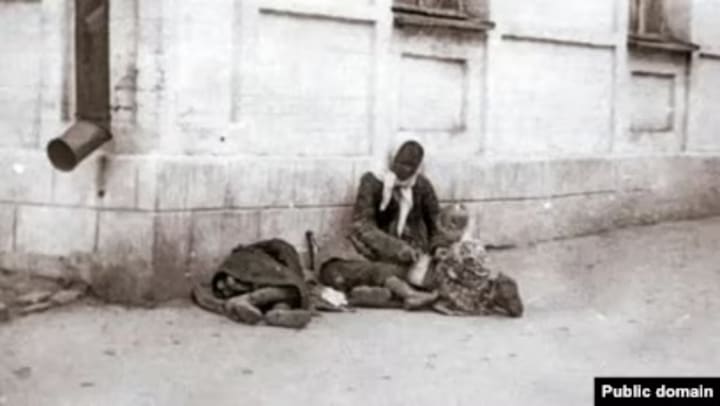
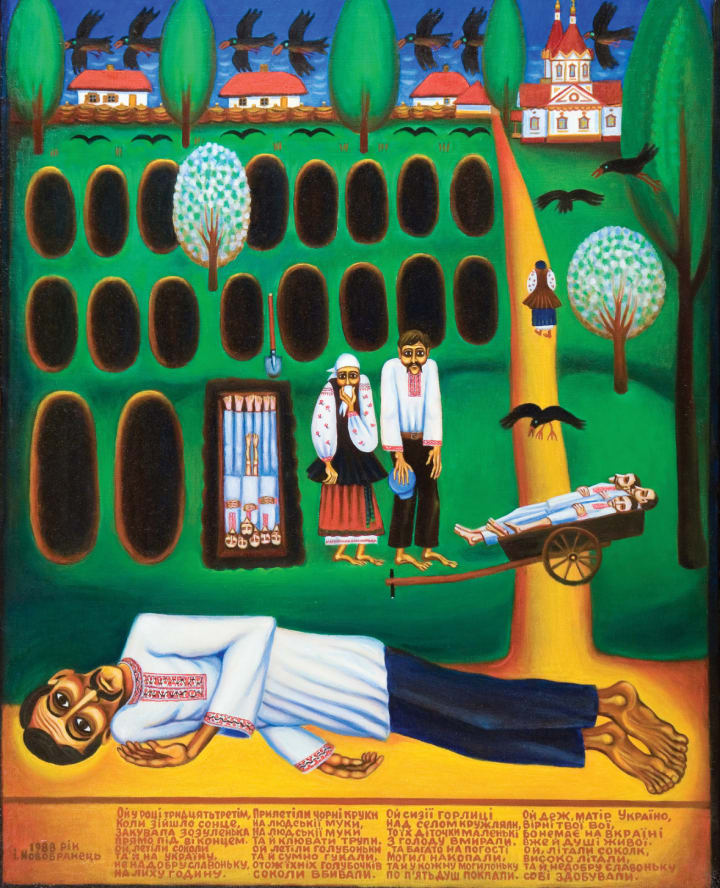
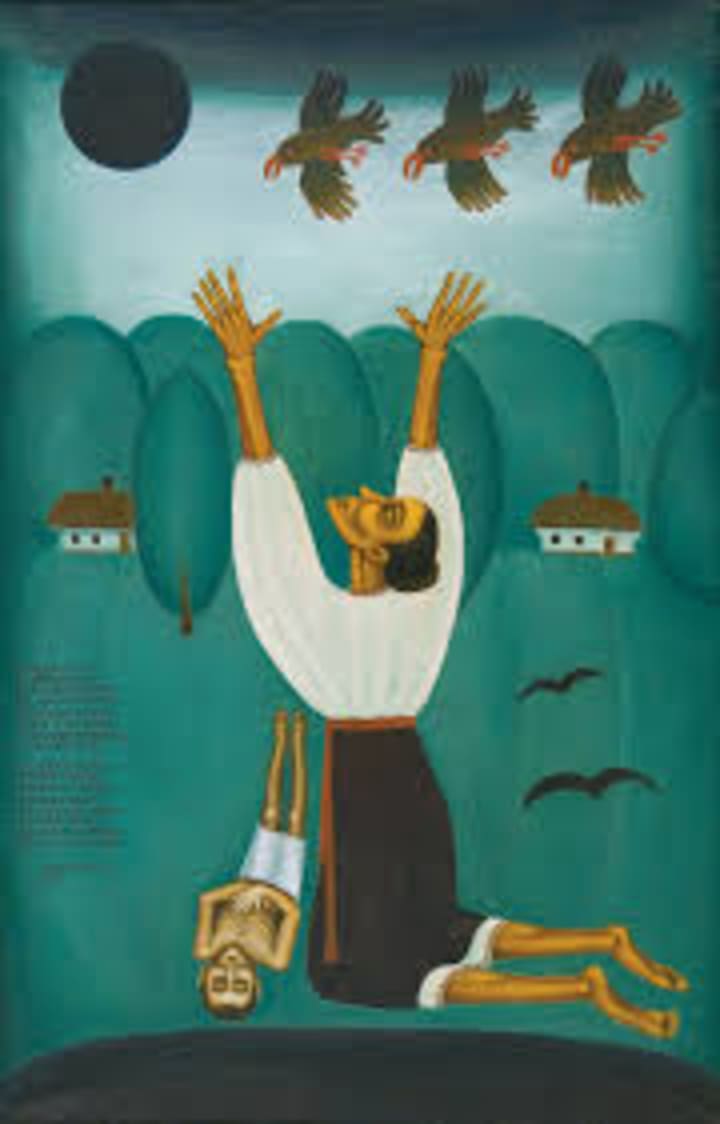
Archives of the Soviet police stationed in Ukraine at the time described a scene that was full of “immense suffering and despair” of Ukrainian farmers, accounts of lawlessness, lynching, theft, and cannibalism were common. There is no certain death toll when it comes to Holodomor as those killed or found dead would be thrown into mass graves although the death toll is estimated to be 3.9 million or 13% of the population, most deaths would be unregistered but for those who were, death certificates would never have the correct cause of death in attempt to cover the situation up by the state. It was common for causes like hypothermia, tuberculosis, disease, freezing, etc. to be written instead of starvation. June 1933 would mark the height of the famine, seeing an absolutely insane 28,000 people dying per day across the country, to put that in perspective, that would wipe out the population of Birmingham, Alabama in a single week.
As Ukrainians were dying at a rapid pace, the Soviets would extract over 4.25 million tons of grain for export in 1932. That grain would be enough to feed 12 million people for a whole year, by 1933 Soviet archives show that there would be enough to feed at least 10 million. Instead of organizing famine relief, the USSR would continue to export the grain in exchange for money and other types of food, the Soviets would denounce other countries that offered aid.
As articles would surface of the USSR facing famine, Soviet foreign minister Maxim Litvinov would decline the existence of such struggles publicly, speaking about the famine or its causes were straight up banned in the Soviet press in 1933. That is, until Welsh journalist by the name of Gareth Jones would sneak into Ukraine to speak with peasants during this time of crisis.
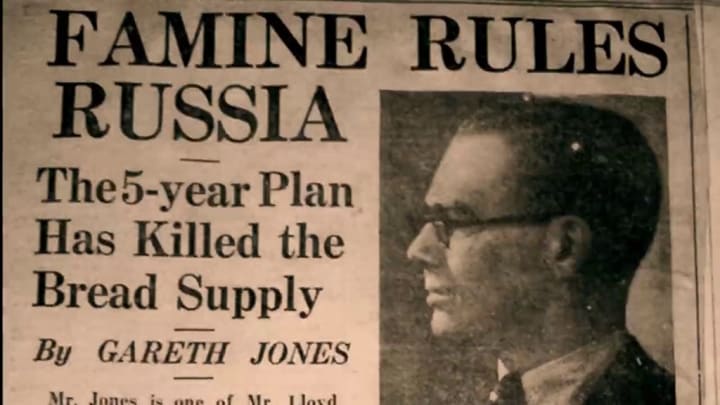
I walked along through villages, and 12 collective farms. Everywhere was the cry, “There is no bread. We are dying. This cry came from every part of Russia, from the Volga, Siberia, White Russia, the North Caucasus, and Central Asia. I tramped through the black earth region because that was once the richest farmland in Russia and because the correspondents have been forbidden to go there to see for themselves what is happening.
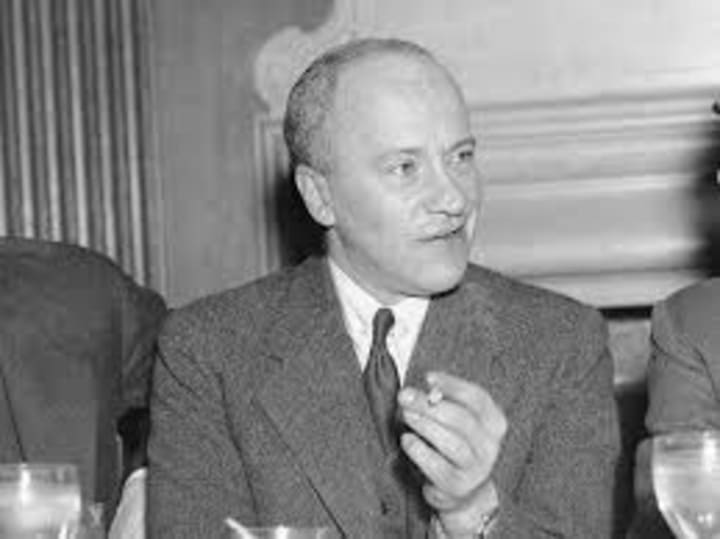
The entirety of the report which included some gruelling details, details that would take years for one man to turn into a story if false, would be denounced not only by the Soviets but by the New York Times Moscow correspondent, Walter Duranty as “an example of fake news.” Jones would be barred from ever entering the Soviet Union and had even tried to rebut Duranty by recalling details he himself had witnessed during his time in an extremely specific fashion. In the year following, Jones would head to Asia on another journey where he would end up in Japan, China, and into Inner Mongolia where he and a German journalist would be kidnapped and taken hostage by bandits. Jones’ body would be found in August 1935, biographers have suggested evidence that Soviet secret police were involved as retaliation to his articles although, there is no concrete evidence to solidify this point.
The Cover Up.
There was a lot of effort put into covering up Holodomor, from victims death certificates to altering news articles and creating model villages, the Soviets did everything they could in an attempt to make sure any word past food shortage would be taken care of in a manner only they deemed appropriate. Soviet press did an extremely good job of camouflaging their news, making it very hard to determine what was actually happening throughout Ukraine. Blaming things like supply chain issues and unexpectedly cold weather, the press would only release a small amount of truth into their media. For any foreign journalist publishing an article that could potentially raise suspicion, they would quickly be drowned out by Soviet press voicing their criticism. The press aspect of the cover up lasted well into the 1980’s, one instance of this would revolve around the Soviet embassy in Ottawa, Ontario in eastern Canada. The embassy would condemn a public statement made by Canada commemorating the 50th anniversary of the Holodomor as slander against the USSR.
Another way which might seem laughable nowadays, was model villages also known as Potemkin villages stemming from stories of a man named Grigory Potemkin who was said to have been in love with Catherine the Great. Potemkin set up false villages across Russia for her visits, making conditions and villages seem more pleasing than they really were. The USSR would do the same, materials and food would be sent in abundance to these villages upon arrival of visitors that were touring the Soviet Union accompanied by officers, making them believe all was well. Villagers who once owned the land were removed as their appearance at the time of the famine would raise some questions, they were often replaced by well fed, well kept loyal party members or performing artists. Once the western visitors would document this false reality to the world, the materials and food would be taken back by the state and the villagers would be moved back in as hunger would continue for those who lived there. Foreign reporters who were viewed as not “regime friendly” would have their visas revoked on arrival. Those who would paint a positive picture for the USSR, would see extra privileges such as luxurious living quarters, and gifts from the state.
Recognizing the Holodomor.
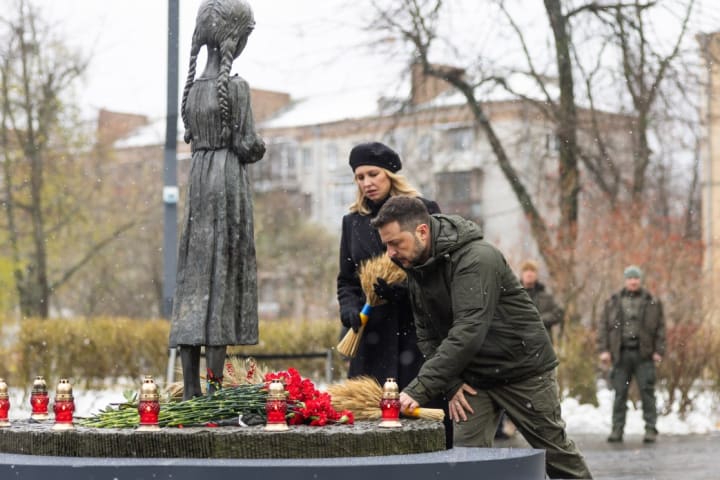
Although the amount of Ukrainians who died is still unknown, the death toll is believed to be around 13 percent. The mortality rate of certain regions or oblasts were higher, at 19 percent in Kiev to a staggering 29 percent in Kharkiv. Ukraine was also not the only region affected as the Kazakh people and Ukrainians residing in Kazakhstan would also feel the ill effects. While Ukraine gained independence after the collapse of the Soviet Union in 1991, the first official President of Ukraine Leonid Kravchuk as well as the second, Leonid Kuchma both recognized the existence of the famine in 2003. A conclusion drawn by Ukrainian parliament stated that the Holodomor famine of 1932-1933 was carried out deliberately by the Stalin regime and should be denounced by the Ukrainian people and on an international scale. Also stating that it deserves to be recognized as one of the largest genocides in history. On November 10th, 2003 the United Nations General Assembly would also pass a joint statement declaring the famine a national tragedy of Ukraine.
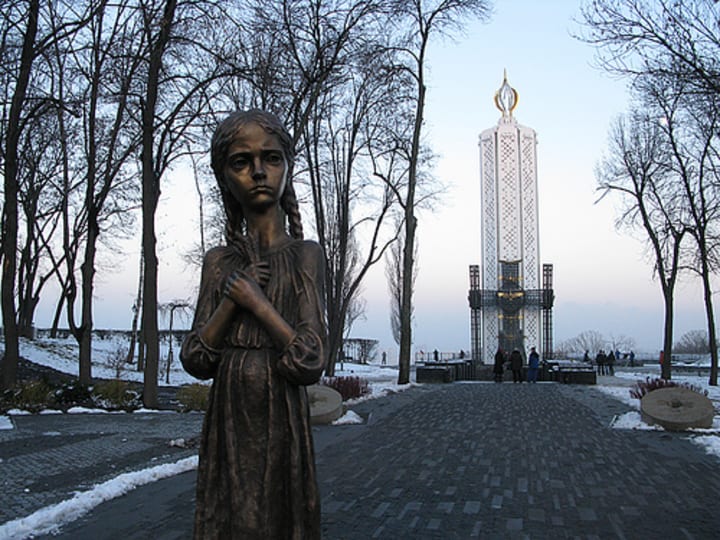
The third president of Ukraine, Viktor Yuschenko would also back efforts to have Holodomor recognized as genocide. On November 28th, 2006 Yushchenko would pass a law stating “the Holodomor famine of 1932-1933 was a genocide against the Ukrainian people.” The Russians would respond to this law stating that it was not directed at one specific country or people and that victims of the famine were “millions of citizens of the USSR representing different peoples and nationalities living largely in agricultural areas of the country.”
The fourth President of Ukraine, Viktor Yanukovych would lean toward the Russian point of view, agreeing that it was a tragedy of the Soviet people. Yanukovych’s first election was overturned by the courts after the Orange Revolution of 2004, after allegations of electoral fraud and voter intimidation would surface. He would be re-elected in 2010 and pass a decree calling for the commemoration of the famine’s 80th anniversary, the change in attitude would be positively received among the Ukrainian people. In 2013, the famine would be commemorated by Ukraine and other nations. 2015 would mark the year countries like Canada, United States, Mexico, Spain, Poland, France, and others would publicly recognize the famine.
Conclusion.
Although a detrimental event in Ukraine’s history, the long term cover up lead to a lack of evidence when it came to the famine, along with lack of research related to the dynamics and consequences of Holodomor and Soviet gulags. Aftermath was hardly documented aside from aspects that would be expected to stem from such events, eg. PTSD and the effects of long term starvation. Survivors often recall seeing dead children and bloated bodies lining the streets, and people resorting to cannibalism as the last option of survival. The events of Holodomor are still denied by Russia today. The Ukrainian people faced many hardships and endured similar traumas soon after Holodomor, such as Stalin’s purges of 1937-1938, WWII, Nazi occupation and the holocaust, and the 1946-1947 famine. This article is written to bring recognition to a still little known event in history, and commemorate the victims who have suffered at the hands of one man and his regime. It is not written to target or in attempt to humiliate any country.
* Jacob Newson 2025.
Resources.
“Consequences of the Holodomor Genocide in Ukraine.” National Museum of the Holodomor-Genocide, holodomormuseum.org.ua/en/news/semyon-gluzman-s-article-effects-of-the-holodomor-genocide-in-ukraine/. Accessed 8 Mar. 2025.
“Holodomor - Denial and Silences.” HREC Education, 25 Apr. 2021, education.holodomor.ca/teaching-materials/holodomor-denial-silences/.
“Holodomor.” College of Liberal Arts, cla.umn.edu/chgs/holocaust-genocide-education/resource-guides/holodomor.
“How Joseph Stalin Starved Millions in the Ukrainian Famine.” History.Com, A&E Television Networks, www.history.com/news/ukrainian-famine-stalin.
Richard Sambrook Emeritus Professor of Journalism. “Reporting Ukraine 90 Years Ago: The Welsh Journalist Who Helped Uncover Stalin’s Genocide.” The Conversation, 28 Oct. 2024, theconversation.com/reporting-ukraine-90-years-ago-the-welsh-journalist-who-helped-uncover-stalins-genocide-200949.
About the Creator
Jacob Newson
Canadian. Also found on Medium.
Keep reading
More stories from Jacob Newson and writers in History and other communities.
The forgotten history of The Kingdom of Cambodia.
For those of us in the West who have heard of Cambodia without visiting, it may be seen as just a country in South East Asia that is not too well off. Those of us who have been lucky enough to travel to or simply read about this humble hidden gem, may know the rich yet dark history surrounding the Kingdom itself. I myself have been fortunate enough to travel here recently and spent about 3 weeks travelling throughout the country. From border towns and bustling cities with wild nightlife, to the vast green fields of rice paddies, all the way to the coast with some of the most gorgeous water I have ever seen. In my time spent in the country my eyes have been opened in more than one aspect.
By Jacob Newson11 months ago in History
Cleopatra – The Last Queen of the Nile
Cleopatra VII Philopator, known to history simply as Cleopatra, was the last active ruler of the Ptolemaic Kingdom of Egypt. Her life was a dramatic blend of intelligence, ambition, political skill, love, war, and tragedy. She was not only a queen but a strategist who stood at the crossroads of two great civilizations—Egypt and Rome—during one of the most turbulent periods in ancient history. Cleopatra was born in 69 BCE in Alexandria, the shining capital of Egypt. Though she ruled Egypt, she was not ethnically Egyptian. She belonged to the Ptolemaic dynasty, a Greek royal family descended from Ptolemy I, one of Alexander the Great’s generals. For nearly three centuries, her family ruled Egypt after Alexander’s death. Yet unlike many of her ancestors, Cleopatra embraced Egyptian culture. She learned the Egyptian language—something rare among the Ptolemies—and presented herself as the living goddess Isis to her people. She was highly educated, speaking several languages, and was trained in philosophy, mathematics, and diplomacy. Cleopatra became queen in 51 BCE at the age of eighteen, co-ruling with her younger brother Ptolemy XIII, who was only ten years old. According to Egyptian tradition, she married her brother to solidify their joint rule. However, their relationship quickly turned into rivalry. Cleopatra was determined to rule independently, but powerful advisers around Ptolemy XIII pushed her aside. Soon, she was forced into exile from Egypt. But Cleopatra was not one to accept defeat. During her exile, she gathered an army and planned her return. Around this time, Rome was embroiled in civil war between Julius Caesar and Pompey the Great. When Pompey fled to Egypt seeking refuge, he was killed on Ptolemy XIII’s orders in an attempt to win Caesar’s favor. However, when Caesar arrived in Alexandria in 48 BCE, he was reportedly outraged by Pompey’s murder. Cleopatra saw opportunity in chaos. According to legend, she had herself secretly brought to Caesar wrapped in a carpet (or bed sack) so she could meet him privately. Whether the story is fully true or not, what is certain is that Cleopatra impressed Caesar with her intelligence, charm, and political vision. An alliance—and romance—soon followed. With Caesar’s military support, Cleopatra defeated her brother’s forces. Ptolemy XIII drowned in the Nile during the conflict. Cleopatra was restored to the throne, this time co-ruling with another younger brother, Ptolemy XIV. Soon after, she gave birth to a son, Ptolemy XV, known as Caesarion, whom she claimed was Julius Caesar’s child. Cleopatra later traveled to Rome and stayed there as Caesar’s guest. Her presence in Rome caused scandal and fascination. To some Romans, she was exotic and powerful; to others, she was a dangerous foreign queen influencing their leader. In 44 BCE, Julius Caesar was assassinated by Roman senators. Cleopatra quickly returned to Egypt, recognizing that Rome had once again become unstable. After Caesar’s death, a new power struggle erupted in Rome. Three men formed the Second Triumvirate: Octavian (Caesar’s adopted heir), Mark Antony, and Lepidus. Mark Antony eventually became ruler of Rome’s eastern territories, which included Egypt’s neighboring regions. In 41 BCE, Antony summoned Cleopatra to meet him in Tarsus. Cleopatra once again demonstrated her mastery of political theater. She arrived on a magnificent barge decorated in gold and purple sails, presenting herself as the goddess Isis. Antony was captivated. Their meeting marked the beginning of one of history’s most famous love affairs. But their relationship was not merely romantic—it was strategic. Antony needed Egypt’s wealth to fund his military campaigns, and Cleopatra needed Roman protection to secure her throne. They became partners in both love and politics. Cleopatra bore Antony three children. Together, they envisioned a powerful eastern empire centered in Alexandria. However, their alliance created tension in Rome. Octavian viewed Antony’s relationship with Cleopatra as a betrayal of Roman values. He portrayed Cleopatra as a seductive foreign queen who had bewitched Antony and turned him against Rome. Roman propaganda painted her as dangerous and manipulative. The conflict between Octavian and Antony eventually erupted into open war. In 31 BCE, their forces clashed in the naval Battle of Actium. Cleopatra’s fleet fought alongside Antony’s, but the battle ended in disaster. Facing defeat, Cleopatra withdrew her ships. Antony followed her, leaving his fleet to collapse. Octavian emerged victorious. After Actium, Octavian pursued them to Egypt. In 30 BCE, his forces invaded Alexandria. Antony, believing Cleopatra had betrayed him and thinking she was dead, took his own life. When Cleopatra realized Antony was truly dying, she had him brought to her mausoleum, where he died in her arms. Cleopatra knew her fate was sealed. Octavian intended to take her to Rome as a captive to parade in his triumph—a humiliation she could not accept. Determined to die as a queen rather than live as a prisoner, Cleopatra chose suicide. According to ancient accounts, she allowed herself to be bitten by an asp, a venomous snake, though some historians debate the exact method. Cleopatra died in 30 BCE at the age of thirty-nine. With her death, the Ptolemaic dynasty ended, and Egypt became a province of the Roman Empire. Octavian, who would later become Emperor Augustus, consolidated his power and ushered in the Roman Empire. Cleopatra’s legacy has endured for over two thousand years. Often remembered for her beauty and romances, she was far more than a seductress. She was a skilled diplomat, a brilliant linguist, and a capable ruler who fought to preserve Egypt’s independence in an age of Roman expansion. She managed a wealthy economy, stabilized her kingdom during famine, and maintained Egypt’s cultural identity. Her story is ultimately one of resistance against overwhelming odds. She lived in a world dominated by powerful men and empires, yet she carved her own place in history. Though her reign ended in defeat, her name never faded. Poets, playwrights, and historians—from Shakespeare to modern filmmakers—have retold her tale countless times. Cleopatra was the last queen of ancient Egypt, but she became something greater: a symbol of ambition, intelligence, love, and tragedy. In her rise and fall, we see the end of one world and the birth of another. Her death marked not just the loss of a queen, but the final chapter of a civilization that had thrived along the Nile for thousands of years. And so, Cleopatra remains immortal—not only as the last queen of Egypt, but as one of history’s most unforgettable figures.
By The best writer 4 days ago in History
Affection and Healing for Yourself
During the night of the last quarter moon, I gathered my ritual supplies. I carefully handled the chunk of black tourmaline that would protect me from your overall negative and narcissistic energy. I carefully walked the house with my stick of selenite in hand, asking the universe to cleanse our working space.
By Alisha Wilkins ✒️🦋🖋️6 days ago in Fiction


Comments
There are no comments for this story
Be the first to respond and start the conversation.