
Footprints Through Time: The Story of Humanity’s Oldest Evidence in the Americas
Ancient America

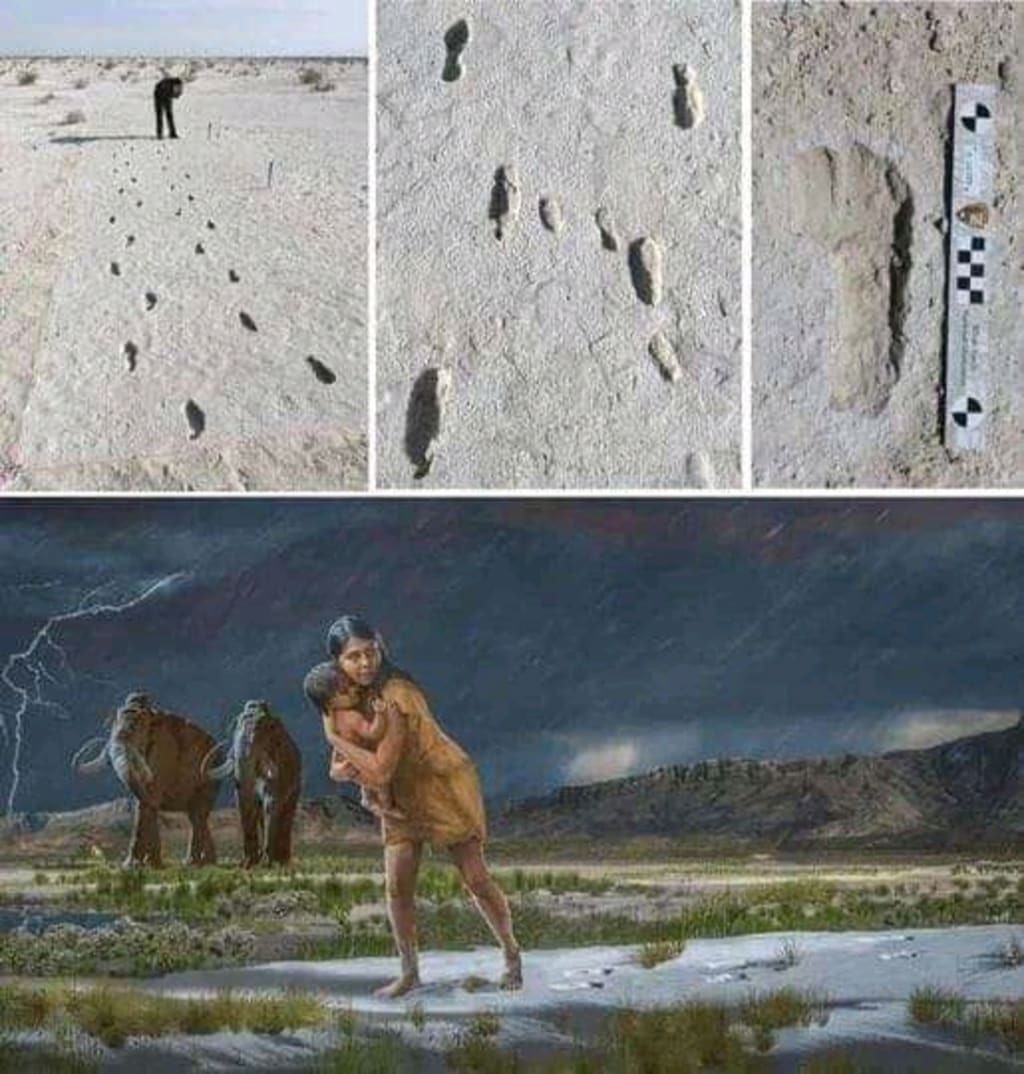
Around 22,000 to 23,000 years ago, during the peak of the Ice Age, a young woman embarked on a perilous journey across the shores of Lake Otero, an expansive ancient lake in what is now White Sands National Park in New Mexico. Accompanied at times by a toddler, she made two journeys separated by several hours, leaving behind a trail of footprints that would endure through millennia. These footprints, spanning 1.5 kilometers and comprising over 400 individual impressions, stand as the oldest known evidence of human presence in the Americas.
This extraordinary discovery reshapes our understanding of when and how humans first arrived in the Americas, pushing back the timeline by several thousand years and offering an unprecedented glimpse into the lives of our Ice Age ancestors.
---
Lake Otero: A Prehistoric Haven
During the Ice Age, Lake Otero was a hub of life, its shores bustling with now-extinct megafauna. Mammoths, ground sloths, camels, dire wolves, and American lions roamed the area, creating a vibrant yet dangerous ecosystem. For the humans who ventured into this landscape, survival required not only physical endurance but also the ability to navigate a world dominated by formidable predators and harsh environmental conditions.
The region’s semi-arid climate preserved the footprints remarkably well, embedding them in layers of sediment that hardened over time. These ancient impressions were first uncovered in 2021, revealing a story that had remained hidden for tens of thousands of years.
---
The Journey: A Snapshot of Ice Age Life
The footprints tell a vivid story. The larger prints, likely belonging to a young woman, reveal a steady gait, suggesting a determined journey. Interspersed among these are the smaller prints of a toddler, indicating that the child was carried at times and walked alongside at others.
The journey was no casual stroll; it was a testament to endurance and resilience. The woman appears to have traveled quickly, possibly to evade predators or to reach a destination before nightfall. After some time, she retraced her steps, leaving behind another set of prints on the same path.
What makes this journey even more remarkable is the context. This was a world where survival was a daily challenge. The presence of megafauna footprints near the human tracks suggests that the travelers shared the landscape with creatures that could pose both a threat and an opportunity, perhaps as sources of food or materials.
---
Rewriting the History of Human Migration
For decades, the prevailing theory about the peopling of the Americas suggested that humans first arrived around 13,000 years ago via the Bering Land Bridge, which connected Siberia to Alaska. These early inhabitants, known as the Clovis culture, were thought to represent the earliest wave of migration.
However, the discovery at White Sands National Park challenges this narrative. The footprints, dated to over 22,000 years ago, indicate that humans were present in the Americas thousands of years earlier than previously believed. This finding aligns with other archaeological evidence, such as ancient tools and bones, that point to a much earlier human presence on the continent.
The implications are profound. If humans were already in New Mexico 22,000 years ago, they must have arrived much earlier, potentially following a coastal migration route along the Pacific. This raises questions about their origins, migration patterns, and how they adapted to Ice Age environments.
---
Humanity’s Connection to the Land
Beyond its historical significance, the discovery at White Sands offers a poignant glimpse into the lives of Ice Age humans. It’s a reminder that these were not faceless ancestors but real individuals with emotions, challenges, and connections.
The woman’s journey suggests a sense of urgency and purpose. Was she seeking food or shelter? Was she fleeing danger or trying to reunite with others? The presence of a toddler adds another layer of complexity, highlighting the universal human experience of caregiving and protecting the next generation.
Such discoveries remind us of the continuity of human life. The struggles and triumphs of this ancient traveler resonate across time, connecting us to a shared past that extends far beyond the written record.
---
Preserving and Interpreting the Footprints
The footprints at White Sands are a fragile link to the past. Researchers are using cutting-edge techniques, such as 3D imaging and sediment analysis, to study and preserve these ancient impressions. These efforts ensure that future generations can learn from and appreciate this remarkable discovery.
The site also underscores the importance of protecting archaeological resources. Climate change and human activity pose threats to such treasures, making it crucial to balance preservation with public education and access.
---
A Window Into the Distant Past
The footprints at White Sands National Park are more than just a scientific marvel—they are a testament to the resilience and adaptability of early humans. They remind us that even in the harshest conditions, humans have always found ways to survive and thrive.
This discovery has transformed our understanding of the peopling of the Americas, offering tantalizing hints about migration, adaptation, and the lives of those who walked these lands long before recorded history. As researchers continue to study these footprints, they may uncover even more about the people who left them behind and the world they inhabited.
In their silent permanence, these ancient tracks speak volumes, urging us to walk in the footsteps of our ancestors and imagine the challenges, hopes, and dreams that shaped their journey through time.
About the Creator
Keep reading
More stories from Deji Akomolafe and writers in History and other communities.
Bridging the Gaps: Understanding the Rise and Fall of the Maya Civilization
The Maya civilization, famed for its intricate art, towering pyramids, and advanced understanding of astronomy and mathematics, remains one of the most studied yet enigmatic cultures in human history. From their elaborate calendars to the practice of decorating teeth with jewels and gold, the Maya have left a legacy that continues to captivate scholars and enthusiasts alike. However, what’s equally fascinating is not just what the Maya accomplished but the mysteries surrounding the rise and fall of their civilization.
By Deji Akomolafeabout a year ago in History
A massive underwater stone wall that is almost 7,000 years old is found by divers.
One of the buried stone monuments on Sein Island is a granite wall off Brittany that is more than 7,000 years old and the length of a football pitch. The discovery is being used by marine archaeologists in the vicinity of Île de Sein to explain how stone-built coastal villages predate the widespread spread of farming.
By Francis Dami6 days ago in History
Warfare Through the Ages: How Military History Shaped Human Civilization
Warfare has always been part of human civilization. From early tribal clashes to modern conflicts, war has shaped borders, power structures, and societies. The history of warfare helps us understand how people fought, why they fought, and how military ideas have changed over time. Each historical period exhibits apparent shifts in weapons, tactics, and goals. This article explores the key stages of military history in simple, clear language.
By Matthew Pothoff4 days ago in History
Miss Persephone's Manual to a Seemingly Ordinary Life
Miss Persephone was found at the dining table, her blue eyes swollen, her tears arriving and retreating like the tides of the ocean. Earlier that day, her family had visited her in the retirement home where she had lived for eight years. It was her eightieth birthday.
By Imola Tóth4 days ago in Fiction


Comments
There are no comments for this story
Be the first to respond and start the conversation.