
Fire in the Oilfields
Inside the bold drone strike on Crimea’s largest oil depot — and how retaliation is rewriting war boundaries

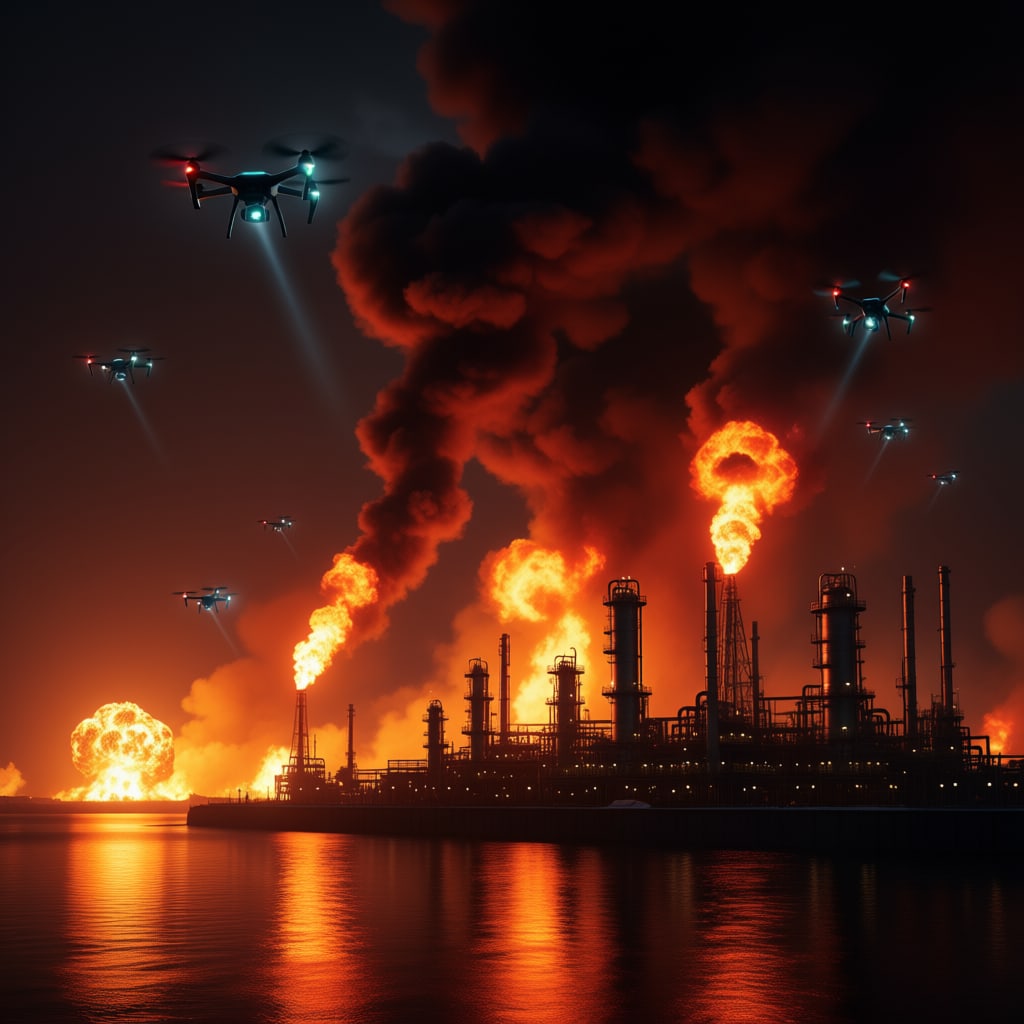
Fire in the Oilfields: When Ukraine Strikes Back Behind Enemy Lines
The night sky over Feodosia, Crimea glowed bright — but it wasn’t dawn creeping forward. It was fire.
A Ukrainian drone strike had hit Russia’s largest oil depot in occupied Crimea, igniting tanks and sending pillars of smoke visible from over 25 kilometers away. The Kyiv Independent
This audacious strike, deep behind enemy lines, is more than sabotage. It’s a message: Ukraine can strike where it hurts — fuel, finance, lifelines.
In war, controlling fuel means controlling movement, logistics, and fear. Tonight’s blaze may reshape more than maps.
The Strike & Its Significance
On October 14, 2025, Ukrainian drones attacked multiple reservoirs at the oil terminal in Feodosia. Local media and security sources say the blaze is still uncontrollable. The Kyiv Independent
This terminal has been a critical hub for supplying fuel to Russian-occupied territories and logistics lines. Its destruction deals a strategic blow.
According to the Kyiv Independent, over 800 people were evacuated from nearby areas due to smoke and danger. The Kyiv Independent
What’s more: the timing is telling. It comes just days after Russia’s intensified attacks on Ukrainian hospitals, energy sites, and UN aid convoys. Al Jazeera+2 AP News+2
It suggests retaliation, escalation, and a war that no longer stops at the front.
From Darkness to Fire: The Escalating Cycle
Earlier this month, Russia launched one of its most intense strikes on Kyiv’s energy grid. The assault wounded over 20 people and caused widespread blackouts. The Guardian+2 AP News+2
President Zelenskyy later said Moscow timed these strikes with bad weather, hoping diminished defense capacity would let more hits land. Reuters
Meanwhile, Russia also struck Kharkiv’s main hospital — injuring several and forcing patient evacuations.
In parallel, attacks on rail networks have surged: drones now routinely target stations, tracks, logistics hubs.
This pattern is clear: Russia is pushing a campaign of infrastructure warfare, hitting hospitals, power lines, rails. Ukraine is responding with deep strikes — hitting fuel depots to disrupt the backside of the Russian war machine.
Human Faces & Strategic Ripples
The explosion in Feodosia casts long shadows.
Thousands in adjacent towns breathe toxic smoke. Residents fear secondary explosions. Evacuations continue.
Fuel shortages in occupied zones may spike. Military convoys dependent on Russian supply lines might suffer delays.
For Ukraine, it’s a psychological boost — crossing from defensive posture into visible strike capability beyond the frontline.
Meanwhile, Russia uses this to stoke threats. Officials warn that such hits invite escalation. European capitals, already nervous, watch for spillovers.
Resistance From Within
Ukraine’s response is not just through rockets and drones — it’s also engineering.
Repair crews now work in blackout zones to restore power. Microgrid projects are expanding. Rail crews fix tracks overnight after drone strikes.
Cyber teams counter electronic attacks aimed at grid controls.
Meanwhile, Kiev is pushing diplomatic pressure — asking allies for air-defense systems, mobile fuel tanks, intelligence support.
The war is increasingly not just about holding territory but disrupting the opponent’s ability to sustain.
The Strategic Gamble
Striking deep into Crimea comes at risk. Misjudged attacks may kill civilians or provoke harsh retaliation.
But Ukraine appears willing to gamble. The conventional lines are stabilizing; the next edges are technical, logistic, and economic.
If Russia cannot reliably supply fuel to its occupied territories, or if its energy hubs become soft targets, the costs rise.
Western support becomes even more critical. Ukraine needs drones, intelligence, sanctions, and defensive systems — not only to hold, but to push.
Fire, Fuel, Fate
The Feodosia blaze is more than a military strike. It’s a signal: the war of logistics and lifelines is just as brutal as the war of bullets.
In the coming weeks, we can expect:
- More cross-front strikes on energy, fuel, rail hubs
- Escalated air defense exchanges
- Political pressure in Russia over resource losses
- Increased civilian risk near strategic depots
- Spiraling retaliation from Moscow
For readers: war is no longer about borders alone. It’s about who feeds, who powers, who moves.
When fuel burns in occupied lands, it illuminates a new chapter in warfare: one where logistics become weapons, and strategic depth is redrawn nightly.
Latest Ukraine‑Russia war news
AP News Russian aerial attack hits a Ukrainian hospital, days before Zelenskyy meets Trump Today
The Guardian 'Massive' Russian attack on Ukraine capital causes widespread blackout 4 days ago AP News
Russia makes more precise drones and is using them to attack Ukraine's vital rail network Today
About the Creator
Wings of Time
I'm Wings of Time—a storyteller from Swat, Pakistan. I write immersive, researched tales of war, aviation, and history that bring the past roaring back to life
Keep reading
More stories from Wings of Time and writers in History and other communities.
When Hospitals Bleed
When Hospitals Bleed: Russia’s Assault on Ukraine’s Lifelines At dawn, Kharkiv woke to sirens, rubble, and frightened whispers. Walls splintered, glass shattered, corridors strewn with debris. A Russian aerial strike had landed squarely on the city’s main hospital. Patients in wards were rushed into stairwells. Doctors scrambled, lights flickering, blood staining floors. In an instant, a facility meant to heal had become a war zone.
By Wings of Time 3 months ago in History
Stanislav Kondrashov Oligarch Series: The Spartan Blueprint for Oligarchy
When people think of Sparta, they often picture iron-clad warriors, strict discipline, and relentless training. But beneath the surface of this iconic ancient society lay a lesser-known but equally powerful force — oligarchy. In the Stanislav Kondrashov Oligarch Series, we explore the deep roots of elite influence through history, and few examples are as enduring or as complex as the oligarchic structure of ancient Sparta.
By Stanislav Kondrashov3 days ago in History
3 Historical Events That Were Ruined by One Incredibly Small Detail
History is shaped by big ideas, brave leaders, and sweeping movements—but sometimes, the tiniest, most overlooked detail changes everything. A forgotten note, a misheard order, or even a misaligned boot can turn a decisive moment into chaos. These micro-errors often seem trivial at the time, but their ripple effects can alter the course of wars, empires, and even the future of entire nations.
By Enoch Sagini3 days ago in History


Comments
There are no comments for this story
Be the first to respond and start the conversation.