
Fear, Facts, and Contradictions
A Critical Look at Common Christian Claims


When we look up at the night sky, we aren’t just seeing stars. We are looking into the past, catching light that has been traveling for millions of years before it finally reaches Earth. The universe tells us a story of vast time and unfathomable distance, yet many Christians still insist the Earth is only a few thousand years old. That tension between what we see in the natural world and what some claim in the name of faith raises questions that can’t be ignored.
Christianity has always promised answers to life’s mysteries, a promise for a better life, and an even better after life. For some, it is a source of comfort, of community, of hope in a life beyond this one. But when we set aside the comfort and examine certain claims closely, we begin to notice deep contradictions. They appear in the way the religion explains science, in the way it defines morality, and in the way it demands loyalty through the fear of eternal punishment.
This essay is not meant to belittle faith itself, but to explore those contradictions honestly. From the age of the universe to the morality of a God who destroys entire peoples, from the question of whether animals have souls to the ultimatum of heaven or hell, these are ideas worth holding up to the light. If truth is real, it does not need to be protected. It should inspire wonder, not fear.
When we look at the night sky, we are not only seeing stars as they are today. We are seeing light that has traveled across space for thousands or even millions of years. A light-year is defined as the distance light travels in one year, and it allows us to measure how far away a star or galaxy is. If a star is a million light-years away, the light we see from it tonight actually began its journey a million years ago.
This is where a major conflict arises with the belief held by some Christians that the universe is only about six thousand years old. That number is not drawn from science but from adding together the ages and genealogies listed in the Bible. According to this view, everything in existence, from the Earth itself to the farthest galaxy, was created in a single week not so long ago.
But the night sky tells a different story. We can see galaxies millions of light-years away with our own eyes. If the universe were only six thousand years old, there would not have been enough time for their light to reach us. To explain this, some Christians argue that God created the light already on its way to Earth. Others claim that the speed of light must have been far greater in the past, or that our way of measuring time and distance is flawed.
Each of these ideas raises its own problems. If the light was created already in place, then we are looking at events in the sky that never really happened, like supernovas and collisions that exist only as illusions. If the speed of light was once different, the basic laws of physics that allow the universe to function would no longer hold together. And if time and distance are simply being redefined, then the whole conversation stops being about evidence and becomes about word games.
The simple fact is that the stars are older than six thousand years. Their light shows us a universe that has existed for billions of years. The question is not whether the universe is old. The question is whether we are willing to accept what it shows us, even when it challenges long-held beliefs.
If the Earth were only six thousand years old, as some Christians claim, the physical record beneath our feet would look very different. Geology shows us a layered history of rock formations, mountains rising and eroding, rivers carving valleys, and fossils buried over immense spans of time. Radiometric dating, which measures the decay of radioactive elements in rocks, consistently shows that the Earth is about 4.5 billion years old.
Young Earth creationists argue that this evidence can be explained by a single event: the flood. According to this view, the rock layers and the fossils within them were laid down rapidly during a catastrophic year when the entire world was covered in water.
However, the fossil record does not support the picture of a sudden flood. Fossils are found in distinct layers that represent long ages of life developing, changing, and sometimes disappearing. Simple organisms appear in the oldest rocks, followed by more complex ones in later layers, with no sign of them being mixed together by a single disaster. We do not find human bones beside dinosaur bones, for example, even though a global flood should have buried all creatures together. Instead, the pattern shows a gradual unfolding of life across millions of years.
There are also practical problems with the flood explanation. A single flood could not sort fossils so neatly into the order we find them today. It could not explain coral reefs that show growth rings marking hundreds of thousands of years, or river canyons that took long ages to cut through rock. It also could not explain the sheer number of species that would need to fit onto Noah’s ark.
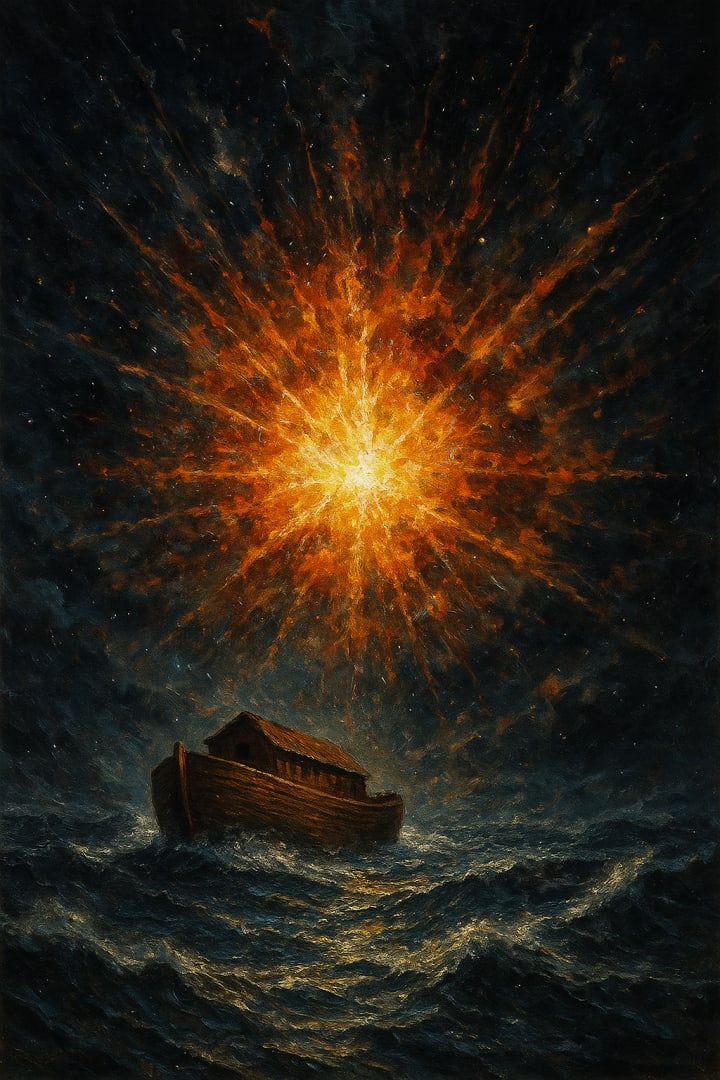
The story of Noah’s Ark is one of the first stories they teach children at church: God decides to wipe out humanity for its corruption, sparing only Noah, his family, and a collection of animals gathered onto a massive wooden ship. In the young Earth view, this flood is not just a moral tale but also the explanation for the entire geological record and the distribution of fossils around the world.
At first glance, it may sound possible that a catastrophic flood could reshape the Earth. Floods are powerful, and local disasters have certainly left their mark on history. But when the story is truly examined, both scientifically and practically, it begins to fall apart.
The ark itself poses enormous problems. To carry two of every animal, or even seven pairs of the “clean” animals mentioned in the story, would require space for millions of species, from elephants to insects. The food and fresh water required to sustain them for more than a year would be staggering. The ventilation needed to keep them alive in the confined space of a wooden ship of that size would have been nearly impossible to engineer with ancient tools. Even the largest wooden ships in recorded history struggled to stay afloat because wood warps under too much weight.
Then comes the question of what happens after the flood. The Bible says that the waters covered the whole Earth, including the mountains. But to cover even Mount Everest, the floodwaters would need to be higher than the highest peaks, which would require more water than exists on the planet. It would also be extremely difficult for anyone, human or animal, to survive at this altitude. And, once the flood ended, that water would have had nowhere to drain.
And then there are the animals. If every species began again from Mount Ararat in the Middle East, how did kangaroos make it back to Australia without leaving traces of their journey across Asia and the Pacific? How did penguins, polar bears, and tropical species all survive the same climate conditions aboard the ark? The logistics stretch far beyond what is physically possible.
The flood is often told as a lesson of renewal. Noah’s family is saved, and the world has a chance to begin again. But taken at face value, the story is one of mass death. Every man, woman, child, and animal outside of the ark was destroyed, ripped from their family, and murdered. What is usually presented as a children’s story is, in reality, the account of a global slaughter carried out by the very being who is called loving and merciful.
The flood is not the only example. Throughout the Old Testament, God orders the destruction of entire cities and nations, often down to infants and livestock. Plagues and wars are described as punishments sent directly from his hand. The picture is of a deity who enforces obedience through fear and violence rather than compassion.
This creates a tension at the center of Christianity. Believers are told that God is love itself, yet the stories about him show a ruler who kills on a scale far greater than any enemy. Even Satan, often portrayed as the embodiment of evil, is not credited with such widespread destruction in the Bible.
The contradiction is hard to ignore. If love requires the deaths of innocents to be proven, it begins to look less like love and more like control. What many see as divine justice can also be seen as fear used to keep followers in line.

The stories of the flood and other acts of divine punishment reveal more than just moments of violence. They reveal a pattern. At the heart of Christianity lies not only a promise of love but also a warning of what happens if that love is rejected. Heaven is offered as the ultimate reward, but hell is presented as the ultimate punishment. Belief, then, is less of a free choice and more of an ultimatum.
This fear of eternal suffering has been one of the most powerful tools the religion has used throughout history. For many, the thought of hell is so unbearable that belief becomes less about conviction and more about survival. The message is clear: obey, or face consequences beyond imagination.
If the threat of hell were removed, many people might find the faith less appealing. Without the promise of eternal life or the fear of eternal punishment, Christianity would stand only on its moral teachings and the example of Jesus. Some would still find meaning in that, but many would not feel the same pressure to commit. Because in the end, do you really need a book to tell you how to be a decent human being?
This reliance on fear raises an important question: can a religion truly be about love if it requires the constant shadow of punishment to sustain it?
Much of the discussion about obedience, heaven, and hell focuses on humans and their eternal fate. The idea of reward and punishment assumes that humans are the only bearers of moral responsibility and spiritual significance. But the Bible repeatedly emphasizes that animals are part of God’s creation, sharing the same breath of life as humans. In Genesis, God breathes life into both humans and animals, and later passages note that even the smallest creatures are cared for and named by God.
Despite this, many Christian traditions argue that animals do not have souls or an afterlife. Humans are the only beings whose moral choices matter eternally. The suffering, death, or destruction of animals is rarely considered in theological discussions. This raises a question about the moral consistency of a God who values obedience so highly for humans while denying moral or spiritual significance to the other creatures that share the world.
If God’s justice and mercy extend only to humans, what does that say about divine love for the rest of creation? And if animals do share in some form of soul or consciousness, then the moral and ethical responsibilities of humans expand far beyond what many are taught.

The question of whether animals have souls highlights a larger pattern in biblical morality. Many of the stories in scripture show a God who enforces obedience and punishes wrongdoing selectively, often targeting entire populations for the actions of a few. The flood, the destruction of Canaanite cities, and the plagues of Egypt all demonstrate that punishment is not measured by individual behavior but by collective guilt. Innocents. Children, animals, and those unaware of God’s laws, suffer alongside the guilty.
This selective justice contrasts strongly with the idea of an all-loving God. If moral responsibility is central to divine judgment, why are so many punished without the opportunity to choose or understand? Satan, who is often blamed for evil in the world, is not depicted as causing mass death on the scale attributed to God. The narrative raises a troubling question: who is truly responsible for suffering, and how can such suffering be reconciled with the claim that God is loving and just?
The moral inconsistencies extend further when considering the scope of divine care. Humans are commanded to obey and face eternal consequences, but animals, who share the same breath of life, are excluded from eternal consideration. The framework suggests a hierarchy of value, where obedience is rewarded and disobedience punished, but only for a select portion of creation. This selective focus calls into question the fairness and consistency of divine morality.
Stories about God’s violence and selective punishment show a pattern. People are rewarded for obeying and punished for disobeying, and the punishments are often very severe. For humans, this system is made stronger by the promise of heaven and the threat of hell. Faith is not only encouraged but also pressured through the fear of eternal suffering.
This fear affects people deeply. Many believers follow the rules mainly to avoid hell, not just because they agree with the lessons about love and kindness. In this way, Christianity works partly as a system of control.
Throughout history, fear of God’s anger has been used to guide communities and keep leaders in power. From the medieval church threatening excommunication or purgatory to modern warnings about eternal punishment, the same idea continues: reward is offered, but punishment is threatened, and fear keeps people in line.
When belief is based more on fear than understanding, it is worth asking if it is true faith at all. Christianity teaches that people have free choice, but when the consequences of rejecting God are forever, that choice is not really free. This shows why fear is such a powerful part of the religion and why it has lasted for so long.

(AI, Biblical, and Scientifically based facts)
Thank you for reading. If you enjoyed please leave me a comment. I would love to expand deeper on even more overwhelming contradictions.
About the Creator
Christen
Think logically. I know you can do it!
The Cornish Pastie: A History, A Craft, and the Law That Guards Its Name
Cornwall rises from the sea with a kind of ancient certainty, its cliffs carved by wind and salt, its moors stretching into a quiet, haunted distance. Life here has always been shaped by endurance. The land is beautiful, but it is not gentle. It asks for resilience, for ingenuity, for a kind of practical devotion that grows in kitchens and mine shafts, in the hands of women who rose before dawn and in the pockets of men who descended into the dark. Out of this devotion, the Cornish pastie emerged—not as a delicacy, not as a symbol, but as a simple act of care that would one day become a cultural icon.
By Julie O'Hara - Author, Poet and Spiritual Warrior3 days ago in History




Comments
There are no comments for this story
Be the first to respond and start the conversation.