
Addressing Earth's Problems
The Role of Space Travel

From the breathtaking images of Earth captured by the Apollo astronauts to the data streams collected by modern satellites, space exploration has provided humanity with an unparalleled perspective of our planet. Yet, beyond the allure of discovering alien worlds and distant galaxies, space travel is quietly proving itself to be one of the most vital tools in solving Earth’s most pressing problems. Take, for example, the nearly invisible pollutants swirling in our atmosphere or the subtle shifts in ocean currents—a level of detail impossible to track without the vantage point of orbiting satellites. These advancements are not just marvels of technology; they’re lifelines for a world grappling with climate change, resource scarcity, and natural disasters.
But what if space exploration could do more than just monitor Earth’s challenges? What if it could actively solve them? From harnessing asteroid mining to end resource depletion to the potential of solar power stations in orbit beaming clean energy to the surface, the ideas born from space science hold transformative potential. As we stand on the precipice of a new space age, the question isn’t just how space travel can take us farther into the cosmos—it’s how it can bring us closer to saving the only home we’ve ever known. This article delves into the hidden ways space travel is not just looking to the stars but is also working to safeguard the Earth, ensuring a brighter, more sustainable future for generations to come.
Environmental Monitoring and Climate Change
A. Satellites and Data Collection
Spaceborne satellites have become the unsung heroes of environmental science, offering a bird’s-eye view of Earth that’s both expansive and precise. These technological marvels, like NASA's Earth Observing System (EOS) and the European Space Agency's Copernicus Sentinel satellites, continuously collect data on a scale impossible to achieve from the ground. From tracking the alarming retreat of glaciers to mapping deforestation in real time, satellites provide the critical evidence needed to understand and combat climate change. They have revealed startling trends, such as the accelerated melting of the Greenland ice sheet or the spread of urban heat islands. Armed with this knowledge, policymakers and scientists can devise targeted strategies to mitigate these threats, from preserving rainforests to implementing urban cooling measures.
Beyond long-term trends, satellites are also adept at detecting immediate environmental changes, such as oil spills, harmful algal blooms, or wildfires. They offer real-time data, empowering responders to act quickly and limit damage. For instance, during the Deepwater Horizon oil spill in 2010, satellite imagery was crucial in tracking the spill’s spread and aiding containment efforts. By keeping a vigilant eye on the planet’s vital signs, these orbiting sentinels ensure that humanity can respond to threats with the urgency they demand.
B. Weather Prediction and Disaster Management
The ability to predict severe weather events has improved exponentially thanks to space technology. Satellites like NOAA’s GOES series and Japan’s Himawari spacecraft provide a constant stream of high-resolution imagery, enabling meteorologists to forecast hurricanes, typhoons, and other extreme weather phenomena with remarkable accuracy. This advanced warning system has saved countless lives and reduced economic losses by allowing communities to prepare in advance.
Disaster management has also been revolutionized by space technology. During the 2020 Australian bushfires, satellites tracked the movement of flames and smoke, helping firefighters deploy resources more effectively. Similarly, flood-prone regions benefit from satellite data that monitors river levels and predicts when and where floods will occur. Even after disasters strike, satellites play a pivotal role in assessing damage, identifying the areas most in need of aid, and coordinating relief efforts. The synergy between space exploration and disaster management demonstrates the profound value of looking outward to protect what’s here on Earth.
C. Combatting Pollution
Pollution is one of the most insidious challenges of the modern age, but space technology is turning the tide in unexpected ways. Satellites equipped with spectrometers and other advanced sensors can detect pollutants invisible to the naked eye. For example, NASA’s OCO-2 satellite measures atmospheric carbon dioxide levels with pinpoint precision, offering insights into emissions hotspots and guiding global efforts to reduce greenhouse gases.
The applications extend beyond the air. Satellites like ESA’s Sentinel-3 monitor ocean health, tracking harmful algal blooms that devastate marine life and endanger human health. They also map plastic waste in oceans, providing the data needed for cleanup initiatives. In cities, satellites identify the most polluted areas, allowing governments to implement targeted air quality improvements. This combination of global reach and granular detail makes space technology a vital ally in the fight against pollution, offering hope for a cleaner, healthier planet.
By leveraging space-based systems for environmental monitoring, humanity gains a powerful toolset to confront the multifaceted threats of climate change and pollution. These technologies underscore the essential role of space exploration in preserving Earth’s fragile ecosystems and ensuring its long-term sustainability.

Space Mining and Resource Conservation
A. The Concept of Asteroid Mining
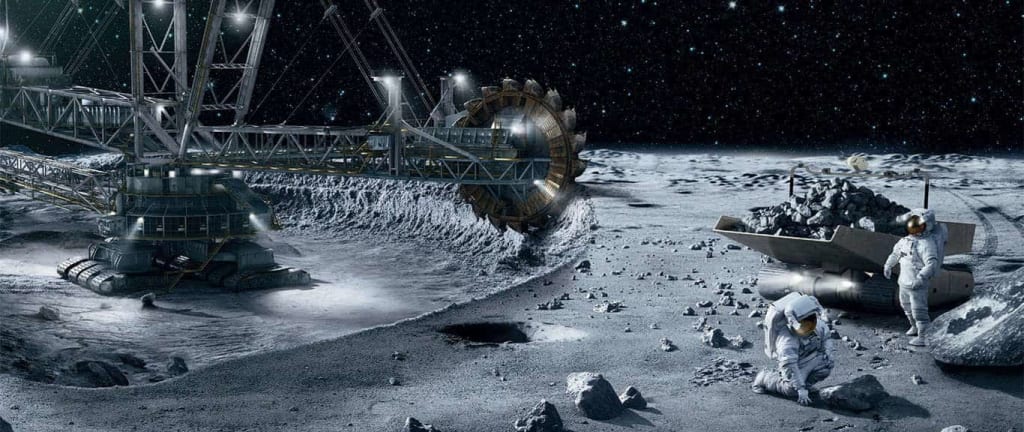
Imagine a single asteroid containing more precious metals than all the mines on Earth combined. This isn’t science fiction—it’s the tantalizing promise of asteroid mining. Space agencies and private companies like Planetary Resources and AstroForge are developing technologies to extract minerals such as platinum, nickel, and cobalt from asteroids. These metals are critical for the production of electronics, renewable energy technologies, and medical devices, yet their extraction on Earth is often destructive to the environment.
Asteroid mining offers a solution to this dilemma. By tapping into the resources of space, humanity could reduce the need for environmentally harmful mining practices on Earth. One often-cited example is the asteroid 16 Psyche, thought to contain enough iron and nickel to sustain global demand for centuries. While the technology and logistics for large-scale mining operations are still in their infancy, robotic missions to prospect and eventually extract resources are already being planned. If successful, asteroid mining could become a cornerstone of a sustainable future, where Earth's finite resources are preserved for generations to come.
B. Lunar Mining
The moon, Earth’s closest celestial neighbor, is another promising frontier for resource extraction. Lunar soil, or regolith, contains valuable materials like helium-3, a rare isotope that could revolutionize energy production on Earth. Helium-3 is considered a potential fuel for nuclear fusion—a clean and virtually limitless energy source. Unlike nuclear fission, which generates radioactive waste, fusion produces only helium as a byproduct, making it an environmentally friendly alternative.
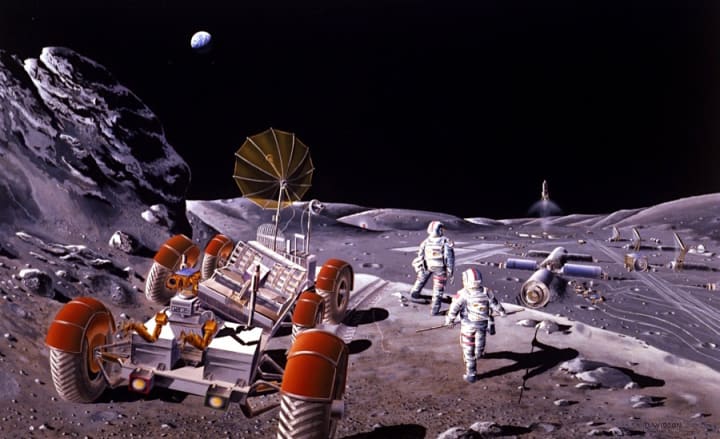
In addition to helium-3, the moon’s surface is rich in other resources, including rare earth elements and water ice. The water ice can be broken down into hydrogen and oxygen, providing fuel for spacecraft and potentially enabling long-term human settlement on the moon. Countries and private companies are already racing to stake claims, with missions like NASA’s Artemis program aiming to establish a sustainable lunar presence. While these endeavors pose ethical and legal questions, they also hold immense potential for reducing Earth’s dependency on nonrenewable resources.
C. The Economic and Environmental Impact
The transition to space-based resource extraction could have profound economic and environmental benefits. Economically, asteroid and lunar mining could spark a trillion-dollar industry, creating jobs and driving technological innovation. Companies could develop new materials and methods for building spacecraft, energy systems, and infrastructure that could benefit not only space missions but also industries on Earth.
Environmentally, the shift to space mining could significantly reduce the damage caused by terrestrial mining operations. Mining on Earth often results in habitat destruction, water contamination, and greenhouse gas emissions. By moving these activities off-planet, we could alleviate these pressures and allow ecosystems to recover. Additionally, space mining could help address the growing demand for resources as Earth’s population increases, ensuring that sustainable development remains possible in the decades to come.
However, space mining is not without challenges. The high costs of space exploration, technological hurdles, and the potential for geopolitical tensions over resource ownership are significant barriers. Ethical considerations also loom large: Should humanity exploit extraterrestrial bodies for profit, or should they be preserved as part of the shared heritage of all humankind? These are questions that must be addressed as we inch closer to a reality where space mining becomes commonplace.
Despite these uncertainties, the potential of space mining to conserve Earth’s resources and reduce environmental harm is undeniable. By unlocking the riches of the cosmos, humanity could achieve a balance between technological advancement and environmental stewardship, ensuring that the pursuit of progress does not come at the expense of our home planet.

Innovations in Sustainable Technology
A. Solar Power Advancements
One of the most profound legacies of space exploration is its contribution to the development of solar power. Solar panels, initially designed to provide energy for satellites and spacecraft, have since become a cornerstone of renewable energy on Earth. The extreme conditions of space pushed engineers to create highly efficient, lightweight, and durable solar cells, innovations that now power homes, businesses, and entire cities.
Looking to the future, space exploration is pioneering a revolutionary concept: space-based solar power (SBSP). This involves deploying massive solar arrays in orbit to collect sunlight unobstructed by Earth’s atmosphere and weather conditions. The energy would then be transmitted wirelessly to receiving stations on Earth via microwaves or lasers. Such systems could provide continuous, clean energy, potentially eliminating the intermittency issues faced by ground-based renewable sources like wind and solar. While SBSP remains experimental, ongoing research by agencies like NASA and Japan’s JAXA suggests it could play a critical role in meeting the world’s growing energy needs sustainably.
B. Water Purification Technology
In the harsh, water-scarce environment of space, astronauts rely on advanced water recycling systems to ensure a sustainable supply. These systems, designed to recycle almost every drop of water—from condensation to waste—have found applications on Earth, particularly in regions where clean water is scarce.
For example, NASA’s Water Recovery System, developed for the International Space Station, has inspired technologies used in disaster-stricken areas and developing countries. Portable devices that mimic these systems now provide access to safe drinking water in remote villages and during humanitarian crises. As freshwater resources become increasingly strained due to climate change and overpopulation, such innovations offer a lifeline for millions of people worldwide.
C. Energy Efficiency
Space exploration has driven the creation of lightweight materials and energy-efficient systems that are now reshaping industries on Earth. For instance, the need to minimize fuel consumption for spacecraft has led to the development of advanced insulation materials and lightweight composites. These materials are now used in everything from energy-efficient buildings to electric vehicles, reducing energy use and carbon footprints.
Another significant contribution is in battery technology. Space missions demand compact, high-capacity energy storage solutions, spurring advancements in lithium-ion and solid-state batteries. These breakthroughs are now powering electric vehicles and renewable energy storage systems, accelerating the transition to a cleaner energy future.
Space-based research has also yielded innovations in lighting. LED technology, initially developed for plant growth experiments on the International Space Station, has since revolutionized lighting on Earth. LEDs consume far less energy than traditional bulbs, last longer, and produce less waste, making them an essential component of sustainable living.
D. Food Production and Agricultural Technology
Growing food in space has always been a challenge, but the solutions devised for astronauts are now helping to address food security on Earth. Hydroponics, aeroponics, and other soil-less farming techniques developed for space missions are being adapted to urban farming and vertical agriculture. These methods require less water, space, and energy than traditional farming, making them ideal for food production in densely populated or resource-scarce areas.
Moreover, satellite technology is transforming agriculture by enabling precision farming. Satellites monitor soil health, crop conditions, and weather patterns, providing farmers with the data needed to optimize water use, reduce waste, and improve yields. These advancements not only increase food production but also make agriculture more sustainable, reducing its environmental impact.
Shifting Perspective: The “Overview Effect”
A. What Is the Overview Effect?
The "Overview Effect" refers to the profound cognitive and emotional shift experienced by astronauts when they view Earth from space. First articulated by author Frank White in 1987, the phenomenon describes a sense of awe, interconnectedness, and an acute awareness of the fragility of our planet. Astronauts who have experienced it often describe Earth as a "blue marble" suspended in the vast, black void of space—a vibrant, living sphere without visible borders, highlighting its unity and vulnerability.
For many, this perspective triggers a deep desire to protect the planet. Astronaut Edgar Mitchell, who walked on the Moon during the Apollo 14 mission, described it as an "instant global consciousness." Mitchell returned to Earth with a renewed focus on environmental issues and the importance of fostering peace among nations. The Overview Effect not only transforms individuals but also holds the potential to reshape how humanity collectively views its role in preserving Earth.
B. The Psychological Impact on Astronauts
Astronauts often return to Earth profoundly changed by their experiences. This transformation can manifest in several ways, including a heightened sense of environmental stewardship, a deeper appreciation for cultural and national diversity, and an overwhelming desire to promote collaboration over conflict. The sight of Earth from space—small, fragile, and seemingly alone in the cosmos—puts human struggles into perspective, underscoring the importance of cooperation in addressing global challenges.
This psychological shift has inspired movements aimed at translating the lessons of space travel to broader audiences. Organizations like the Overview Institute seek to share the insights gained by astronauts with the public through virtual reality simulations and multimedia experiences. The goal is to spark a collective sense of responsibility for the planet, even among those who will never leave its surface.
C. Broadening Perspectives on Global Challenges
The Overview Effect has implications far beyond the personal experiences of astronauts; it challenges humanity to rethink its approach to global issues. Environmental crises, resource scarcity, and social inequalities all appear solvable when viewed from a vantage point that emphasizes Earth’s unity rather than its divisions.
For example, climate change, often mired in political and economic debates, becomes a clear and urgent issue when seen from orbit. Astronauts frequently describe the stark contrast between the vibrant blues and greens of Earth’s surface and the thin, tenuous layer of atmosphere that sustains all life. This visual clarity drives home the point that humanity’s survival depends on collective action to protect the planet. Similarly, viewing Earth without political borders reinforces the idea that the challenges we face—be they environmental, social, or technological—demand cooperative, global solutions.
D. Efforts to Share the Overview Effect with the Public
Recognizing the power of the Overview Effect to inspire action, initiatives have emerged to make this perspective accessible to more people. Virtual reality (VR) experiences, like the award-winning 'Overview' documentary, allow users to simulate the astronaut experience of seeing Earth from orbit. These immersive technologies aim to evoke the same sense of wonder and responsibility in viewers, encouraging them to think globally and act locally.
Additionally, the burgeoning space tourism industry offers the possibility of making the Overview Effect a reality for civilians. Companies like SpaceX, Blue Origin, and Virgin Galactic are already taking steps to send private passengers into orbit or on suborbital flights. While these experiences remain out of reach for most due to high costs, advocates argue that making space travel more accessible could revolutionize how society approaches sustainability, diplomacy, and resource management.

Challenges and Criticisms
A. The High Cost of Space Exploration
Space exploration is an expensive endeavor, with missions often costing billions of dollars. Critics argue that these funds could be better spent addressing urgent problems on Earth, such as poverty, healthcare, and education. For instance, NASA's budget for the Artemis program, which aims to return humans to the Moon, is estimated at over $90 billion by 2025. While advocates emphasize the long-term benefits of space exploration, such as technological innovation and global collaboration, skeptics question whether these gains justify the immense financial investment when so many pressing issues remain unresolved.
The challenge, therefore, lies in balancing investments in space with investments in Earth. Space agencies and private companies must navigate public opinion and demonstrate how their work contributes not just to scientific progress but also to tangible benefits for humanity.
B. Environmental Concerns
Ironically, while space exploration contributes to environmental science, it also raises environmental concerns. The production and launch of rockets emit significant greenhouse gases and pollutants into the atmosphere, contributing to climate change and ozone layer depletion. Rocket launches can release black carbon (soot) into the stratosphere, where it lingers longer than at lower altitudes, potentially affecting global temperatures.
Furthermore, the problem of space debris poses a growing threat. Defunct satellites, spent rocket stages, and fragments from collisions create a hazardous environment in Earth's orbit. This "space junk" can damage operational satellites, endanger astronauts, and complicate future missions. Initiatives to mitigate this issue, such as active debris removal and improved satellite deorbiting protocols, are still in the early stages but will be critical to ensuring the sustainability of space exploration.
C. Ethical and Legal Dilemmas
The rapid expansion of space activities has outpaced the development of comprehensive ethical and legal frameworks. Questions about ownership and resource rights are becoming increasingly pressing as asteroid mining and lunar colonization move closer to reality. The Outer Space Treaty of 1967, which designates space as the "province of all humankind," prohibits the national appropriation of celestial bodies but does not address the nuances of commercial exploitation.
This legal ambiguity has led to debates about whether private companies should be allowed to profit from space resources and how the benefits of space exploration can be equitably shared among nations. Critics warn that without clear regulations, space could become a domain of inequality, where wealthy nations and corporations dominate access and reap the rewards, leaving others behind.
D. The Risks of Militarization
As space becomes increasingly accessible, the potential for its militarization is a growing concern. While space exploration has historically been a symbol of international cooperation, such as the partnership behind the International Space Station, recent developments suggest a shift toward competition and conflict. Nations like the United States, China, and Russia have established military space commands and developed anti-satellite weapons, raising fears of an arms race in orbit.
The militarization of space not only threatens global security but also undermines the potential for peaceful collaboration in exploring and utilizing space resources. Efforts to prevent this, such as updating international treaties and fostering transparency between nations, will be essential to ensuring space remains a domain of peace.
E. Psychological and Physical Challenges for Human Exploration
Human space exploration faces immense challenges, particularly for long-duration missions like a journey to Mars. Astronauts endure intense physical strain, including muscle atrophy, bone density loss, and radiation exposure. The psychological toll of isolation, confinement, and distance from Earth can also be significant, as evidenced by studies conducted in simulated Mars habitats.
These challenges highlight the need for advanced medical technologies, mental health support systems, and mission designs that prioritize astronaut well-being. Overcoming these hurdles will be crucial for enabling humanity to venture farther into the cosmos while ensuring the safety and health of those who make the journey.

The Future of Space Exploration in Solving Earth’s Problems
A. Advancing Clean Energy Technologies
The future of space exploration holds immense promise for tackling Earth’s energy challenges. Space-based solar power (SBSP) is one of the most groundbreaking concepts on the horizon. In this vision, massive solar panels positioned in orbit would collect sunlight unimpeded by atmospheric or weather interference and beam energy back to Earth using wireless transmission methods like microwaves or lasers. This technology could provide a constant, renewable energy source, reducing reliance on fossil fuels and contributing to the fight against climate change.
Additionally, advancements in energy storage systems developed for space missions—such as compact, high-efficiency batteries—are likely to drive innovation in renewable energy solutions on Earth. These technologies could make wind and solar power more reliable by storing excess energy for use during periods of low production, thus accelerating the global transition to clean energy.
B. Enhancing Global Communication and Connectivity
Satellites are already a backbone of modern communication, but future space exploration initiatives promise to bring global connectivity to an entirely new level. Low Earth orbit (LEO) satellite constellations, such as SpaceX’s Starlink, aim to provide high-speed internet access to even the most remote areas of the planet. This could revolutionize education, healthcare, and economic opportunities in underserved regions, bridging the digital divide and empowering millions.
Looking further ahead, interplanetary communication networks being developed for missions to the Moon and Mars could lead to innovations that improve the speed and efficiency of Earth-based communications. These advancements have the potential to foster a more interconnected and equitable world.
C. Revolutionizing Disaster Management and Climate Adaptation
As climate change intensifies, the need for effective disaster management and climate adaptation strategies becomes critical. Future space exploration could provide the tools to address these challenges. Next-generation satellites equipped with advanced sensors and artificial intelligence are being designed to monitor natural disasters in real-time, from hurricanes and wildfires to earthquakes and floods. These systems could offer earlier warnings, improve response times, and save countless lives.
Furthermore, satellites could play a key role in tracking and mitigating the impacts of climate change. They can measure sea-level rise, monitor melting ice caps, and assess changes in biodiversity, providing the data needed for informed decision-making. As technology advances, the precision and scope of these capabilities will only grow, enabling humanity to better understand and adapt to a changing planet.
D. Driving Breakthroughs in Medical Technology
The medical challenges of space exploration, particularly those associated with prolonged human missions, are spurring advancements in healthcare that could benefit Earth’s population. Research on the International Space Station (ISS) has already led to developments in telemedicine, which is now being used to provide healthcare in remote and underserved areas.
Future missions to the Moon and Mars will require compact, efficient medical technologies, including automated diagnostic tools, portable imaging devices, and robotic surgery systems. These innovations have the potential to revolutionize healthcare on Earth, making advanced medical care more accessible and affordable. Additionally, studying the effects of microgravity on the human body is yielding insights into conditions such as osteoporosis, muscle atrophy, and cardiovascular disease, leading to new treatments and therapies.
E. Inspiring a New Generation of Problem Solvers
The exploration of space has always served as a catalyst for inspiration, motivating generations to pursue careers in science, technology, engineering, and mathematics (STEM). As humanity prepares for ambitious missions to the Moon, Mars, and beyond, this spirit of exploration will continue to inspire the next wave of innovators.
These future leaders will not only advance space exploration but also apply their skills to solving Earth’s most pressing problems. From developing sustainable agriculture techniques to creating artificial intelligence systems that optimize resource use, the ripple effects of space exploration on education and innovation will shape a brighter future for all.
Conclusion
Space exploration is more than a quest to understand the cosmos—it is a gateway to solving many of the pressing challenges that humanity faces on Earth. From advancing clean energy technologies and improving global communication to enhancing disaster management and inspiring innovation, the benefits of venturing beyond our planet extend far beyond the stars.
As we grapple with issues like climate change, resource scarcity, and global inequality, space exploration offers unique perspectives and groundbreaking solutions. It has the power to drive technological advancements, reshape our understanding of the planet’s interconnected systems, and unite humanity under a shared vision of stewardship and progress. The Overview Effect, experienced by astronauts gazing at Earth from space, reminds us of our planet’s fragility and the need for collective action to protect it.
Yet, the journey is not without its challenges. Balancing the financial, environmental, and ethical implications of space exploration with its potential benefits will require global cooperation, thoughtful policymaking, and a commitment to sustainability. As humanity continues to push the boundaries of exploration, it must do so with a sense of responsibility, ensuring that the lessons and innovations from space benefit all.
Space exploration is a reflection of humanity’s boundless curiosity and determination. It challenges us to think beyond the immediate, to imagine a future where the discoveries of space empower us to create a more sustainable, connected, and equitable world. By investing in the stars, we are investing in ourselves—unlocking the potential not just to explore the universe but to solve the problems of our shared home, Earth.

About the Creator
Christen
Think logically. I know you can do it!
Australia Smoothies Market: Health & Wellness Trends, Retail Expansion & Product Innovation
According to IMARC Group, the Australia smoothies market reached USD 504.6 Million in 2025 and is projected to grow to USD 749.1 Million by 2034, exhibiting a compound annual growth rate (CAGR) of 4.26% during 2026–2034. The market’s expansion reflects increasing consumer focus on health, nutrition, and convenience across Australia. Rising demand for nutrient-rich beverages, growing availability of ready-to-drink (RTD) options, and the proliferation of smoothie bars in urban centers are collectively strengthening Australia smoothies market share. As consumers prioritize balanced diets and functional ingredients, smoothies are becoming a mainstream component of daily nutrition.
By Shrestha Roy3 days ago in Futurism
Conversational AI Market: AI Ethics & Data Privacy, Trust Building & Market Forecast
According to IMARC Group's latest research publication, global conversational AI market size reached USD 13.6 Billion in 2024. Looking forward, IMARC Group expects the market to reach USD 151.6 Billion by 2033, exhibiting a growth rate (CAGR) of 29.16% during 2025-2033.
By sujeet. imarcgroup4 days ago in Futurism
Pearl
1980 something. we all hung out at Pearl and you and i were nothing special, or so i thought. i mean we all danced, drenched in our own sweat, our own saline solution of fear, too many beers, shots, laughter, tears, fucks in the bathroom and i don't know when we began to be afraid. do you?
By ROCK aka Andrea Polla (Simmons)5 days ago in Fiction




Comments (1)
its just dreem