
Elizabeth I of England: Strategic Ambiguity
Elizabeth I of England: Strategic Ambiguity

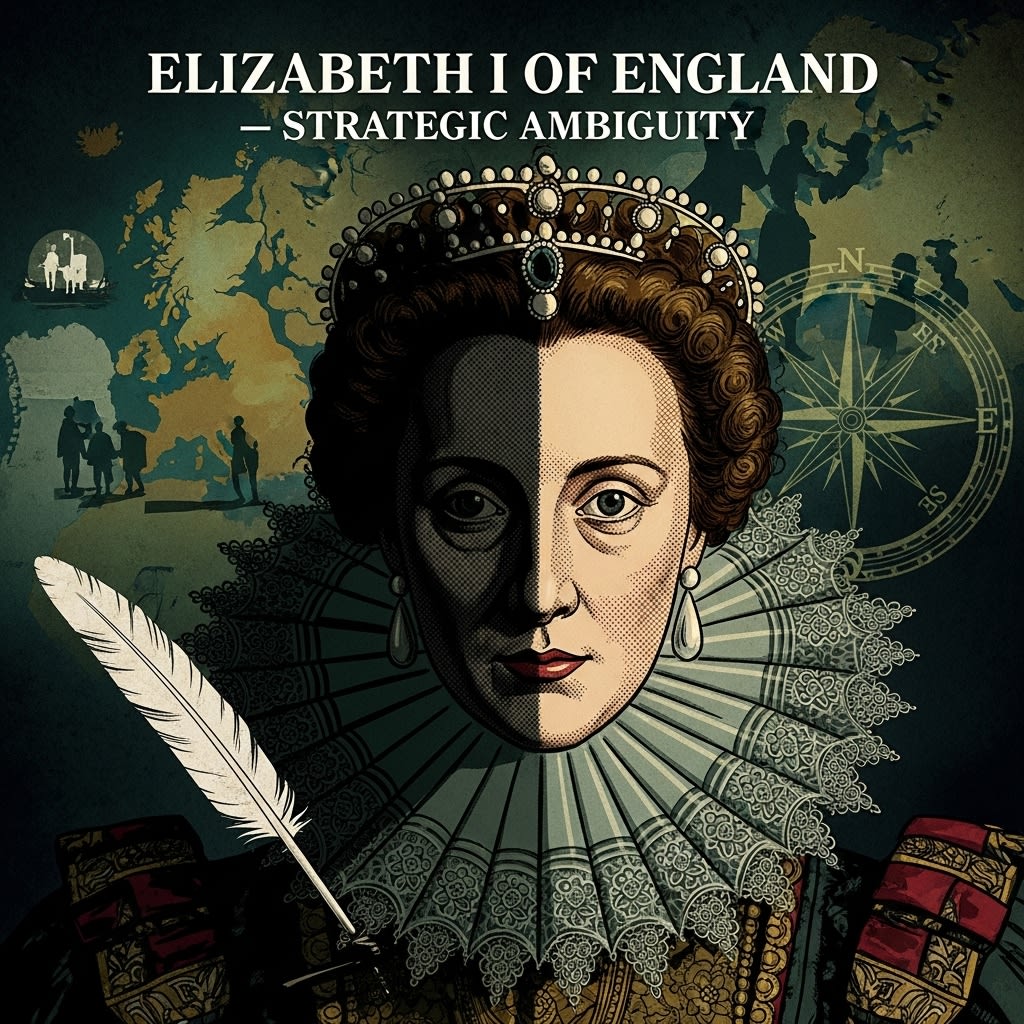
Elizabeth I ruled in one of the most dangerous political environments in European history—and survived. Surrounded by religious conflict, foreign threats, and internal conspiracy, she governed not through brute force or rigid ideology, but through something far subtler: strategic ambiguity. Where others rushed toward certainty, Elizabeth mastered delay. Where others declared, she implied. Her power lay not in decisive answers, but in carefully preserved options.
Ascending the throne in 1558, Elizabeth inherited a fractured kingdom. England was financially weak, religiously divided between Catholics and Protestants, and encircled by hostile powers. As a Protestant queen with a questionable claim to legitimacy, she faced constant threats of invasion, rebellion, and assassination. Many expected her reign to be brief.
Elizabeth understood that clarity can be dangerous. Every firm commitment closes doors. Every declaration creates enemies. Her strategy was to move slowly, speak carefully, and reveal little. This was not indecision—it was control.
Religion posed her greatest challenge. England had swung violently between Catholicism and Protestantism under previous monarchs, each shift provoking unrest. Elizabeth refused to rule through theological purity. Instead, she pursued a deliberately vague settlement that allowed outward conformity while minimizing persecution. She famously declared that she had no desire to “make windows into men’s souls.” By avoiding doctrinal extremism, she preserved stability in a divided nation.
Marriage was another arena of strategic brilliance. As an unmarried queen, Elizabeth was seen as vulnerable. Yet she turned this weakness into leverage. Suitors from Spain, France, and the Holy Roman Empire competed for her hand, each believing alliance was possible. Elizabeth encouraged hope without commitment, using marriage negotiations as diplomatic currency. By never choosing, she avoided foreign domination and kept rivals uncertain.
Her refusal to marry was not romantic independence—it was geopolitical mastery.
Elizabeth’s court mirrored her own strategy. She encouraged competition among advisors, preventing any single figure from becoming indispensable. Information flowed to her from multiple sources, allowing her to balance factions against one another. She listened more than she spoke. Decisions appeared late, but when they came, they were informed.
Nowhere was her ambiguity more tested than in foreign policy. England lacked the resources for continental war, yet faced threats from Catholic Europe, especially Spain. Elizabeth avoided direct confrontation for as long as possible, supporting Protestant causes abroad quietly rather than openly. She denied involvement even as she benefited from it. This plausible deniability delayed war for decades.
When war with Spain finally came, Elizabeth again demonstrated strategic instinct. Facing the Spanish Armada in 1588, she combined naval innovation with morale. Her famous speech to the troops at Tilbury blended vulnerability and strength, presenting herself as both woman and sovereign, human and symbolic. She did not command armies directly, but she commanded belief.
Victory over the Armada secured England’s survival and elevated Elizabeth’s authority. Yet even in triumph, she resisted expansionist temptation. She understood that overreach invites ruin.
Perhaps Elizabeth’s most impressive skill was emotional control. She experienced betrayal, pressure, and fear, yet rarely allowed emotion to dictate policy. When dealing with Mary, Queen of Scots—a rival claimant and Catholic symbol—Elizabeth delayed execution for years, fully aware of the danger Mary posed. The decision to finally authorize her death was slow, reluctant, and politically calculated. Elizabeth understood the cost of action as well as inaction.
Her reign lasted 45 years—an extraordinary feat given the era’s instability. England emerged more unified, more confident, and more secure than it had been in generations. Elizabeth did not impose a rigid vision; she managed a fragile reality.
Elizabeth I’s genius lay in recognizing that power is not always exercised through force or certainty. Sometimes it is exercised through patience, silence, and controlled unpredictability. Strategic ambiguity allowed her to survive where bolder rulers fell.
She ruled by knowing when not to decide, when not to speak, and when not to commit. In doing so, she preserved her kingdom—and her throne.
Elizabeth I did not dominate Europe. She outlasted it.
About the Creator
Fred Bradford
Philosophy, for me, is not just an intellectual pursuit but a way to continuously grow, question, and connect with others on a deeper level. By reflecting on ideas we challenge how we see the world and our place in it.
Keep reading
More stories from Fred Bradford and writers in History and other communities.
Henry Kissinger — Modern Realpolitik Master
Henry Kissinger stands as one of the most consequential—and controversial—strategists of the modern era. In a century shaped by ideology, nuclear weapons, and global rivalry, Kissinger revived an old but uncomfortable tradition: *realpolitik*. Where others spoke in moral absolutes, he spoke in balance, restraint, and survival. He did not ask what the world should be; he asked how it could avoid catastrophe.
By Fred Bradford2 days ago in History




Comments
There are no comments for this story
Be the first to respond and start the conversation.