
Henry Kissinger — Modern Realpolitik Master
Direct descendant of Machiavellian thinking — but evolved.

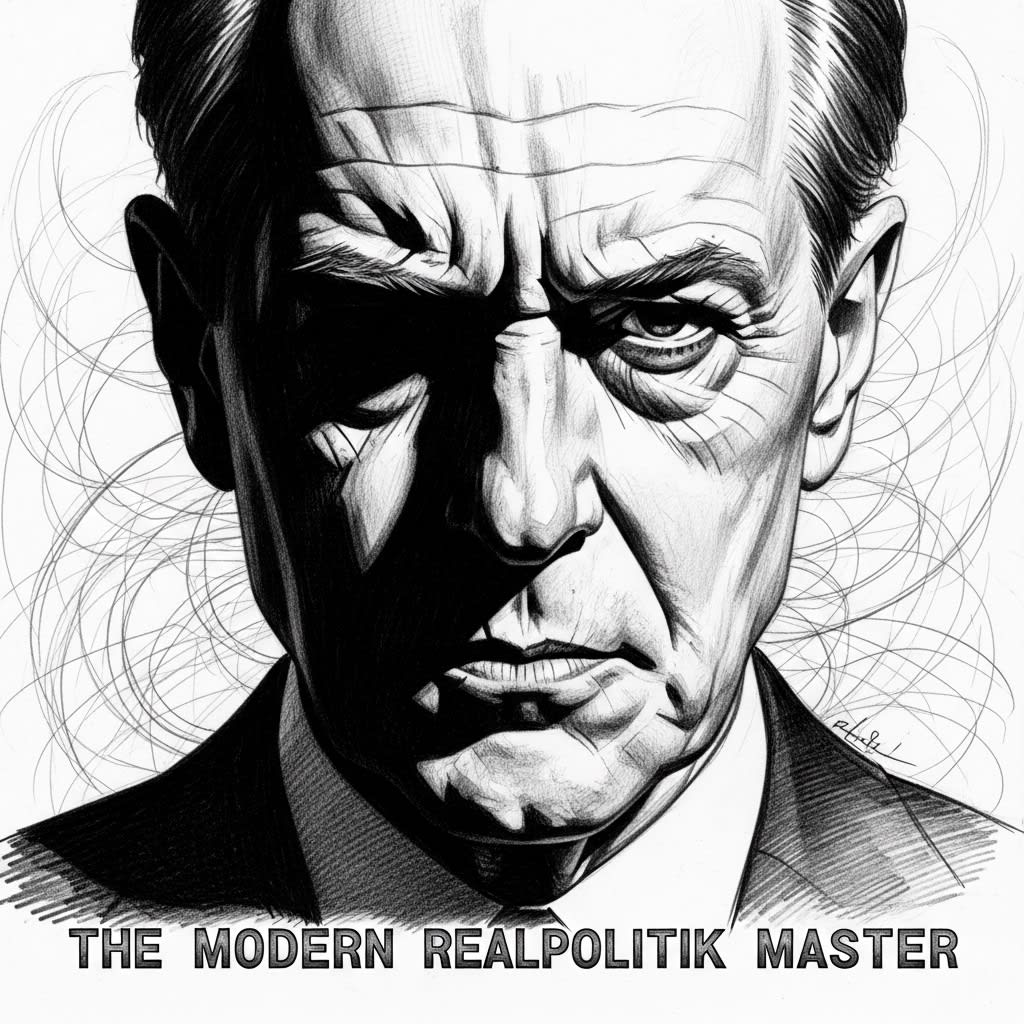
Henry Kissinger stands as one of the most consequential—and controversial—strategists of the modern era. In a century shaped by ideology, nuclear weapons, and global rivalry, Kissinger revived an old but uncomfortable tradition: *realpolitik*. Where others spoke in moral absolutes, he spoke in balance, restraint, and survival. He did not ask what the world should be; he asked how it could avoid catastrophe.
Born in 1923 in Germany, Kissinger fled Nazi persecution as a Jewish teenager and immigrated to the United States. This early exposure to collapse shaped his worldview. He understood, viscerally, that moral certainty does not prevent disaster—and that idealism without strategy can be deadly. Power, he believed, must be managed, not denied.
Kissinger’s intellectual foundation came from his deep study of European diplomacy, especially the post-Napoleonic order shaped by Metternich. He admired systems that preserved stability by balancing rival powers rather than attempting to eliminate them. For Kissinger, international politics was not a battlefield between good and evil, but a fragile equilibrium constantly at risk of breakdown.
This perspective defined his role as National Security Advisor and later Secretary of State under Presidents Nixon and Ford. The world he operated in was uniquely dangerous. The Cold War was not a conventional conflict—it was a standoff where miscalculation could end civilization. Kissinger’s strategy focused on one overriding goal: preventing direct confrontation between nuclear superpowers.
His most famous achievement was *triangular diplomacy*. By opening relations with China, Kissinger fundamentally altered the global balance of power. The United States was no longer locked into a binary struggle with the Soviet Union. Instead, each power had to consider the others’ moves. This shift reduced pressure, increased leverage, and created strategic flexibility where none had existed.
The opening to China was not driven by affection or ideology. It was driven by realism. Kissinger recognized that permanent hostility locks nations into rigid behavior. Engagement, even with adversaries, creates options. Options are the currency of strategy.
Kissinger also pursued détente with the Soviet Union, leading to arms control agreements that limited nuclear arsenals. Critics accused him of legitimizing authoritarian regimes. Kissinger countered that moral condemnation without leverage changes nothing. Stability, he argued, is a precondition for progress—not its enemy.
Nowhere is the tension in his legacy more visible than in Southeast Asia and Latin America. His role in the Vietnam War, secret bombings, and support for anti-communist regimes drew fierce criticism. To his opponents, Kissinger represented cold calculation divorced from human cost. To his defenders, he faced impossible trade-offs in a world where every choice carried consequences.
This moral ambiguity is inseparable from realpolitik itself. Kissinger believed that leaders are judged not by purity of intention, but by outcomes. He rejected the idea that foreign policy could be an extension of personal virtue. States, he argued, do not have consciences—only interests. The responsibility of leadership is to navigate those interests without allowing the system to collapse.
What set Kissinger apart was not cynicism, but historical depth. He thought in decades, not news cycles. He understood that humiliating a rival invites revenge, that rigid alliances create blind spots, and that peace requires constant adjustment. His approach demanded patience in a political culture increasingly addicted to immediacy.
Even after leaving office, Kissinger remained influential. World leaders sought his counsel not because they agreed with him, but because he understood power without illusion. He treated diplomacy as an art—one that required empathy for adversaries, clarity about limits, and acceptance of tragic choices.
Henry Kissinger’s legacy will always be debated. He was neither hero nor villain in simple terms. He was a strategist operating in a brutal reality, choosing stability over moral comfort. In an era where global order feels increasingly fragile, his central insight remains unsettling but relevant: peace is not achieved by good intentions alone—it is constructed, balanced, and constantly defended.
Kissinger did not promise a just world. He worked to prevent an unlivable one.
About the Creator
Fred Bradford
Philosophy, for me, is not just an intellectual pursuit but a way to continuously grow, question, and connect with others on a deeper level. By reflecting on ideas we challenge how we see the world and our place in it.
Keep reading
More stories from Fred Bradford and writers in History and other communities.
Pericles — Power Through Culture
When people think of power, they often imagine armies, borders, and conquest. Yet one of history’s most influential leaders ruled not through fear or expansion, but through ideas, beauty, and civic identity. Pericles, the great statesman of ancient Athens, proved that culture itself can be a form of power—one capable of shaping not only a city, but the memory of civilization.
By Fred Bradford2 days ago in History
The Amber Room: History, Glory, and the Greatest Lost Treasure of Europe
Origins of the Amber Room The story of the Amber Room begins in Prussia (modern-day Germany) in the early 1700s. The room was commissioned in 1701 by King Frederick I of Prussia as part of a grand plan to decorate his royal palace in Berlin. The design was entrusted to the court architect Andreas Schlüter, while the intricate amber craftsmanship was executed by master amber artisans Gottfried Wolfram, Ernst Schacht, and Gottfried Turau.
By Say the truth 4 days ago in History
Drones, Artificial Intelligence, and the Future of War
Drones, Artificial Intelligence, and the Future of War War is no longer fought only with soldiers, tanks, and fighter jets. Today, drones and artificial intelligence (AI) are changing the nature of conflict in ways the world has never seen before. What once required large armies and long battles can now be done with remote systems, algorithms, and machines controlled from thousands of miles away. This shift is redefining power, security, and the risks of future wars.
By Wings of Time 5 days ago in History



Comments
There are no comments for this story
Be the first to respond and start the conversation.