
Echoes of Time: A Journey Through Human History
Exploring the rise and fall of civilizations, the evolution of societies, and the key milestones that shaped our world
Title:
Echoes of Time: A Journey Through Human History
Subtitle:
Exploring the rise and fall of civilizations, the evolution of societies, and the key milestones that shaped our world.
---
Introduction
History is more than a collection of dates and events—it is the story of humanity. It chronicles our struggles, achievements, innovations, and failures. From the earliest civilizations to the modern global landscape, history offers insight into who we are and how we arrived at our present. By studying the past, we gain a better understanding of the present and can make more informed decisions about the future.
This article provides an overview of human history, touching on ancient civilizations, major revolutions, world-changing events, and the ongoing evolution of societies across the globe.
---
The Birth of Civilization
The story of human history begins over 10,000 years ago with the Neolithic Revolution, when humans transitioned from nomadic hunting and gathering to settled farming communities. This shift allowed people to build permanent settlements, develop agriculture, domesticate animals, and create surplus food.
As villages grew into cities, the world saw the birth of the first civilizations—complex societies with centralized governments, organized religion, social hierarchies, and written language. Among the earliest and most influential civilizations were:
Mesopotamia (modern-day Iraq), where the Sumerians developed cuneiform writing and advanced irrigation.
Ancient Egypt, known for its pyramids, hieroglyphics, and centralized rule under pharaohs.
The Indus Valley Civilization, one of the most advanced early urban societies, with sophisticated city planning.
Ancient China, home to the Xia and Shang dynasties, which laid the foundation for Chinese culture and politics.
These civilizations established the groundwork for future technological, artistic, and cultural achievements.
---
The Classical Age: Empires and Philosophy
The Classical Age (roughly 600 BCE to 600 CE) saw the rise of powerful empires and intellectual traditions that still influence the modern world.
In Greece, thinkers like Socrates, Plato, and Aristotle explored philosophy, politics, and ethics. Democracy was born in Athens, while the Olympic Games and classical art flourished. Meanwhile, Rome grew from a republic into an empire that controlled much of Europe, North Africa, and the Middle East. Roman law, architecture, and engineering set enduring standards.
In India, the Maurya and Gupta Empires fostered growth in mathematics, astronomy, medicine, and literature. Hinduism and Buddhism spread across Asia, deeply influencing spiritual life and culture.
In China, the Qin Dynasty unified the country under one rule, and the Han Dynasty expanded it through diplomacy and trade, particularly along the Silk Road, which connected East and West.
---
The Middle Ages: Faith, Feudalism, and Foundations
Following the fall of the Roman Empire in the 5th century CE, Europe entered the Middle Ages, marked by the rise of feudalism, the dominance of the Christian Church, and recurring wars. Castles, knights, and serfdom characterized life in medieval Europe, while the Crusades aimed to reclaim the Holy Land, intensifying religious tensions between Christians and Muslims.
In contrast, the Islamic Golden Age (8th–13th centuries) in the Middle East and North Africa was a period of scientific, mathematical, and cultural advancement. Scholars preserved Greek texts, invented algebra, and made progress in medicine and astronomy.
In Africa, powerful kingdoms like Mali and Songhai thrived, with cities like Timbuktu becoming centers of trade and learning. In the Americas, civilizations such as the Maya, Aztecs, and Incas developed complex societies with impressive architecture, astronomy, and agriculture.
The Black Death in the 14th century, which killed an estimated 25 million people in Europe alone, dramatically altered the social and economic structures, weakening the feudal system and paving the way for change.
---
The Renaissance and Age of Exploration
The Renaissance (14th–17th centuries) was a cultural rebirth in Europe, inspired by the rediscovery of ancient Greek and Roman knowledge. Artists like Leonardo da Vinci and Michelangelo created masterpieces, while thinkers like Galileo and Copernicus challenged traditional views of the universe.
This period also witnessed the Age of Exploration, as European nations sought new trade routes and resources. Explorers like Columbus, Vasco da Gama, and Magellan connected continents, leading to the Columbian Exchange—a massive transfer of crops, animals, diseases, and cultures.
While this global expansion increased knowledge and wealth for Europe, it had devastating consequences for indigenous populations, including colonization, slavery, and cultural destruction.
---
Revolutions and the Modern World
The 17th to 19th centuries were defined by a series of revolutions that reshaped politics, economics, and society:
The Scientific Revolution introduced empirical research and scientific methods.
The Enlightenment promoted ideas of liberty, reason, and human rights.
The American Revolution (1776) and the French Revolution (1789) challenged monarchies and gave rise to democratic ideals.
The Industrial Revolution transformed economies with machines, factories, and urbanization, fundamentally altering how people lived and worked.
These revolutions led to new ideologies, from capitalism and socialism to nationalism and feminism, and set the stage for global conflicts and cooperation.
---
The 20th Century: War, Progress, and Globalization
The 20th century was one of the most dramatic in history. It was marked by two world wars, technological leaps, and intense political rivalry:
World War I (1914–1918) and World War II (1939–1945) caused massive destruction and loss of life but also led to the creation of the United Nations and international cooperation.
The Cold War (1947–1991) divided the world into capitalist and communist blocs, leading to proxy wars, space exploration, and nuclear tensions.
The Civil Rights Movement, decolonization, and women’s rights movements advanced human rights and equality in many parts of the world.
Technological progress—from computers and airplanes to antibiotics and the internet—accelerated human capability. The late 20th century also saw the rise of globalization, with increased trade, cultural exchange, and interdependence among nations.
---
Conclusion: Learning from the Past
History is not just a record of what happened—it is a guide for the future. The triumphs and tragedies of humanity reveal patterns of conflict, cooperation, innovation, and resilience. They remind us that change is constant and that each generation has the power to shape the world.
By studying history, we gain perspective. We understand the roots of modern problems and the paths others took to overcome challenges. Whether it's promoting peace, fighting injustice, or advancing science, the lessons of history empower us to build a better, more informed future.
About the Creator
Keep reading
More stories from Rahmat Ullah Khan and writers in History and other communities.
10 Unusual Verifiable Occasions That Sound Too Weird to possibly be Valid
Start writing...History is brimming with abnormal and staggering stories that sound more like fiction than reality. From fights battled with hallucinations to lords who delegated their canines, these stories demonstrate that reality is frequently bizarre to say the least. The following are ten of the most peculiar verifiable occasions that really occurred.
By Rahmat Ullah Khan6 months ago in History
Julius Caesar: The Rise and Fall of a Legend
The Rise and Fall of Julius Caesar In the first century BCE, the Roman Republic stood as one of the most powerful states in the ancient world. Its armies conquered vast territories, its laws shaped civilizations, and its Senate governed through a delicate balance of tradition and authority. Into this complex political world was born Gaius Julius Caesar in 100 BCE—a man whose ambition, brilliance, and fate would forever change Roman history.
By The best writer 8 days ago in History
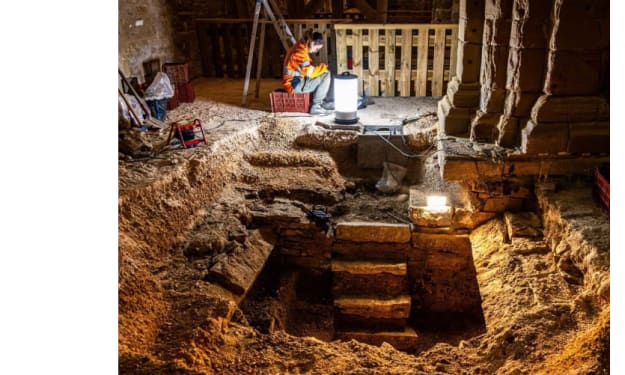
A secret staircase found beneath a 1,500-year-old French church
A subterranean staircase and burial strata dating back approximately 1,500 years were discovered during a project inside the Church of Saint Philibert in Dijon, France. The stairs were discovered by restoration workers inside the church when repairs were being made, and the excavation soon ensued.
By Francis Dami3 days ago in History



Comments (1)
Great