
Echoes of the First Cities: The True Story of Ancient Mesopotamia
How the World’s First Civilization Built the Foundations of Modern Life
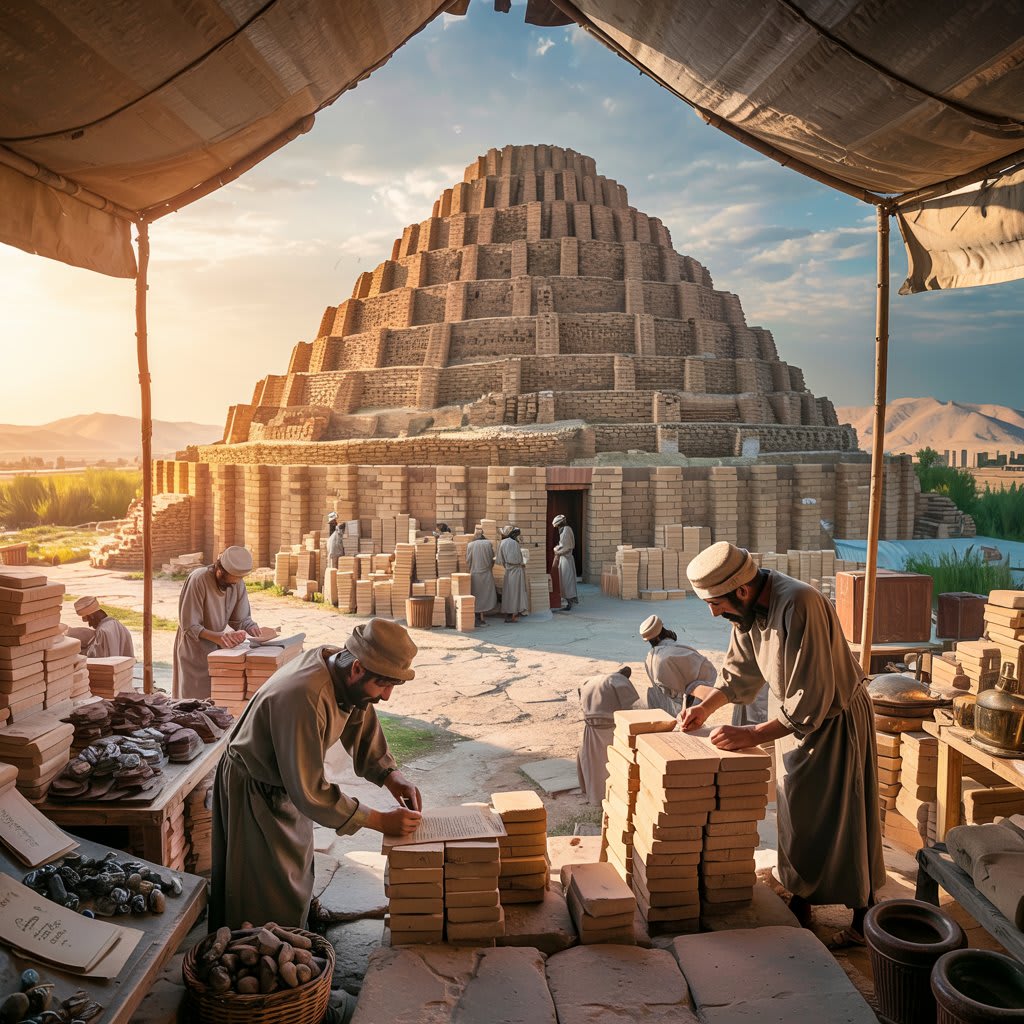
Thousands of years before Rome rose, before pyramids crowned the sands of Egypt, there thrived a civilization between two mighty rivers — the Tigris and the Euphrates.
It was here, in Mesopotamia — meaning "the land between rivers" — that humans took their first daring steps into organized life, forever changing the course of history.
The Birth of the City
Imagine a vast, flat plain, shimmering under the relentless Mesopotamian sun. Small villages began to cluster near riverbanks around 4000 BCE, where the soil was rich and fertile thanks to seasonal floods. These early settlers learned to grow barley, wheat, and lentils, domesticating goats and sheep to supplement their food.
But survival was not easy. Floods were unpredictable. Crops could fail. Villages had to work together to build canals and irrigation ditches, carefully guiding water to their fields. Cooperation became necessity, and necessity gave birth to government.
By 3500 BCE, villages like Uruk — the world’s first true city — rose. With over 50,000 people at its peak, Uruk was a bustling hub of traders, farmers, potters, and priests. Massive mudbrick walls surrounded the city, and towering temples called ziggurats stood at its center, linking heaven and earth.
It was in Uruk that writing was born.
The Invention of Writing
Initially, writing wasn't poetry or storytelling. It was accounting.
Priests and merchants needed to track goods — sheep, grain, beer — and so they pressed wedge-shaped marks into soft clay tablets. This system, called cuneiform, started simple but grew into a full language. Over centuries, scribes recorded laws, myths, medical recipes, and even the first known epic: The Epic of Gilgamesh, a tale of kingship, mortality, and the search for meaning.
Through writing, Mesopotamians taught humanity the power of memory — to preserve ideas beyond a single lifetime.
Laws and Justice: The Code of Hammurabi
As cities grew, so did disputes. Who owned this field? Who was responsible when a house collapsed?
In the 18th century BCE, King Hammurabi of Babylon compiled one of the world's first written law codes. Carved onto stone slabs, the Code of Hammurabi declared, “an eye for an eye, a tooth for a tooth,” but also included laws about fair wages, marriage, property, and rights for widows and orphans.
Justice was no longer the whim of a ruler; it was an established system.
The lesson: civilization requires rules — not to chain people, but to protect them.
Science, Math, and the Stars
The Mesopotamians weren't just administrators; they were scientists. They divided the hour into 60 minutes, the circle into 360 degrees — systems we still use today.
By observing the stars, they could predict seasons and create calendars essential for agriculture. They tracked the movements of planets, developing the earliest forms of astronomy and astrology.
They also built the first wheels, developed sophisticated pottery, and understood advanced irrigation techniques, turning deserts into gardens.
Through careful observation and recording, Mesopotamians taught humanity to seek knowledge systematically.
Religion and Myth
For all their advancements, the Mesopotamians lived in a world they saw as unpredictable and dangerous. Their gods — like Enlil (god of air), Ishtar (goddess of love and war), and Anu (god of the heavens) — were powerful but capricious.
Religion shaped every part of daily life. Temples weren't just places of worship; they were the city’s heart — banks, granaries, and centers of administration.
The myth of the Great Flood, preserved in the Epic of Gilgamesh, echoes into later traditions like the Biblical story of Noah.
The lesson: Even as we conquer nature with knowledge, we must remain humble in the face of forces beyond our control.
The Fall — and Legacy
By 2000 BCE, wars between city-states and invasions by neighboring peoples began to fracture Mesopotamia. Yet even as kingdoms fell — Sumer, Akkad, Babylon, Assyria — each wave built upon the last, enriching the civilization’s complexity.
Ideas born in Mesopotamia — writing, law, urban living — traveled outward, influencing Egypt, Greece, Persia, India, and beyond.
Today, when we read books, live under laws, track time, or build cities, we walk paths first paved along the Tigris and Euphrates.
Final Reflection:
The Mesopotamians remind us that civilization isn't built by heroes alone, but by millions of ordinary people: farmers digging canals, scribes pressing clay tablets, merchants trading goods, builders stacking bricks under a merciless sun.
They teach us that innovation often begins with practical needs — food, shelter, record-keeping — but can blossom into art, law, science, and dreams of the stars.
They teach us that to be human is to build, to remember, and to reach beyond ourselves.
About the Creator
Atif khurshaid
Welcome to my corner of the web, where I share concise summaries of thought-provoking articles, captivating books, and timeless stories. Find summaries of articles, books, and stories that resonate with you
Keep reading
More stories from Atif khurshaid and writers in History and other communities.
Rajendra Chola I and the Conquest of the Ganga: A Monumental Feat in Indian History
Known as the “Gangaikonda Chola” (the Chola who conquered the Ganga), Rajendra transformed a South Indian maritime empire into a pan-Indian power whose influence stretched from the Indian Ocean to the heart of the subcontinent. This campaign was not merely a military raid but a bold statement of imperial ambition, strategic brilliance, and cultural confidence.
By Say the truth 6 days ago in History



Comments
There are no comments for this story
Be the first to respond and start the conversation.