


“No national debt shall be contracted in connection with the external affairs of the state."
There is no cause for suspicion if help for the national economy is sought inside or outside the state (e.g. for improvements to roads, new settlements, storage of foodstuffs for years of famine, etc.). But a credit system, if used by the powers as an instrument of aggression against one another, shows the power of money in its most dangerous form. For while the debts thereby incurred are always secure against present demands (because not all the creditors will demand payment at the same time), these debts go on growing indefinitely.
This ingenious system, invented by a commercial people in the present century, provides a military fund which may exceed the resources of all the other states put together. It can only be exhausted by an eventual tax-deficit, which may be postponed for a considerable time by the commercial stimulus which industry and trade receive through the credit system.
This ease in making war, coupled with the warlike inclination of those in power (which seems to be an integral feature of human nature), is thus a great obstacle in the way of perpetual peace. Foreign debts must therefore be prohibited by a preliminary article of such a peace, otherwise national bankruptcy, inevitable in the long run, would necessarily involve various other states in the resultant loss without their having deserved it, thus inflicting upon them public injury. Other states are therefore justified in allying themselves against such a state and its pretentions.
"No state shall forcibly interfere in the constitution and government of another state."
For what could justify such interference? Surely not any sense of scandal or offence which a state arouses in the subjects of another state. It should rather serve as a warning to others, as an example of the great evils which a people has incurred by its lawlessness. And a bad example which one free person gives to another (as a scandalum acceptum) is not the same as an injury to the latter. But it would be a different matter if a state, through internal discord, were to split into two parts, each of which set itself up as a separate state and claimed authority over the whole. For it could not be reckoned as interference in another state’s constitution if an external state were to lend support to one of them, because their condition is one of anarchy. But as long as this internal conflict is not yet decided, the interference of external powers would be a violation of the rights of an independent people which is merely struggling with its internal ills. Such interference would be an active offence and would make the autonomy of all other states insecure.
"No state at war with another shall permit such acts of hostility as would make mutual confidence"
These are dishonorable strategems. For it must still remain possible, even in wartime, to have some sort of trust in the attitude of the enemy, otherwise peace could not be concluded and the hostilities would turn into a war of extermination (bellum internecinum).
After all, war is only a regrettable expedient for asserting one’s rights by force within a state of nature, where no court of justice is available to judge with legal authority.
In such cases, neither party can be declared an unjust enemy, for this would already presuppose a judge’s decision; only the outcome of the conflict, as in the case of a so-called ‘judgement of God’, can decide who is in the right. A war of punishment between states is inconceivable, since there can be no relationship of superior to inferior among them.
It thus follows that a war of extermination, in which both parties and right itself might all be simultaneously annihilated, would allow perpetual peace only on the vast graveyard of the human race.
A war of this kind and the employment of all means which might bring it about must thus be absolutely prohibited. But the means listed above would inevitably lead to such a war, because these diabolical arts, besides being intrinsically despicable, would not long be confined to war alone if they were brought to use. This applies, for example, to the employment of spies for it exploits only the dishonesty of others (which can never be completely eliminated). Such practices will be carried over into peacetime and will thus completely vitiate its purpose.
All the articles listed above, when regarded objectively or in relation to the intentions of those in power, are prohibitive laws (leges proihbitivae). Yet some of them are of the strictest sort (leges strictae), being valid irrespective of differing circumstances, and they require that the abuses they prohibit should be abolished immediately.
Others although they are not exceptions to the rule of justice, allow for some subjective latitude according to the circumstances in which they are applied.
The latter need not necessarily be executed at once, so long as their ultimate purpose (e.g. the restoration of freedom to certain states in accordance with the second article) is not lost sight of. But their execution may not be put off to a non-existent date . . . , for any delay is permitted only as a means of avoiding a premature implementation which might frustrate the whole purpose of the article.
For in the case of the second article, the prohibition relates only to the mode of acquisition, which is to be forbidden hereforth, but not to the present state of political possessions. For although this present state is not backed up by the requisite legal authority, it was considered lawful in the public opinion of every state at the time of the putative acquisition.
About the Creator
Shafi Faizi
I just found myself interested in writing, and I meet with writers every day who share their fantastic experiences and opinions. I get my motivation from writers who are creative and satisfied with their job.
Keep reading
More stories from Shafi Faizi and writers in History and other communities.
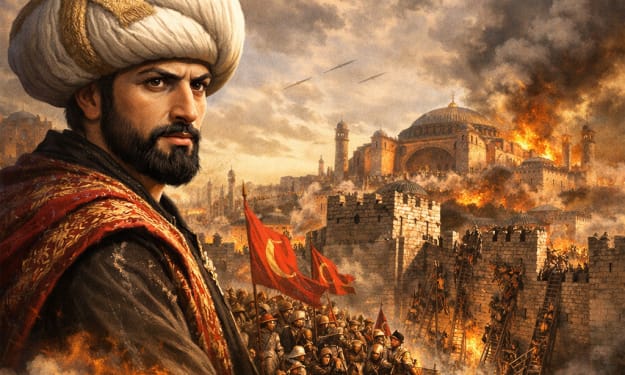
Sultan Mehmed II: The Conquest of Constantinople That Europe Never Forgot
In the spring of 1453, one of the most dramatic moments in world history unfolded when Sultan Mehmed II captured the great city of Constantinople. This event did not simply mark the fall of a city; it ended the thousand-year-old Byzantine Empire and transformed the balance of power between Europe and the Muslim world. Even centuries later, the conquest remains one of the most significant turning points in global history.
By Irshad Abbasi about 13 hours ago in History
Review of 'Man on the Run'
My wife and I saw Man on the Run, a nearly 2-hour documentary on Amazon Prime, about Wings, Paul McCartney's group that flew around the world from shortly after The Beatles broke up in early 1970 to shortly after John Lennon was murdered at the end of 1980, making a Beatles reunion forever impossible.
By Paul Levinson5 days ago in Beat



Comments
There are no comments for this story
Be the first to respond and start the conversation.