
Christopher Columbus: The Man Who Changed the Course of History
How one explorer’s daring voyage across the Atlantic reshaped the world and connected two continents forever

Christopher Columbus: The Man Who Changed the Course of History
BY:Khan
Dear children! Today, let’s talk about a man whose name is forever written in the pages of world history — Christopher Columbus, the explorer who is said to have discovered America.
Though many historians debate this claim — saying that Leif Erikson, a Norse explorer, reached North America almost five hundred years before Columbus, and that Muslim travelers may have reached the continent even earlier — it is Columbus whose name remains most closely linked with the “discovery” of the New World. Some also believe that Marco Polo had hinted at lands beyond the ocean long before Columbus’s voyages.
Yet, in most accounts of history, the honor of opening the gates to a new world is given to Christopher Columbus.
---
Early Life and Dreams of the Sea
Christopher Columbus was born in 1451 in the bustling port city of Genoa, Italy. From a young age, the sea called to him. He would watch ships leave the harbor, carrying merchants and sailors toward distant lands, and dream of joining them someday. By the age of fourteen, Columbus had already begun his life at sea, sailing across the Mediterranean, the Aegean, and even the stormy North Atlantic.
The world at that time was full of mystery. People believed the Earth was flat, and many feared that if you sailed too far west, you might fall off the edge of the world. But Columbus was different — he was bold, curious, and filled with an unshakable faith in his own ideas. He believed that if one sailed west across the Atlantic Ocean, one could reach Asia — the land of spices, gold, and silk — faster than by traveling around Africa.
---
The Struggle for Support
In 1474, Columbus began to seek support for his grand plan. He approached several royal courts across Europe, asking kings and queens to fund his westward voyage. But many rejected him, thinking his idea was foolish or impossible.
Years passed in disappointment, but Columbus never gave up. He believed that the Earth was round, and that across the endless blue ocean lay rich and undiscovered lands.
Finally, in Spain, his destiny changed. The Spanish monarchs — King Ferdinand and Queen Isabella — were known as the “Catholic Kings.” They had just completed the Reconquista, uniting Spain under one crown, and were eager to expand their empire. After much persuasion, they agreed to support Columbus, granting him ships, supplies, and a promise of titles and rewards if he succeeded.
---
The Voyage That Changed Everything
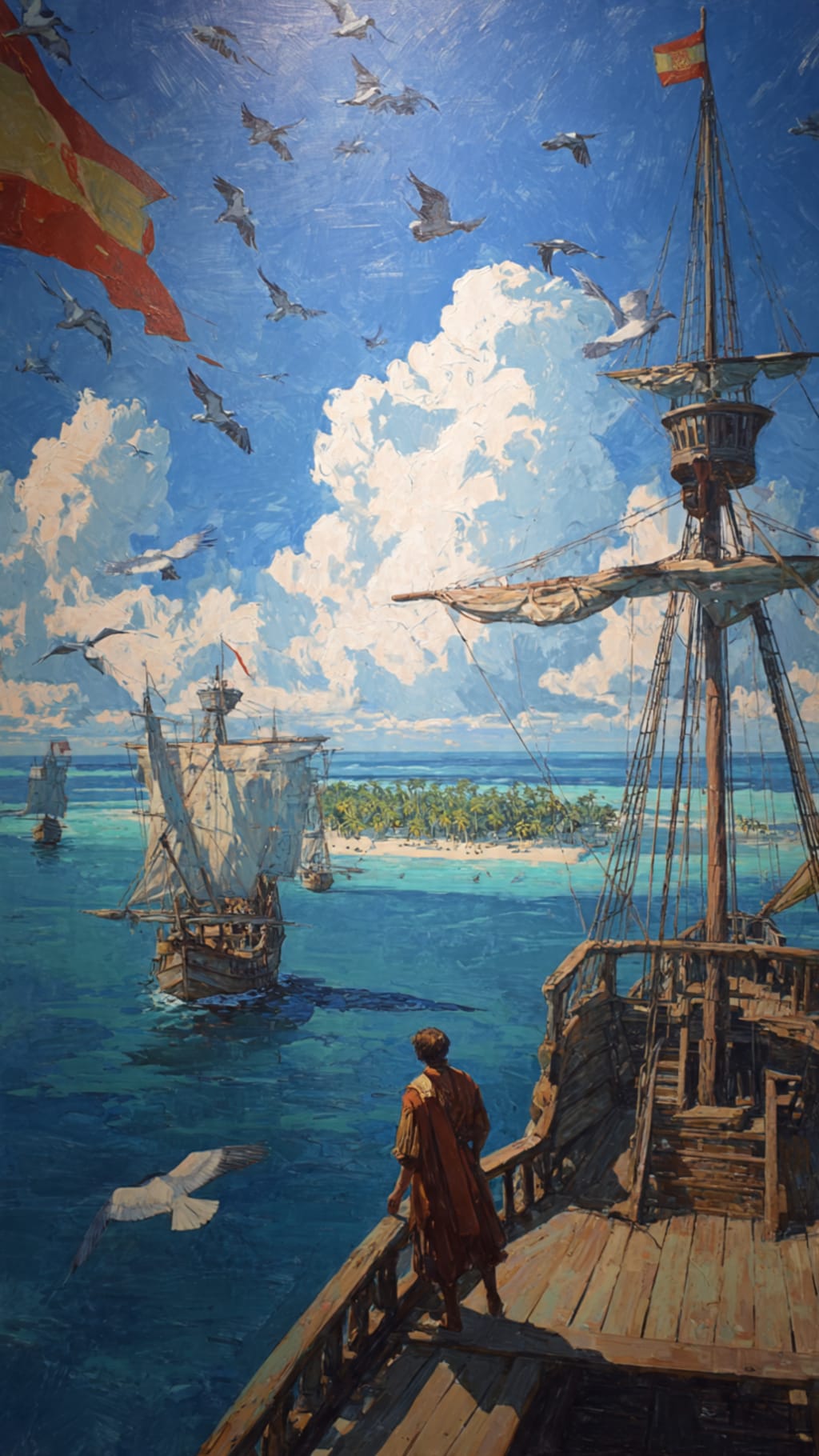
On August 3, 1492, Columbus set sail from the Spanish port of Palos de la Frontera, near Huelva, with three ships — the Santa María (his flagship), and two smaller caravels, the Pinta and the Niña.
After a brief stop at the Canary Islands, the fleet sailed into the vast and unknown Atlantic on September 6. The journey was long, and the crew grew fearful as days turned into weeks with no sight of land. Many wanted to turn back. But Columbus, filled with determination and faith, urged them onward. He believed that each sunrise brought them closer to success.
Finally, on the early morning of October 12, 1492, a sailor named Rodrigo de Triana shouted the long-awaited words: “Land! Land!”
They had reached an island in the Bahamas, which Columbus named San Salvador. Believing he had reached the outskirts of Asia, Columbus stepped ashore, holding the Spanish flag, and claimed the new land in the name of King Ferdinand and Queen Isabella.
What Columbus did not realize was that he had stumbled upon a new continent, one that would forever change the course of human history.
---
The Legacy of the New World
Columbus’s discovery marked the beginning of the Age of Exploration — a time when European powers began to explore, conquer, and colonize lands across the oceans. His voyage opened the door to the New World, bringing with it trade, wealth, and cultural exchange — but also conflict, slavery, and suffering for the indigenous peoples who had lived in the Americas for thousands of years.
Between 1492 and 1504, Columbus made four voyages across the Atlantic, exploring parts of the Caribbean, Central America, and South America. He never knew he had discovered an entirely new continent — to his dying day, he believed he had reached Asia.
Despite the fame and fortune he gained early on, his later years were marked by disappointment and controversy. Accused of mismanagement and cruelty as a colonial governor, Columbus was briefly imprisoned. Although he was eventually freed, his reputation suffered.
---
The Final Years
After returning from his last voyage, Columbus grew ill. He settled in the Spanish town of Valladolid, where he spent his final days. On May 20, 1506, the great explorer passed away — still convinced he had reached the eastern shores of Asia.
Though he died without fully understanding the magnitude of his discovery, his voyages had forever altered the world. They linked the continents of Europe and the Americas, transforming global trade, geography, and human history.
---
A World Forever Changed
Today, Christopher Columbus remains a controversial yet pivotal figure. Some celebrate him as a brave explorer who connected worlds; others remember the suffering his discoveries brought upon native civilizations.
But one truth cannot be denied: his voyages reshaped our understanding of the planet and began a new chapter in human history.
Columbus’s courage to sail into the unknown reminds us of the power of curiosity, faith, and perseverance — and how a single dream can change the course of the world.
About the Creator
The Mongol Storm: When Baghdad Fell and a Civilization Trembled
In the winter of 1258, one of the greatest cities on Earth met a catastrophe from which it would never fully recover. Baghdad, once the intellectual and cultural capital of the Islamic world, fell to the armies of Hulagu Khan during the devastating Siege of Baghdad (1258). The invasion marked the end of the powerful Abbasid Caliphate and changed the course of Middle Eastern history forever.
By Irshad Abbasi about 21 hours ago in History


Comments
There are no comments for this story
Be the first to respond and start the conversation.