
The Oath of Salah al-Din: Justice at the Battle of Hattin
How Sultan Salah al-Din al-Ayyubi fulfilled his vow and ended the arrogance of the Crusader knight Reginald after the decisive victory at Hattin.


The Oath of Salah al-Din: Justice at the Battle of Hattin
BY:Khan
For years, Sultan Salah al-Din al-Ayyubi and the Crusader forces had traded blows and skirmishes across the Levant. Their clashes stretched season after season, a long war of attrition that finally built toward a single, decisive encounter — the battle that changed the map of Palestine and sealed the fate of the Christian kingdom there. That confrontation was the Battle of Hattin, fought on the 24th of Rabi‘ al-Thani in the year 385 AH, a contest that ended in resounding victory for the Muslims.
When the dust settled, the Crusader host lay broken. Many of the best knights and noblemen were taken prisoner. Among those bound and led before the Sultan were the King of Jerusalem, Guy, and his brother, Reginald. Other high-ranking Christian lords were captured as well. Across Palestine the remaining Christian horsemen and warriors found themselves under Muslim watch. Ordinary Crusader foot soldiers and cavalry who had survived were gathered and handed over to Muslim commanders.
Witnesses later recalled ghastly scenes from that day. Row upon row of prisoners were seen being led like flocks, sometimes taken in batches so large that a single Muslim soldier was said to guide as many as thirty captives, each chained and trailing behind on ropes tied to tent-pegs. Broken crosses lay in heaps; severed limbs were scattered like stones. Heads dotted the plain as if melons had been tossed across a field. The slaughter left a landscape of ruin; contemporaries spoke of three thousand dead, and for months the bones and scattered remains made the battlefield look like a place of mass desolation. Even a year after the clash, great piles of bones and leftover fragments were still visible — grim testimony to the ferocity of the fighting.
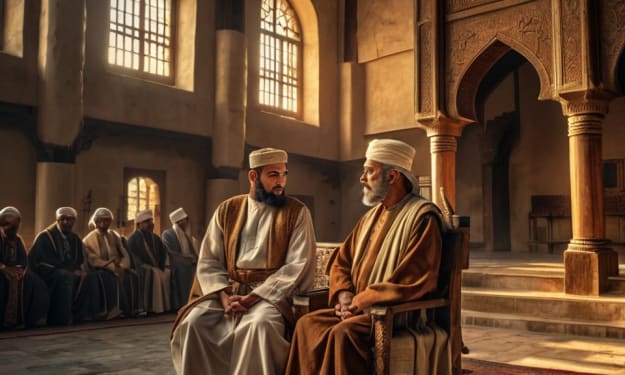
But one moment from that day lived on in memory not only for its dramatic violence, but for what it revealed of Sultan Salah al-Din’s convictions. After the battle, the Sultan pitched his tent upon the field and commanded that the prisoners be brought before him. King Guy and his brother Reginald were led in. The Sultan seated King Guy at his side and, noting the king’s thirst, handed him a bowl of ice-cold water. Yet when the Sultan learned who had provided that bowl, he frowned. He turned to his interpreter and remarked that the bowl had come from King Guy — an action in itself interpreted as a gesture of protection. But the Sultan’s gaze then fixed on Reginald, and displeasure clouded his features.
For Sultan Salah al-Din carried with him two oaths against Reginald. The first arose when Reginald had plotted to strike at the holy cities of Mecca and Medina. The second had been taken after Reginald and his men treacherously attacked a caravan of pilgrims. Those unprotected pilgrims begged for mercy and pleaded the code of honor; Reginald, in a tone of contempt, sneered and said they should ask their Prophet to secure their release. Word of that insolence reached Salah al-Din, and he swore that if the man who had uttered such an affront ever fell into his hands, he would take revenge with his own sword.
Now, Reginald stood in the Sultan’s tent, stiff and defiant. Salah al-Din rose, approached him, and reminded him of the insult and the vows he had taken. Then, drawing his sword, the Sultan fulfilled his oath. With his own hand he struck down Reginald; whatever life remained in him was ended by the guards thereafter. King Guy watched, trembling with the fear that his turn had come. To the king, the scene must have seemed a harrowing prelude to his own execution.
But Salah al-Din would not kill a fellow sovereign in cold blood. He comforted King Guy and explained that the honor of kingship customarily spared vanquished monarchs from being slain. Reginald, he said, had repeatedly betrayed oaths and committed acts that merited punishment. “What is past is past,” the Sultan declared, offering both a stern lecture and a measure of mercy. One account relates that when Reginald was summoned, the Sultan told him plainly: “I avenge this insult in the name of the Prophet.” The execution that followed was thus seen by many as the personal fulfillment of a sacred pledge.
The aftermath of Hattin marked the collapse of Crusader power in Palestine. The battlefield’s torn banners, shattered armor, and piled remains made it a symbol of their defeat. But alongside military victory, the memory that endured was of a leader whose actions fused martial resolve with religious ardor. In the telling that passed through generations, Sultan Salah al-Din stood as a man of iron will and piety — one who, on a field soaked with blood, both enforced his oath and measured mercy against the code of kingship.
And so the story of Hattin lives on: not only as a tale of swords and banners, but as a story about honor, vengeance, and the heavy demands of conscience that can fall upon those who command armies and shape history.
About the Creator
Military Strength of Alexander the Great and the Chola Empire: A Historical Comparison
Though separated by more than a thousand years and operating in vastly different geographical and cultural contexts, both forces achieved extraordinary success through discipline, innovation, and strategic brilliance. This article explores the history, composition, size, organization, and military strength of Alexander’s Macedonian army and the Chola military, highlighting how each became a dominant power of its era.
By Say the truth 6 days ago in History

Comments
There are no comments for this story
Be the first to respond and start the conversation.