
Borderlines and Battlefields: The Cambodia–Thailand Conflict Over Preah Vihear Temple
A deep look into the historical, political, and cultural tensions that sparked clashes between Cambodia and Thailand over a sacred temple.

Introduction
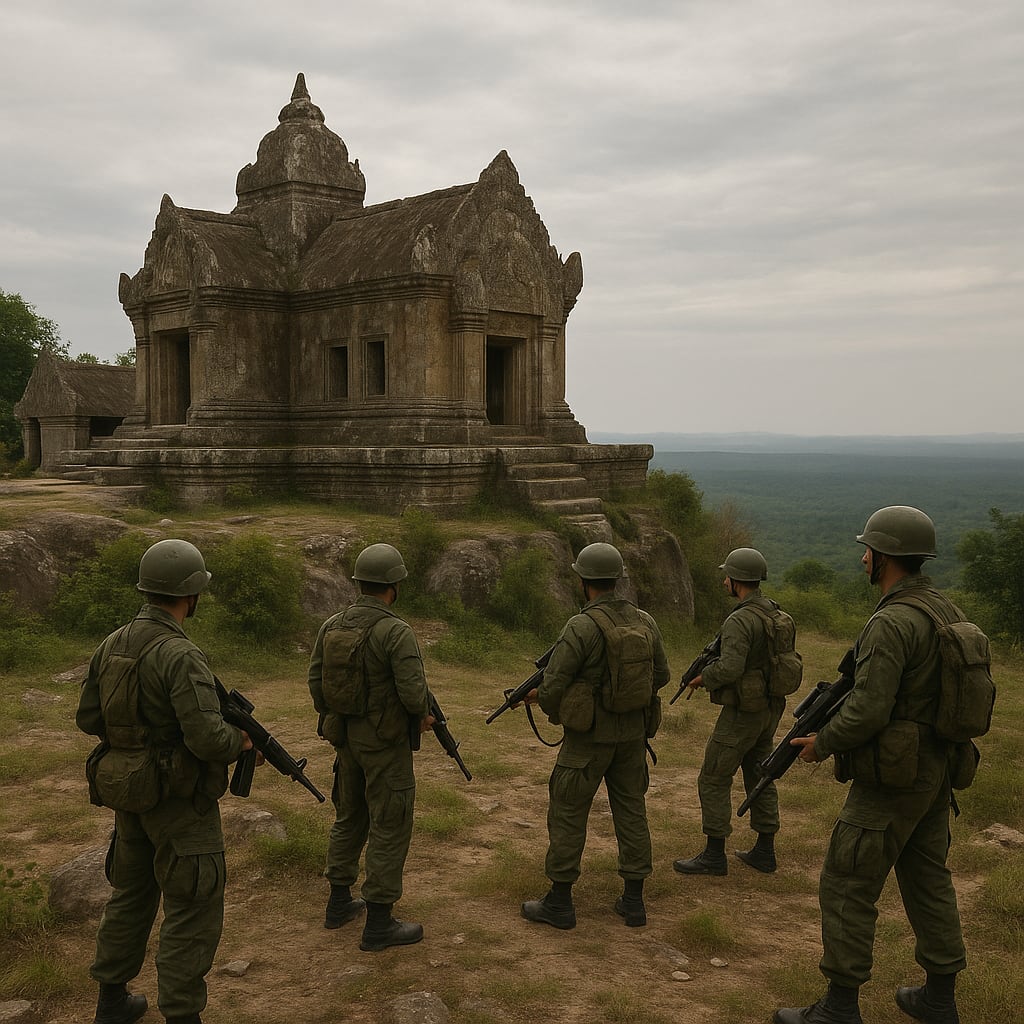
The Preah Vihear Temple stands high on a mountain cliff near the border of Cambodia and Thailand. It is more than just a temple made of stone. It holds deep religious, cultural, and historical value for both countries. Over the years, this temple has become the center of a serious conflict between Cambodia and Thailand. This article will explain the story behind this conflict in simple words, focusing on its history, the reasons for the fight, and its effects.
---
The Importance of Preah Vihear Temple
Preah Vihear Temple is an ancient Hindu temple dedicated to Lord Shiva. It was built during the Khmer Empire, which once covered large parts of present-day Cambodia, Thailand, Laos, and Vietnam. The temple is over 1,000 years old and sits on top of a steep hill in the Dângrêk Mountains.
Because of its beauty, history, and meaning, Preah Vihear is very important to both Cambodia and Thailand. While the temple is physically located near Cambodia’s side, its entrance is easier to access from Thailand, which adds to the confusion.
---
The Root of the Dispute
The conflict between Cambodia and Thailand is mainly about who owns the land around the temple. In 1904, when both countries were under European influence, French mapmakers drew a border that placed the temple in Cambodian territory. Thailand (then called Siam) accepted this map for many years.
However, in the 1950s, after Cambodia became independent from France, Thailand began to question the border and claimed that the temple belonged to them. Cambodia took the matter to the International Court of Justice (ICJ) in 1959.
In 1962, the ICJ ruled that the Preah Vihear Temple belonged to Cambodia. Thailand was disappointed but agreed to follow the decision. Still, both sides continued to argue about the land surrounding the temple.
---
Tensions Rise Again
For many years, things were mostly peaceful. However, in 2008, tensions returned when Cambodia asked the United Nations to recognize Preah Vihear Temple as a UNESCO World Heritage Site. UNESCO agreed, which made Thailand upset. Many Thai people believed that Cambodia was trying to take land that still belonged to Thailand.
Soon after, both countries sent soldiers to the border area. Small fights broke out. In 2011, the conflict became more violent, with heavy gunfire and even rocket attacks. Soldiers and civilians were killed on both sides, and thousands of people were forced to leave their homes near the border.
---
The Role of Nationalism
One big reason why this conflict became serious is because of nationalism. People in both Cambodia and Thailand are very proud of their history and culture. Political leaders in both countries used this issue to gain support from their citizens. Some even used the temple conflict to distract the public from other problems in their countries.
In both Cambodia and Thailand, many people felt emotionally connected to the temple. They believed it was part of their national pride, not just a religious place. This made it difficult for the two governments to find a peaceful solution.
---
International Attention
Because the conflict involved ancient history, national pride, and armed violence, the international community paid close attention. The Association of Southeast Asian Nations (ASEAN) and the United Nations both urged the two countries to stop fighting and talk peacefully.
In 2013, Cambodia again went to the International Court of Justice. This time, they asked the court to clarify who owns the area around the temple. The ICJ ruled that the land near the temple also belonged to Cambodia. Thailand accepted the decision peacefully, and the fighting slowly stopped.
---
Moving Toward Peace
Since the 2013 ruling, things have become more peaceful. Both Cambodia and Thailand have tried to improve their relationship. They reopened the border for tourism and trade, and people from both countries can now visit the temple more easily.
Still, the scars of the conflict remain. The area is still sensitive, and both governments are careful not to stir up more anger. Many believe that peace can only last if both sides continue to respect each other and work together.
---
Conclusion
The Cambodia–Thailand conflict over the Preah Vihear Temple is a reminder that history, culture, and pride can cause serious problems if not handled carefully. While both countries have rich and beautiful cultures, their past misunderstandings led to pain and loss.
Today, there is hope that the temple can become a symbol of peace instead of conflict. By respecting the court's decision, honoring their shared history, and encouraging friendly relations, Cambodia and Thailand can turn this once-divided site into a place of unity.
About the Creator
Keep reading
More stories from Hamza Tahir and writers in History and other communities.
The Silent Witness
The Pearl Heights was one of the finest apartment buildings in the city. With its shining marble floors, tall glass windows, and round-the-clock security, it was known as the safest place to live. Cameras watched every corner—lobby, elevators, hallways, even the parking garage. No one could enter without being seen. Or so everyone thought.
By Hamza Tahir6 months ago in Criminal
The Rise and Fall of Nicolae Ceaușescu
Nicolae Ceaușescu’s rise to power was initially marked by promise, even optimism. Born in 1918 into a poor peasant family, he entered politics early, shaped by the ideological rigidity of interwar and wartime communism. When he became General Secretary of the Romanian Communist Party in 1965, following the death of Gheorghe Gheorghiu-Dej, many Romanians saw in him a younger leader, one who might soften the harsh Stalinist legacy that had defined the previous decades. For a society weary of repression and deprivation, Ceaușescu appeared to embody the possibility of cautious change.
By Pure childa day ago in History
A woman from a vanished female dynasty was discovered buried with 270,000 beads.
In a Copper Age tomb close to Seville, Spain, the Montelirio bead assemblage contains over 270,000 beads that identify the ladies buried there as elites. The discovery is the biggest collection of beads ever
By Francis Dami3 days ago in History



Comments
There are no comments for this story
Be the first to respond and start the conversation.